









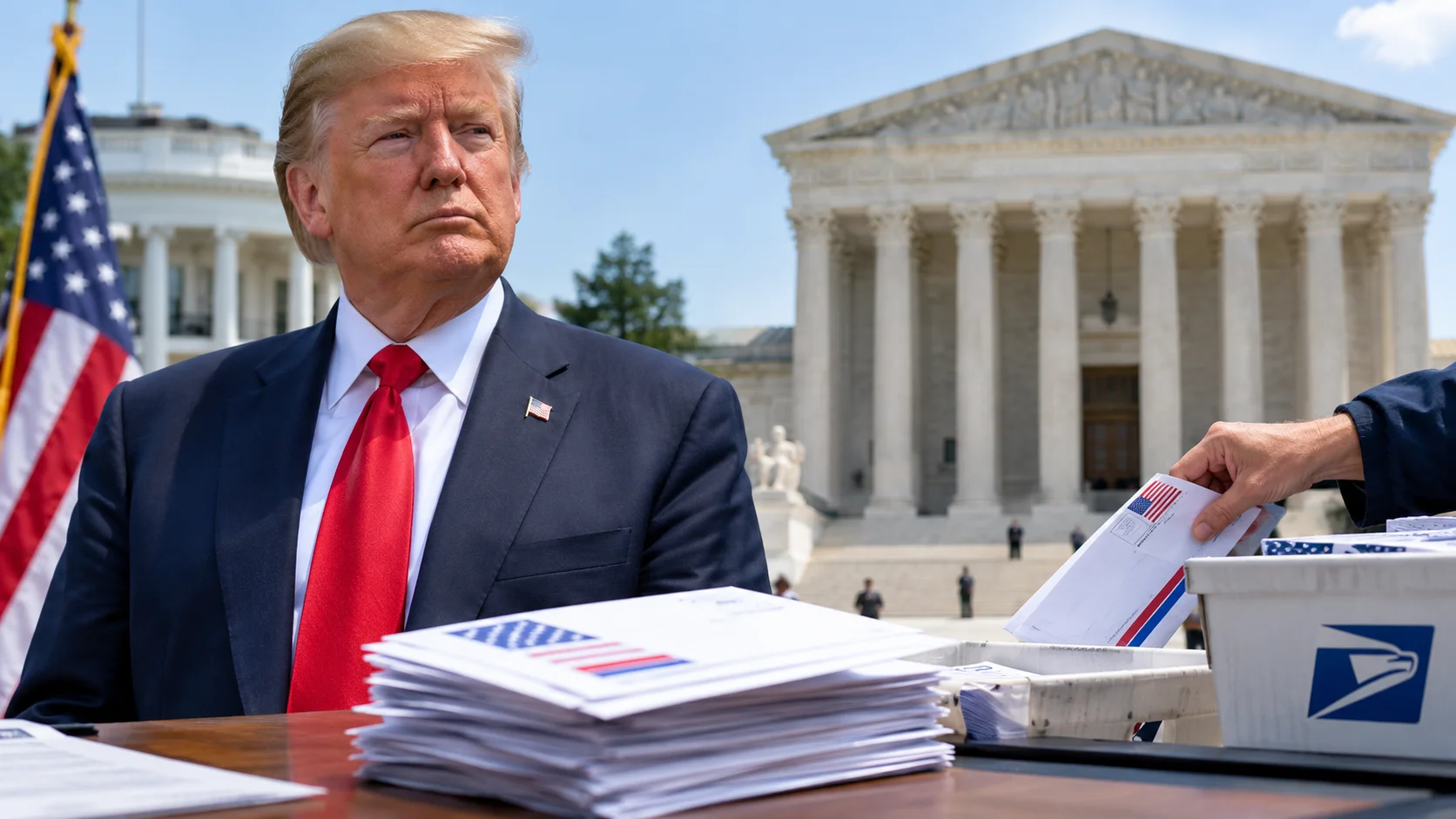
The Trump administration has again asked the U.S. Supreme Court to let the Postal Service enforce new restrictions on mail-in ballots, escalating a legal fight that could affect voting procedures before the 2026 midterm elections.
The administration filed its latest emergency request Sunday after a federal judge blocked the new rules from being enforced.
It is the third time the Trump administration has asked the Supreme Court to intervene in the dispute.
The timing is becoming increasingly important because states have already begun preparing and sending mail ballots to voters.
What is the Trump administration asking the Supreme Court to do?
Solicitor General D. John Sauer asked the justices to immediately allow the U.S. Postal Service to enforce the new mail-ballot requirements while the broader legal challenges continue.
The administration wants USPS to apply requirements involving the identification and handling of election-related mail.
Under the administration’s interpretation, states would provide information about intended mail-ballot recipients, including names, addresses and barcode information, through a federal system.
The administration argues that the rule does not take control of elections away from states.
Instead, Sauer says, it establishes preparation requirements for election mail while states remain responsible for determining who is eligible to vote and who can vote by mail.
Why did a federal judge block the rule?
U.S. District Judge Indira Talwani blocked the administration’s effort to enforce the USPS rule.
Talwani said the challengers were likely to succeed in arguing that the rule was unlawful and unconstitutional.
She also expressed concern about the timing.
The rule was issued less than 70 days before the November 2026 election, and Talwani warned that implementing it so close to the election could create a risk of disenfranchising voters who rely on mail voting.
Her order prevented the Postal Service from enforcing the new requirements while the legal challenge proceeds.
Why is the Supreme Court appeal happening now?
The administration says the situation is urgent because states have already started mailing ballots.
North Carolina became the first state to begin sending mail ballots last week.
In its Supreme Court filing, the administration warned that more states were approaching their mailing dates.
Sauer specifically pointed to Alabama, which was scheduled to begin mailing ballots Sept. 9, as well as at least five other states expected to start during the week of Sept. 13.
That creates a narrowing window for the administration to have the new requirements in place before ballots enter the postal system.
Once ballot envelopes are mailed, the administration argues, they cannot simply be retrieved and redesigned if the Supreme Court later allows the rule to take effect.
What would the USPS rule change?
At the center of the dispute is how election-related mail is prepared and handled by the Postal Service.
The administration says the rule would establish relatively limited requirements concerning ballot-envelope design and information identifying intended recipients.
The Justice Department argues that the requirements do not dictate:
- Who is eligible to vote
- Whether a voter qualifies for mail voting
- What appears on the ballot
- When states must mail ballots
- When ballots must be received
- How ballots are counted
According to the administration, those decisions would remain with the states.
Opponents see the issue differently.
They argue that requiring states to provide voter information to a federal system gives the federal government an inappropriate role in an area traditionally administered by state and local election officials.
What does the Trump administration say?
The administration says the rule is a lawful use of Postal Service authority and does not amount to federal control of state elections.
Sauer argued that states would still determine voter eligibility and mail-voting eligibility.
The administration also says the rule simply establishes reasonable preparation requirements for election mail.
That argument is central to the Supreme Court request because the administration must persuade the justices that the Postal Service is regulating mail operations rather than unlawfully regulating how states conduct elections.
What do voting-rights groups say?
Opponents of the rule argue that the restrictions could interfere with established voting procedures and potentially disenfranchise voters.
The American Civil Liberties Union has called the policy unconstitutional.
Sophia Lin Lakin, director of the ACLU’s Voting Rights Project, criticized the administration’s repeated requests for emergency Supreme Court intervention after losing in lower court.
The challengers argue that the existing court order protects voting procedures that Americans have relied on for years.
This is the administration’s third Supreme Court request
The latest filing marks the third attempt by the Trump administration to get the Supreme Court involved in the dispute.
The Supreme Court had previously allowed the administration’s plan to move forward in an earlier stage of the litigation, but it has not issued a final ruling on whether the policy itself is lawful.
The Justice Department withdrew an earlier pending request after submitting the new application following Talwani’s latest order.
The new filing asks the Supreme Court to put Talwani’s preliminary injunction on hold.
Which Supreme Court justice is handling the request?
The Supreme Court is currently on recess but is expected to consider the administration’s emergency request on an expedited basis.
Justice Ketanji Brown Jackson was assigned to handle the administration’s new application.
That assignment does not mean she has made a decision on the merits of the case. It is part of the court’s process for handling emergency applications.
Why the dispute matters for the 2026 midterms
The fight could have consequences well beyond the technical requirements for envelopes.
The 2026 midterm elections will determine control of Congress, making voting procedures a major political issue.
Mail voting is also widely used across the United States.
Nearly one-third of U.S. voters cast ballots by mail, according to the AP report, meaning any major change to mail-ballot procedures could affect a significant number of voters.
The timing adds another layer of uncertainty.
With states already beginning to send ballots, election officials are preparing for an election under rules that could still be affected by court decisions.
Trump’s broader push over election administration
The mail-ballot dispute is part of the administration’s broader effort to increase federal involvement in election administration.
The current rule stems from an executive order signed by Trump in March 2026 concerning citizenship verification and election integrity.
Trump has also previously called for Republicans to consider “nationalizing” elections, a proposal that drew criticism from state and local election officials as well as some lawmakers in his own party.
The administration has maintained that the current USPS rule does not nationalize election administration and instead concerns the handling and preparation of election mail.
What happens next?
The immediate question is whether the Supreme Court will temporarily allow the Postal Service to enforce the rule while the broader legal challenges continue.
The justices’ decision could come as states move deeper into the mail-ballot process.
If the court allows the rule to take effect, states and election officials could have to adjust their procedures while ballots are already being prepared.
If the injunction remains in place, the administration would be prevented from enforcing the new USPS requirements while the lower-court litigation continues.
The Supreme Court’s eventual ruling on the underlying legal questions could have broader implications for the balance between federal authority and state control over elections.
The key takeaway
The Trump administration is making its third Supreme Court appeal over new mail-ballot restrictions at a critical moment in the 2026 election calendar.
North Carolina has already begun sending ballots, Alabama is expected to begin Sept. 9, and other states are scheduled to follow.
The administration says the USPS rule only establishes limited mail-preparation requirements and leaves voter eligibility and election administration to the states.
Opponents argue that the policy gives the federal government too much authority over voting and could threaten access to mail voting.
For now, the Supreme Court’s decision on the emergency request will determine whether the restrictions can be enforced while the larger legal battle continues.


