









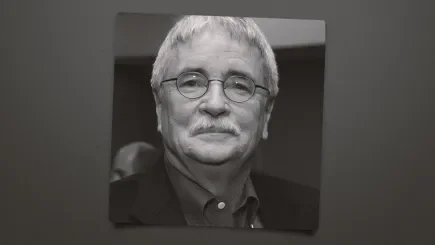
Bruce Davis, the longtime executive director of the Academy of Motion Picture Arts and Sciences who helped oversee the organization for more than two decades, has died at 83.
Davis died Saturday evening following a battle with leukemia, his wife, Joann, told The Hollywood Reporter.
He spent 30 years with the Academy, serving as its executive director from 1989 until his retirement in 2011. During that period, he worked under six Academy presidents and oversaw a major expansion of the organization.
Bruce Davis: Key Facts
| Detail | Information |
|---|---|
| Name | Bruce Davis |
| Age | 83 |
| Born | March 10, 1943 |
| Birthplace | Washington, D.C. |
| Died | Saturday evening, September 5, 2026 |
| Cause of death | Leukemia |
| Academy career | 30 years |
| Executive director | 1989–2011 |
| Organization | Academy of Motion Picture Arts and Sciences |
| Book | The Academy and the Award |
| Published | 2022 |
From academia to the Film Academy
Davis was born in Washington, D.C., on March 10, 1943. He earned an undergraduate degree in English from Juniata College in Pennsylvania and a master’s degree in medieval literature from the University of Maryland.
He initially pursued an academic career and eventually became chair of the theater department at Juniata.
But Davis had a longstanding ambition to write screenplays. He moved to Los Angeles in 1980 to pursue that goal.
Soon after arriving in Hollywood, a chance meeting at a party connected him with someone whose wife worked at the Academy. Davis was hired weeks later to organize seminars and lectures for the organization.
He was promoted to executive administrator in 1983, taking responsibility for the Academy’s library, archives and public programming.
In 1989, he became executive director, succeeding Jim Roberts.
Two decades at the center of the Oscars
Davis managed the Academy’s day-to-day operations for 22 years.
During his tenure, the organization’s staff grew from about 75 employees to 200.
He also oversaw several major institutional projects, including the relocation of the Academy’s Margaret Herrick Library to the Beverly Hills Waterworks Building in 1991.
In 2002, the Academy opened its film archive at the Pickford Center for Motion Picture Study, another project overseen during Davis’ tenure.
Davis also spent years advocating for an Academy museum. His efforts to secure financial backing were slowed by the Great Recession.
The Academy Museum of Motion Pictures eventually opened in Los Angeles in 2021, a decade after Davis retired.
He documented the Academy’s history
Davis remained closely connected to the Academy after his retirement.
He maintained an office at the Pickford Center and frequently worked at the Margaret Herrick Library, researching the organization’s history.
That research became the 2022 book The Academy and the Award: The Coming of Age of Oscar and the Academy of Motion Picture Arts and Sciences, published by Brandeis University Press.
The book examined the development of the Academy and the Academy Awards and explored one of Hollywood’s enduring mysteries: how the Academy Award statue came to be known as Oscar.
Davis’ research went further than previous efforts in identifying the likely origin of the nickname. He concluded that Eleanore Lilleberg, an assistant in the Academy’s early years, was connected to the name.
A career that never lost its Oscar-night excitement
Davis remained enthusiastic about the Academy even after three decades with the organization.
The day before his retirement in 2011, he told the Associated Press that he had never been bored during his time there.
He also described the excitement of arriving on Oscar night and stepping onto the red carpet, calling it one of the great emotional rushes of his career.
Ric Robertson, who worked as Davis’ top deputy and later succeeded him as executive administrator, remembered him as a leader, mentor and friend.
Davis is survived by his wife, Joann, and their daughters Brangien, Alexandra, Archer and Roxanne, who were with him at the end.


