







Masked Men Block Dover Port in ‘Stop the Boats’ Protest as 4-Mile Traffic Jam Hits UK Ferry Hub

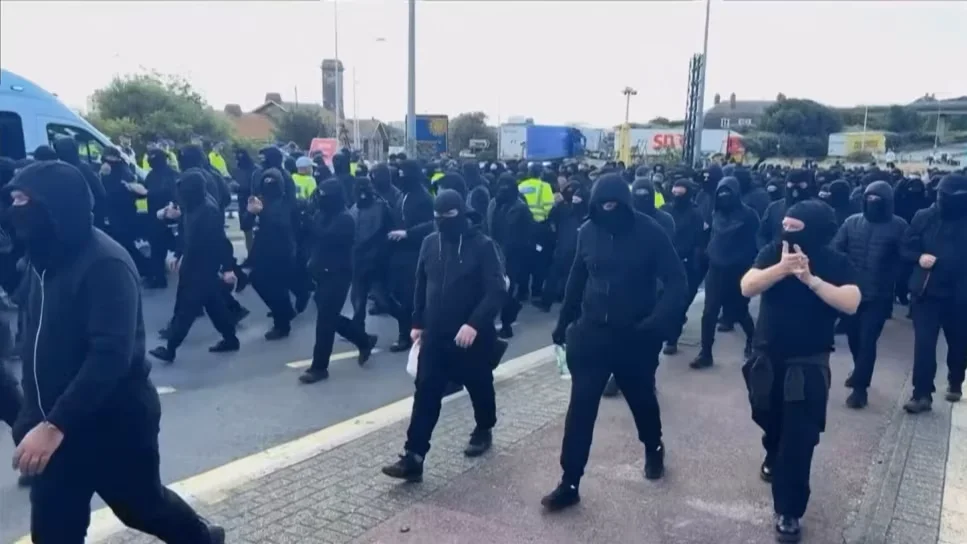
A large group of masked men dressed in black blocked roads around the Port of Dover on Saturday, disrupting traffic to one of the UK’s busiest ferry terminals and leaving passengers and freight vehicles caught in long queues.
The protesters, many wearing balaclavas and face coverings, were heard chanting “stop the boats” as they blocked roads and a roundabout leading to the port.
The disruption began at about 7am BST and lasted for several hours before Kent Police moved the group away from the port area. No arrests were made.
By midday, police said those involved had dispersed and traffic was flowing normally again.
What happened at Dover Port?
The protest brought major routes into and out of Dover to a standstill on Saturday morning.
The Port of Dover said the incident was affecting routes in and out of both the port and the town. National Highways reported significant congestion, with queues stretching for about four miles (6.4km).
Video and photographs from the scene showed dozens of men dressed in black, with their faces covered, standing across roads and blocking vehicles.
Some protesters linked arms across the road while chanting slogans including “stop the boats”.
Kent Police described the demonstration as a spontaneous protest and said officers were engaging with those involved.
Police later moved the protesters towards Dover Priory railway station at about 11:30am. The force said everyone had dispersed by about midday.
No arrests were reported.
Were the Dover protesters protesting against immigration?
The exact organisation behind the demonstration was not immediately confirmed by Kent Police.
However, the protest appeared to be connected to opposition to illegal migration and small boats crossing the English Channel.
Dover West councillor Paul King said he had been told it was a “stop the boats” protest.
Dover District Council Conservative group leader Chris Vinson said the demonstration appeared to have been coordinated, with large numbers of masked men arriving in the area and blocking roads around the port.
The anti-hate organisation Hope Not Hate said the protest was organised by Patriot Platform, which it described as a network bringing together members of anti-migrant groups.
That claim had not been independently confirmed by Kent Police at the time of the reports.
Far-right activists Tommy Robinson and Danny Thomas also posted about the demonstration on X, praising those involved. Thomas is believed to be the founder of the Patriot Platform network.
Protesters approached by the BBC generally declined to speak to journalists. One was heard saying “send them back”, while others repeated the “stop the boats” slogan.
How badly was traffic affected?
The protest caused serious disruption around Dover, affecting both local traffic and people travelling through the ferry port.
National Highways reported a traffic jam of around four miles.
One ferry passenger, Remco van Schellen, told the BBC he was unable to drive away from the terminal because protesters were blocking roads and a roundabout outside the port.
London tour guide Rafael Pittman described the area as “absolute chaos” while he waited to collect tourists arriving at Dover.
He said passengers were unable to disembark normally and that freight trucks were blocking access to parts of the terminal.
Another visitor, Lania Tkaczyk, said the protest delayed her journey to Folkestone, where her children were taking part in a Channel swimming relay.
She described seeing groups of men dressed completely in black and said their appearance was intimidating.
The disruption also affected people working at the port. Dover District Council Conservative leader Chris Vinson said some night-shift workers had been prevented from leaving because of concerns about their safety.
What happened to ferry passengers?
Ferry operators warned passengers that access to the port had been restricted.
P&O Ferries said customers who missed their scheduled sailing would be moved onto the next available service.
DFDS gave passengers similar assurances, saying those affected by the disruption would be accommodated on the next departure once they reached the port.
The Port of Dover later confirmed that its routes had reopened and operations were returning to normal.
The port thanked passengers and local residents for their patience while police dealt with what it described as a public-order incident.
What did the UK government say?
The government condemned the disruption while acknowledging that peaceful protest is a fundamental democratic right.
It said the behaviour at Dover had caused unacceptable travel disruption and thanked police and transport operators for working to restore access.
The government also advised people travelling to the port to allow extra time and follow guidance from their travel providers.
Dover and Deal MP Mike Tapp strongly criticised the protesters.
He said he was “fed up with idiots coming to Dover to cause disruption” and pointed to the decline in small-boat crossings compared with the previous year.
Tapp said crossings were down by about 40% and argued that people protesting in Dover should recognise that the government and authorities were already working to address the issue.
Why is Dover important?
The Port of Dover is the UK’s busiest international ferry and passenger port and a major connection between Britain and France.
According to figures cited by the port, more than 9 million passengers travelled through Dover in 2025, along with about 2 million freight vehicles.
That makes disruption at the port significant not only for local residents but also for holidaymakers, hauliers and cross-Channel trade.
Dover has also become a frequent focus of demonstrations over immigration because migrants rescued or intercepted after crossing the English Channel in small boats are brought ashore in the area.
Are small-boat crossings actually falling?
Yes.
Government figures cited in reports on Saturday showed that 16,513 people had arrived in the UK by small boat by September 1, 2026.
That was around 43% lower than during the same period in 2025.
The decline has been linked by the government to increased enforcement and cooperation between the UK and France.
Despite that fall, Channel crossings remain one of the UK’s most politically contentious immigration issues.
Can protesters legally wear masks in England?
The demonstration also comes against the backdrop of a new law covering face coverings at protests.
The Crime and Policing Act 2026 created an offence relating to concealing one’s identity at a protest in England and Wales when the relevant area has been formally designated by a police officer of at least inspector rank.
The law requires the officer to believe offences are likely to take place before an area can be designated.
The section concerning concealment of identity came into force in June 2026.
It does not mean that every person wearing a face covering at every protest automatically commits an offence; the legal restrictions depend on the circumstances and whether the area has been formally designated.
What happens next?
The immediate disruption at Dover has ended.
Kent Police said the protesters had dispersed by midday and traffic was flowing normally.
The Port of Dover has also reopened routes into and out of the town, while ferry operators have offered alternative sailings to passengers affected by the blockade.
However, questions remain over who organised the demonstration and whether further protests could take place.
The incident has also renewed attention on the continuing political dispute over Channel crossings, even as the latest government figures show that small-boat arrivals are significantly lower than they were at the same point last year.
For Dover, Saturday’s protest turned a major international transport hub into the centre of an immigration demonstration—and temporarily brought traffic around one of Britain’s most important ferry routes to a standstill.


