









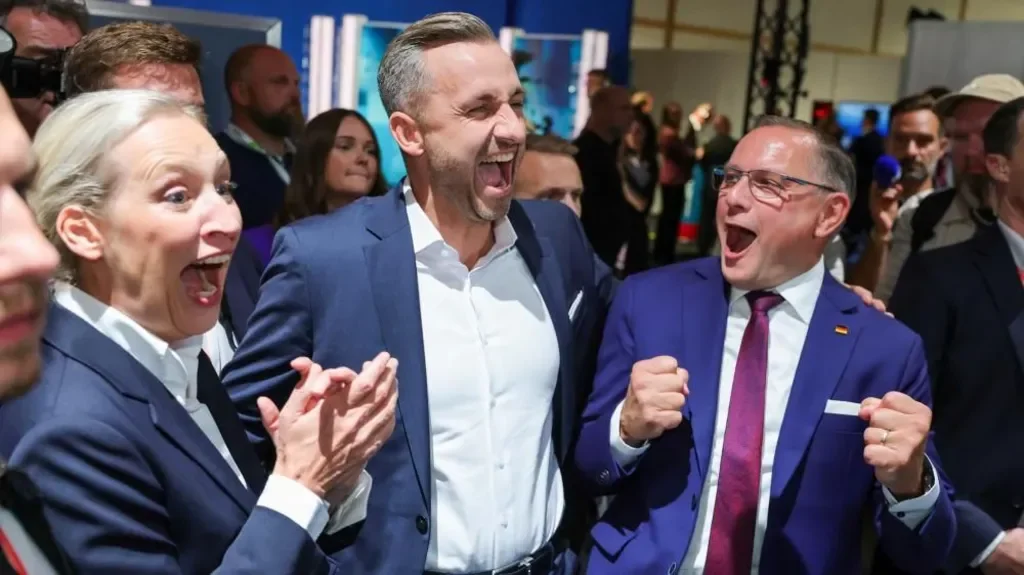
Ulrich Siegmund has emerged as one of the most closely watched political figures in Germany after the Alternative for Germany (AfD) secured a major victory in the 2026 Saxony-Anhalt state election.
The 35-year-old politician led the AfD campaign in the eastern German state, where the party won about 44.5% of the vote in early projections, far ahead of Chancellor Friedrich Merz’s Christian Democratic Union (CDU), which was around 18.5%.
The result has put Siegmund at the center of a much larger question: can the AfD turn its election success into actual state power?
Here is what to know about Ulrich Siegmund, his political career, his background and what he wants to change in Saxony-Anhalt.
Who Is Ulrich Siegmund?
Ulrich Siegmund is a German politician and the AfD’s leading candidate in Saxony-Anhalt.
He is 35 years old and has become a prominent figure within the party’s eastern German political base.
Siegmund has built a strong public profile during the election campaign, including through social media, rallies and highly recognizable appearances across the state.
His political message has focused heavily on immigration, security, German identity and opposition to policies associated with the country’s mainstream political parties.
His rise has also attracted national attention because the Saxony-Anhalt election was viewed as an important test of how far the AfD could advance in eastern Germany.
How Old Is Ulrich Siegmund?
Ulrich Siegmund is 35 years old.
His relatively young age has been notable within a German political environment dominated by more established national figures.
Siegmund has used social media extensively and has developed a particularly strong following among AfD supporters in Saxony-Anhalt.
What Happened in the Saxony-Anhalt Election?
The AfD recorded its strongest-ever performance in a Saxony-Anhalt state election, according to initial election projections.
The party received approximately 44.5%, compared with about 18.5% for the CDU.
The scale of the result was striking because the AfD had received 20.8% in the previous state election in 2021.
The CDU, meanwhile, suffered a dramatic decline after having dominated the state for years.
The result made the AfD the clear largest political force in the state, but winning the most votes does not automatically mean that Siegmund can form a government.
Can Ulrich Siegmund Become Governor of Saxony-Anhalt?
That remains the key political question following the election.
Siegmund has repeatedly argued that the AfD should govern only if it can secure enough seats to exercise power without relying on another party.
Mainstream German parties have maintained a political firewall, known as the Brandmauer, against cooperation with the AfD.
That means the AfD faces a major obstacle even after finishing far ahead of its competitors.
The final distribution of seats and the performance of smaller parties such as the Sahra Wagenknecht Alliance (BSW) could therefore determine what happens next.
What Does Ulrich Siegmund Believe In?
Siegmund’s campaign has centered on a number of issues that distinguish the AfD from Germany’s mainstream parties.
Immigration
Immigration and deportation have been among his most prominent political themes.
Siegmund has called for tougher action against people who are in Germany illegally and has advocated what he describes as a deportation offensive.
German Identity
Siegmund has also emphasized national identity and traditional values.
During the campaign, he proposed changing Saxony-Anhalt’s state slogan from “Think Modern” to “Think German.”
He has also backed greater emphasis on national symbols in schools.
Schools and Culture
His political agenda includes changes to education and cultural policy.
Among the proposals associated with the AfD’s Saxony-Anhalt campaign are allowing homeschooling and preventing schools from officially raising rainbow flags.
The party has also called for stronger use of the German national flag in schools.
Energy Policy
Siegmund has opposed further expansion of wind farms in the state.
His position reflects the AfD’s wider criticism of Germany’s energy transition and some environmental policies.
Relations With Russia and Ukraine
The AfD in Saxony-Anhalt has also taken positions critical of Germany’s continued support for Ukraine and has called for a different approach to sanctions against Russia.
However, many foreign-policy decisions remain under the authority of Germany’s federal government rather than an individual state government.
Why Is Ulrich Siegmund Important Now?
Siegmund’s importance goes beyond the state of Saxony-Anhalt.
The AfD has been gaining support nationally, particularly in eastern Germany, and the party has increasingly positioned itself as a potential future governing force.
The Saxony-Anhalt result gives that strategy a significant boost.
The party’s performance also puts additional pressure on Chancellor Friedrich Merz and his CDU.
The CDU had governed Saxony-Anhalt for decades, but its support fell sharply in this election.
That makes the result both a regional political earthquake and a warning sign for Germany’s mainstream parties.
What Is the AfD?
AfD stands for Alternative für Deutschland, or Alternative for Germany.
The party was founded in 2013 and initially focused heavily on opposition to the euro and Germany’s European policy before moving toward a broader platform that includes strong opposition to immigration.
It has become Germany’s most important far-right political force.
The AfD’s regional organization in Saxony-Anhalt has been classified as right-wing extremist by Germany’s domestic intelligence authorities, a characterization the party rejects.
Is Ulrich Siegmund the Leader of the AfD?
Siegmund is not the national leader of the AfD.
He is the party’s leading political figure in Saxony-Anhalt and served as its top candidate in the state election.
The AfD’s national leadership includes Alice Weidel and Tino Chrupalla.
Siegmund’s election performance, however, has elevated his national profile considerably.
Who Is Ulrich Siegmund’s Wife?
Siegmund is married, and his wife has appeared with him publicly during the election campaign.
However, detailed information about her personal life and background is limited in widely available public reporting.
Siegmund has generally kept the focus of his public profile on his political activities rather than his family life.
What Is Known About Ulrich Siegmund’s Career?
Before becoming one of the AfD’s best-known figures in Saxony-Anhalt, Siegmund worked outside traditional national politics.
He has been described as a former fragrance salesman and built his political profile through the AfD’s state organization.
His campaign style has helped him develop a substantial social-media following, particularly on TikTok.
That combination of conventional campaigning and social-media visibility has contributed to his rapid rise within the party.
Why Does Saxony-Anhalt Matter to Germany?
Saxony-Anhalt is an eastern German state with a population of roughly 2.1 million people.
Although relatively small compared with Germany’s largest states, its election has national significance because of the AfD’s unusually strong performance.
A successful AfD government at state level would represent a major break with Germany’s post-war political pattern.
It would also give the party practical responsibility over areas such as education, policing and aspects of state administration.
What Happens Next?
The immediate issue is government formation.
The AfD has won the election decisively, but its ability to govern depends on the final seat distribution and whether it can obtain the numbers needed to control the state parliament.
The party’s refusal to rely on a conventional coalition makes the situation more complicated.
If the AfD cannot govern alone, other parties will face pressure to determine how a government can be formed while maintaining their refusal to cooperate with the party.
That could lead to a difficult and potentially lengthy period of negotiations.
Ulrich Siegmund’s Rise Could Have National Consequences
The Saxony-Anhalt election has transformed Ulrich Siegmund from a prominent regional AfD politician into a figure attracting national and international attention.
His party’s approximately 44.5% result is far more than a routine state-election victory.
It demonstrates the scale of AfD support in one of its eastern German strongholds and increases pressure on Germany’s established political parties.
For Siegmund, however, the biggest test begins after election night.
Winning the largest share of the vote is one achievement. Turning that result into a functioning government will be considerably harder.
The coming negotiations over seats, coalitions and the political firewall will determine whether the AfD’s historic result becomes its first opportunity to exercise state power in modern Germany.


