









Jannis Lenz’s ‘Oasis’ Explores Teen Violence, Vulnerability and the Search for a Safe Space

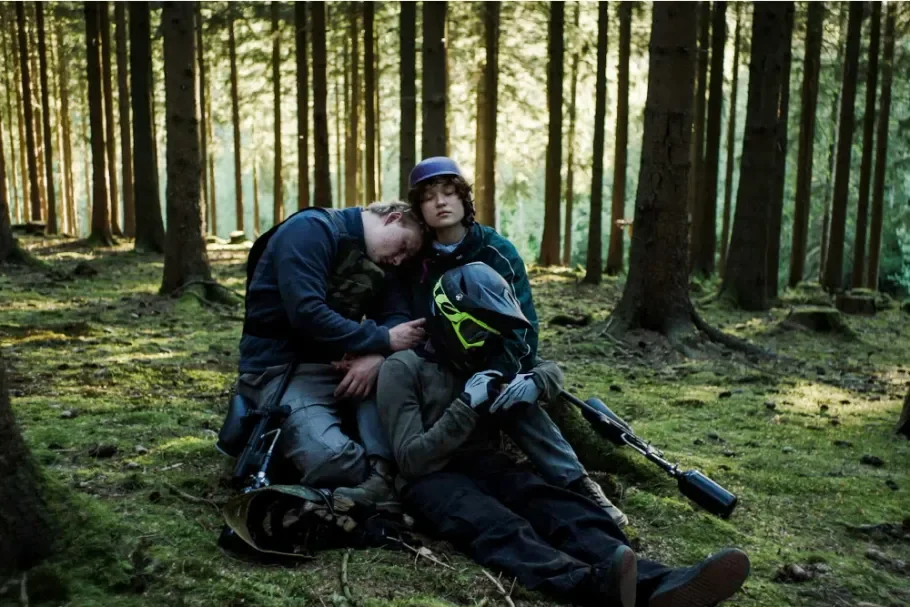
Jannis Lenz’s debut feature “Oasis” turns teenage violence, exclusion and vulnerability into an unsettling story about young people searching for somewhere they can feel safe.
The German-language film, which premieres in the Horizons section of the 83rd Venice International Film Festival, follows three teenagers who retreat to a forest as pressure from school, parents and other students begins to overwhelm them. The film is produced by Germany and Austria and runs for 118 minutes.
What is Jannis Lenz’s ‘Oasis’ about?
The story begins when a video of Andy, a new student at a school in southern Germany, threatening other students goes viral.
The incident puts Andy under pressure from teachers, parents and classmates, with expulsion becoming a possibility. His closest friend, Lukas, joins him in escaping to a nearby forest.
The forest initially becomes a place where the two boys can step outside the rules and expectations surrounding them. They later meet Maya, a student from a music and performing-arts school.
Together, the three begin developing an intense friendship that allows them to explore emotions and vulnerabilities they struggle to express elsewhere.
The film’s official synopsis describes the forest as a refuge where play gradually turns into ritual and pain becomes a form of escape as the teenagers confront their unresolved wounds.
A story about violence without a simple villain
Although “Oasis” begins with an act of threatening behavior, Lenz does not present the story as a straightforward explanation of how a young person becomes violent.
Instead, the film examines the fear, isolation and social pressure surrounding the teenagers.
Parents demand action because they are afraid for their children. School officials attempt to control the situation. Other adults try different approaches, including anti-violence training and counseling.
Lenz has said he wanted to understand the motivations of the different people in the story rather than divide them into obvious heroes and villains.
That approach gives “Oasis” a more ambiguous view of teenage conflict, focusing on how fear and exclusion can affect everyone involved.
The meaning behind the film’s title
The “oasis” in the title is not simply the forest.
For Lenz, it represents the space the teenagers create through trust and togetherness.
Away from the rigid structures of school and family, they are able to reveal parts of themselves that they normally keep hidden.
Their physical rituals become connected to emotional wounds, allowing the characters to explore vulnerability and the need to be seen and accepted.
The film’s official director statement similarly describes “Oase” as a story about young people trying to find an identity beyond the labels imposed on them.
Jannis Lenz’s connection to Jessica Hausner and Michael Haneke
Lenz’s filmmaking background helps explain the film’s restrained and psychologically focused approach.
He trained under Austrian filmmaker Jessica Hausner and worked as an assistant to Michael Haneke, two filmmakers known for precise, often unsettling examinations of human behavior.
Lenz acknowledges their influence but says his own working method is different. He describes his process as carefully prepared but more open to improvisation once filming begins.
That balance between precision and openness also shaped his work with the young cast.
Why the intimate scenes were carefully developed
Some of the film’s most demanding scenes involve physical vulnerability and intimacy between the teenagers.
Lenz said the production focused on building trust before filming those sequences. The young actors first worked through the scenes theoretically, discussing their characters and interpretations before moving into physical rehearsals.
An intimacy coordinator was brought in when the work became physical.
The approach was designed to give the actors space to communicate through movement while maintaining trust and clear boundaries.
The resulting scenes are central to the film’s exploration of vulnerability rather than simply being used for shock value.
Lenz’s connection to a real-life tragedy
The film also draws indirectly on Lenz’s personal connection to the 2009 Winnenden school massacre in Germany, which occurred near where he grew up.
The tragedy left him thinking about fear, exclusion and what can happen when young people feel they cannot find a place within their surroundings.
But “Oasis” does not present a conventional “future killer” narrative.
Instead, Lenz uses the teenagers’ experiences to ask broader questions about belonging, masculinity, violence and whether young people can find healthier ways to deal with emotional pain.
‘Oasis’ at Venice Film Festival
“Oasis” is Lenz’s first fiction feature and is part of the Orizzonti program at Venice. The film’s public world premiere is scheduled for Sept. 6, with additional festival screenings following.
The film stars Florian Geißelmann, Anton Petzold and Mathilda Smidt, with Godehard Giese also among the cast. Lenz co-wrote the screenplay with Alexander Dirninger, who also serves as cinematographer.
Rather than offering an easy answer to teenage violence, “Oasis” focuses on a more difficult question: what happens when young people are constantly watched, judged and labeled, but rarely feel genuinely understood?


