









Tim Cook has stepped down as Apple CEO after 15 years at the helm, closing one of the most consequential chapters in the technology company’s history.
Cook handed the CEO role to John Ternus, Apple’s former senior vice president of Hardware Engineering, on August 31. But this is not a complete departure: Cook remains at Apple as executive chairman and is expected to continue working on areas including the company’s relationships with policymakers around the world.
The leadership change comes at a pivotal moment.
Apple is now a company worth more than $4 trillion, has an enormous installed base of active devices and continues to generate record revenue from its hardware and services businesses. At the same time, its new CEO faces pressure to strengthen Apple’s position in artificial intelligence while navigating its dependence on China and political pressure in Washington.
For Ternus, the question is no longer simply how to maintain Cook’s Apple.
It is how to define what comes next.
Tim Cook’s 15-year Apple transformation
Cook became Apple’s CEO in August 2011 after Steve Jobs stepped down because of his declining health. Jobs died six weeks later.
Before becoming CEO, Cook had already established himself as one of Apple’s most important executives. He joined the company in 1998 after Jobs recruited him and eventually became chief operating officer, where his expertise in operations and supply-chain management became central to Apple’s growth.
During Cook’s tenure, Apple expanded far beyond the traditional Mac, iPhone and iPad business.
The company introduced products and services including the Apple Watch, Apple Pay, Apple Music, AirPods, Apple TV+ and Apple Card, while steadily expanding its subscription and services businesses.
The financial scale of the transformation was equally striking.
Apple’s annual revenue increased from roughly $108 billion in fiscal 2011 to $416 billion in fiscal 2025, according to the company’s reported figures.
Apple also crossed a series of historic market-capitalization milestones during Cook’s tenure.
The company became the first U.S. publicly traded company to reach:
- $1 trillion in market value in 2018
- $2 trillion in 2020
- $3 trillion in 2022
- $4 trillion in 2025
Apple’s market capitalization was around $4.6 trillion as Cook left the CEO position, although the company’s exact valuation continues to move with its stock price.
What does John Ternus inherit?
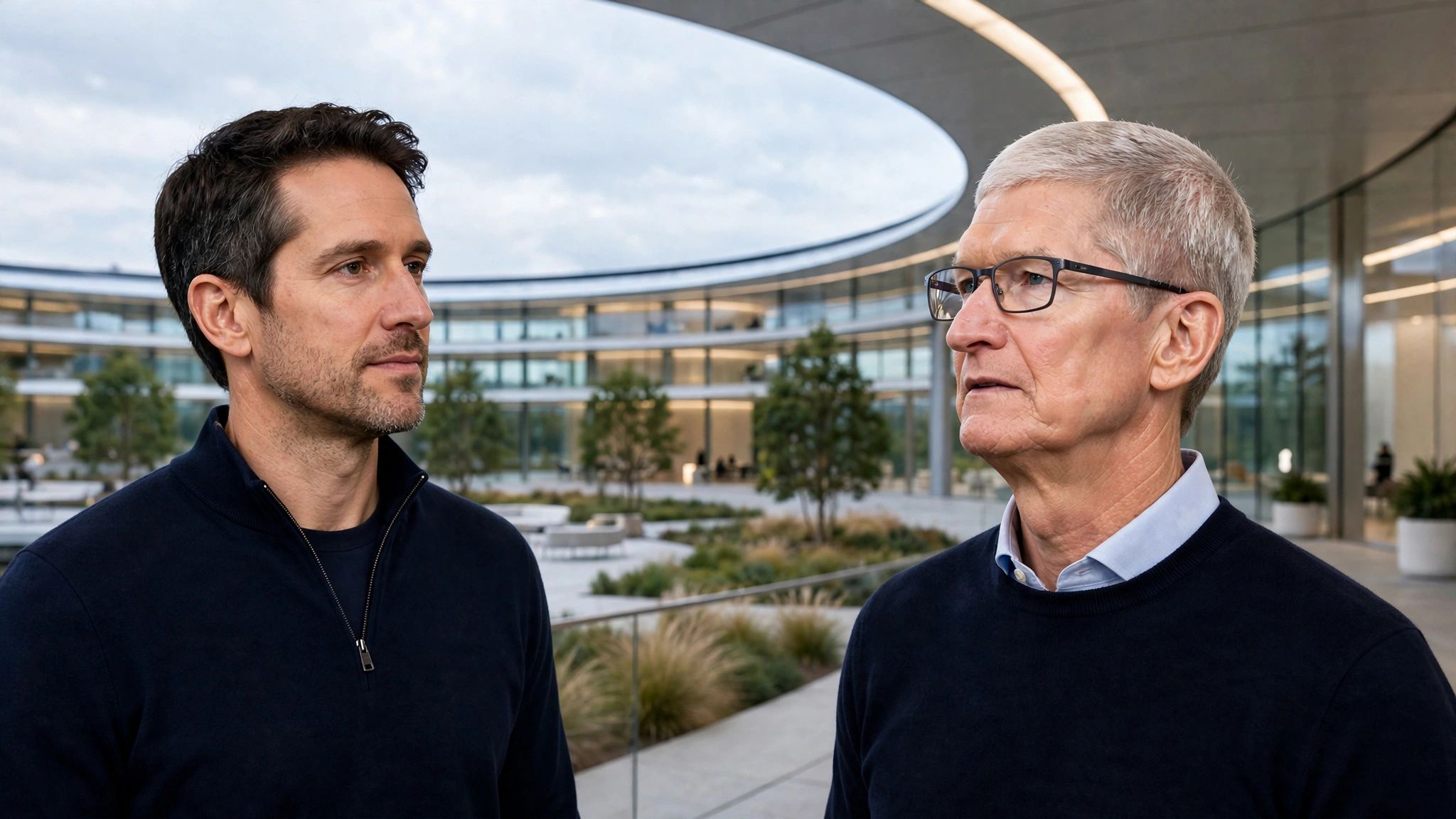
Ternus takes control of an Apple that is financially enormous but facing a very different competitive environment from the one Cook inherited.
The new CEO is an engineer rather than an operations specialist.
Ternus joined Apple in 2001 and eventually became senior vice president of Hardware Engineering, overseeing engineering work across Apple’s major product lines.
That background could shape Apple’s next phase.
The company is preparing for another major product cycle, including its annual iPhone event on September 9, where Apple is expected to unveil new hardware and potentially its first foldable iPhone.
But hardware is only one part of the challenge.
Apple is under increasing pressure to demonstrate that it can compete effectively in artificial intelligence.
That makes Ternus’s engineering background particularly significant.
Analysts have suggested that Apple does not necessarily need to abandon what is already working. Instead, the company may need to use its hardware strength as the foundation for a stronger AI strategy.
Apple’s AI problem could become Ternus’s defining test
Artificial intelligence may ultimately become the biggest difference between the Cook and Ternus eras.
Apple has enormous advantages: a global hardware ecosystem, billions of active devices and direct control over the software and hardware experience.
But competitors have moved aggressively in generative AI and AI-powered hardware.
Ternus therefore inherits a company that has to answer a difficult question:
How does Apple turn its hardware advantage into a meaningful AI advantage?
Cook’s final message to employees also put AI in a broader context.
He has repeatedly argued that technology should ultimately benefit people. In one of the quotes highlighted as he left the CEO role, Cook said:
“What all of us have to do is to make sure we are using AI in a way that is for the benefit of humanity, not to the detriment of humanity.”
That message could become part of the broader legacy Cook leaves behind as Apple moves deeper into AI.
Apple is still winning where it matters most: the iPhone
Despite concerns about AI, Apple enters the leadership transition from a position of considerable strength.
Counterpoint Research ranked the iPhone 17 as the world’s best-selling smartphone in both the first and second quarters of 2026, with the iPhone 17 Pro Max and Pro also ranking highly.
Apple’s unit sales increased 5% in the June quarter, even as the overall smartphone market contracted by about 11%, according to the figures cited in the supplied reporting.
That matters because Ternus’s background is deeply connected to Apple’s hardware.
He has spent years working on the engineering behind the company’s products, including the iPhone.
His immediate challenge is therefore not to reinvent Apple’s hardware business from scratch.
It is to keep that business growing while making Apple’s next generation of products increasingly relevant to the AI era.
Apple’s latest numbers show the strength of Cook’s final year
Cook’s final quarter as CEO was also a record June quarter for Apple.
The company reported $109.4 billion in fiscal Q3 2026 revenue, up 16% year over year.
According to Apple’s results:
- iPhone revenue rose 22%
- Mac revenue rose 29%
- Services revenue reached $30.7 billion
- Services revenue increased 12% year over year
Apple also said its installed base of active devices reached another all-time high.
The company had previously disclosed in January that its installed base had surpassed 2.5 billion active devices.
That installed base is one of Ternus’s biggest assets.
Every active iPhone, Mac, iPad, Apple Watch and other Apple device represents a potential customer for future hardware, software, subscriptions and services.
Services are becoming increasingly important
One of Cook’s biggest strategic achievements was Apple’s expansion beyond hardware.
Services have become a major recurring-revenue engine for the company, encompassing areas such as the App Store, Apple Music, Apple TV+, iCloud and other offerings.
Apple’s advertising business is also becoming increasingly significant.
Omdia estimated that Apple generated roughly $7 billion in advertising revenue in 2025, with the App Store accounting for the vast majority of that total.
Now Apple is expanding advertising into another important consumer surface: Maps.
Apple began showing search-related advertisements in Maps for users in the United States and Canada on August 25.
The move is potentially important because Maps searches can occur when users are already looking for a business, restaurant or service.
That creates a direct connection between search intent and commercial activity.
But it also creates a potential tension with Apple’s privacy-focused brand.
The Maps ads controversy is arriving at the worst possible time
The timing is notable.
Apple’s Maps advertising expansion came only days before Cook’s final day as CEO.
The new advertising model has already raised questions about how aggressively Apple intends to expand its advertising business and whether users will be given meaningful control over the experience.
That leaves Ternus with a delicate balancing act.
Apple wants to grow Services and advertising because they can provide additional revenue from its enormous installed base.
But the company also has to protect the user experience and the privacy positioning that differentiates Apple from some of its competitors.
How far Ternus takes that advertising strategy could become an early indicator of the direction of his Apple.
China remains another major challenge
AI is not Ternus’s only problem.
Apple continues to rely heavily on China as part of its manufacturing and supply chain, while geopolitical tensions and pressure from Washington add another layer of uncertainty.
That creates a difficult situation for Apple’s new CEO.
Cook’s operational expertise was one of the defining characteristics of his leadership. Ternus now inherits the supply-chain system that Cook spent years strengthening while facing a much more complicated geopolitical environment.
Maintaining Apple’s global production network while reducing risks will be one of the company’s longer-term strategic challenges.
Tim Cook is not actually leaving Apple
Despite the headline of his CEO departure, Cook is not walking away from Apple.
He becomes executive chairman and will remain involved with the company.
His role is expected to include engagement with policymakers around the world, meaning Cook can continue to influence Apple’s relationships with governments and regulators even though Ternus now controls day-to-day operations.
That makes this transition different from a clean break.
Apple is changing CEOs, but Cook remains part of the company.
What comes next for Apple?
The first major test arrives almost immediately.
Apple’s September 9 event is expected to put Ternus in front of consumers as the company’s new chief executive during one of Apple’s most important annual product moments.
The company is expected to introduce new iPhone hardware, with a foldable iPhone among the products reportedly anticipated.
Beyond the next iPhone, however, the bigger question is whether Ternus can create a clear technology strategy for the next decade.
He inherits:
- a more than $4 trillion company
- a massive global device ecosystem
- a powerful iPhone business
- record Services revenue
- a highly developed supply chain
- growing advertising ambitions
- increasing pressure to compete in AI
- exposure to China and geopolitical risks
- and a customer base expecting Apple’s next major innovation
That is an extraordinary starting point for any CEO.
It is also an extraordinary amount to protect.
The end of the Cook era—and the beginning of the Ternus era
Tim Cook’s 15 years at Apple were defined less by one revolutionary product than by the expansion and optimization of the ecosystem Steve Jobs helped create.
Cook turned Apple into an even larger global business, expanded its services operation, strengthened its supply chain and helped the company reach market values that were almost unimaginable when he took over.
John Ternus now inherits that machine.
But the technology industry has changed.
The next Apple era will be shaped by artificial intelligence, new hardware categories, advertising, services and geopolitical competition.
Cook leaves the CEO office with Apple at an extraordinary financial scale.
Ternus now has to determine whether that scale can translate into Apple’s next major technological leap.
And with Cook remaining as executive chairman, the transition may be less about saying goodbye to the old Apple—and more about watching how the company evolves under a new leader.


