









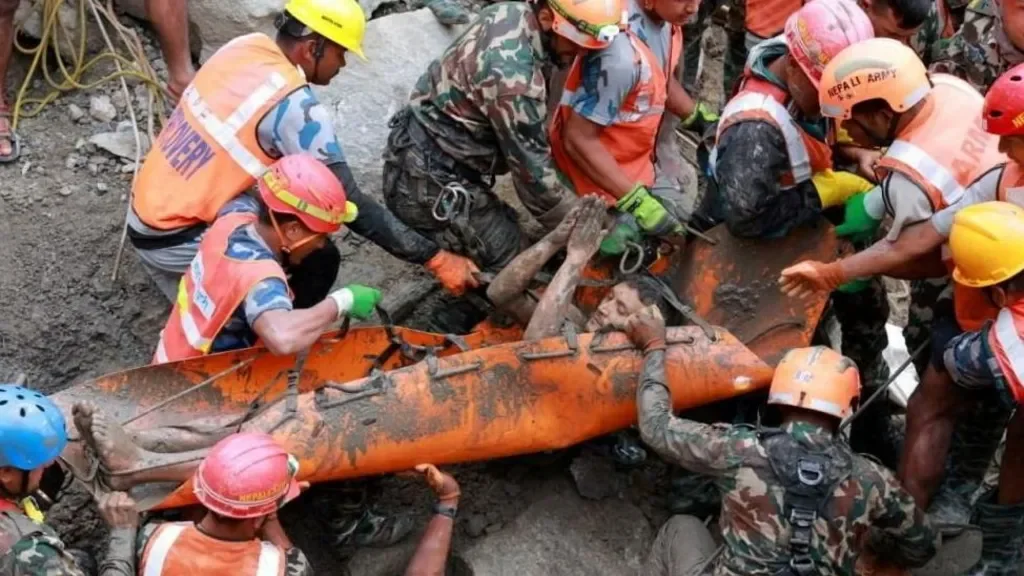
Two workers have been pulled alive from a flooded hydropower tunnel in Nepal nine days after a devastating flash flood, raising fresh hopes for others still believed to be trapped underground.
Two workers have been rescued alive from a hydropower tunnel in Nepal nine days after a massive flash flood swept through the Himalayan region, offering a rare breakthrough in a disaster that has left thousands dead or missing.
Mechanical foreman Sanjay Sah and mechanical supervisor Kabir Maharjan were pulled from the Trishuli 3A hydropower tunnel on Friday after rescuers detected possible signs of life underground.
The rescue has renewed hopes for other workers believed to be trapped inside tunnels across the flood-hit area.
Officials believe around 900 people could still be trapped in tunnels connected to six hydropower projects, according to Reuters. BBC reporting separately said more than 150 people were feared trapped across seven hydropower tunnels.
Two Workers Survived Nine Days Inside the Tunnel
Sah and Maharjan were found inside the Trishuli 3A hydropower project after rescuers heard what appeared to be voices early Friday.
Rescue teams called out to the workers and told them not to worry.
A faint response came back: “okay.”
Crews then worked their way into the tunnel and found the two men alive.
Both had injuries to their hands and legs, possibly sustained while attempting to move through the damaged tunnel.
Sah was carried out by rescuers and taken for medical treatment. Maharjan, who was rescued after him, was reported to be in critical condition.
A third person was later found dead inside the same tunnel. The body was badly swollen and could not immediately be identified.
Officials believe another 39 people may still be inside the Trishuli 3A tunnel, although it remains unclear how many could be alive.

Sanjay Sah Stayed Behind to Help Other Workers
Sah’s account has added a human dimension to the rescue.
When the disaster began, Sah was working in the tunnel’s control room. He said the area could normally have four to six people, but as many as 40 to 45 people may have been there that day.
After receiving word that the disaster was unfolding upstream, he warned other workers to get out.
But Sah did not make it to safety himself.
By the time he tried to escape, the flood and debris had already cut off the route.
Speaking after his rescue, Sah explained why he had stayed:
“My responsibility was to save everyone’s lives.”
He also said that when the disaster happened, “it was not right for me to run away.”
Sah spent nine days in darkness inside the tunnel. Reuters reported that he used mantras and prayers to maintain hope and remained in contact with three or four other workers somewhere inside the underground network.
Rescuers Face Water, Mud and Collapsed Tunnels
The rescue operation remains extremely difficult.
Floodwaters filled sections of the tunnels, while huge amounts of mud and rock blocked access routes.
Rescuers have been forced to dig new openings to reach underground areas rather than relying entirely on the original entrances.
Engineers are also pumping air into the tunnels in an effort to keep conditions survivable for anyone still trapped.
Much of the heavy machinery needed for the operation was swept away by the flood, further slowing efforts to clear debris.
The successful rescue of Sah and Maharjan has nevertheless given rescue teams renewed motivation to continue searching.
Hundreds May Still Be Underground
The two rescues are significant because they demonstrate that people can survive for days inside the damaged tunnels.
But authorities still face a much larger search operation.
Reuters reported that officials believe at least 900 people are trapped in tunnels linked to six hydropower projects along the Trishuli River.
The BBC reported a narrower figure for the known hydropower sites, saying more than 150 people were feared trapped across seven tunnels, including the Trishuli 3A site.
The difference reflects the evolving estimates as authorities continue to establish how many workers were actually underground when the flood struck.
Nepal Flood Disaster Has Killed More Than 1,200 People
The tunnel rescue is taking place against the backdrop of a much wider catastrophe.
At least 1,287 people have been confirmed dead in Nepal, while 5,083 remain missing, according to the latest figures cited by the BBC.
The disaster struck on August 26, when a huge wall of water, ice, rock and debris moved through valleys and settlements near Nepal’s border with Tibet.
Homes, roads, vehicles and other infrastructure were swept away.
China has also reported deaths and missing people on the Tibetan side of the border. The full impact there remains less clear because information released by Chinese authorities has been limited.
Thousands of people have also been displaced.
What Caused the Flash Flood?
Scientists are still examining the precise sequence of events, but the disaster is believed to have been linked to a glacial collapse.
What initially appeared to some observers to be an earthquake was followed by an enormous flow of water and debris moving downstream.
Experts have pointed to signs of increasing instability around the glacier before the collapse.
They have also raised concerns about whether stronger early-warning systems could have reduced the loss of life.
Climate change is being considered as one possible factor, although scientists are still studying the exact causes and conditions that led to the collapse.
Rescue Efforts Continue After the Breakthrough
The rescue of Sanjay Sah and Kabir Maharjan has changed the tone of the operation.
For nine days, families and rescuers had faced uncertainty over whether anyone could still be alive inside the flooded tunnels.
Now, two workers have emerged alive.
But the operation is far from over.
Rescuers must continue dealing with unstable structures, high water levels, mud and collapsed sections while trying to locate people who may still be underground.
Nepalese authorities have also warned that additional rainfall could trigger further flooding in the region.
For the rescue teams, the discovery of two survivors provides something that had been increasingly difficult to find after nine days: hope that others may still be alive.

