







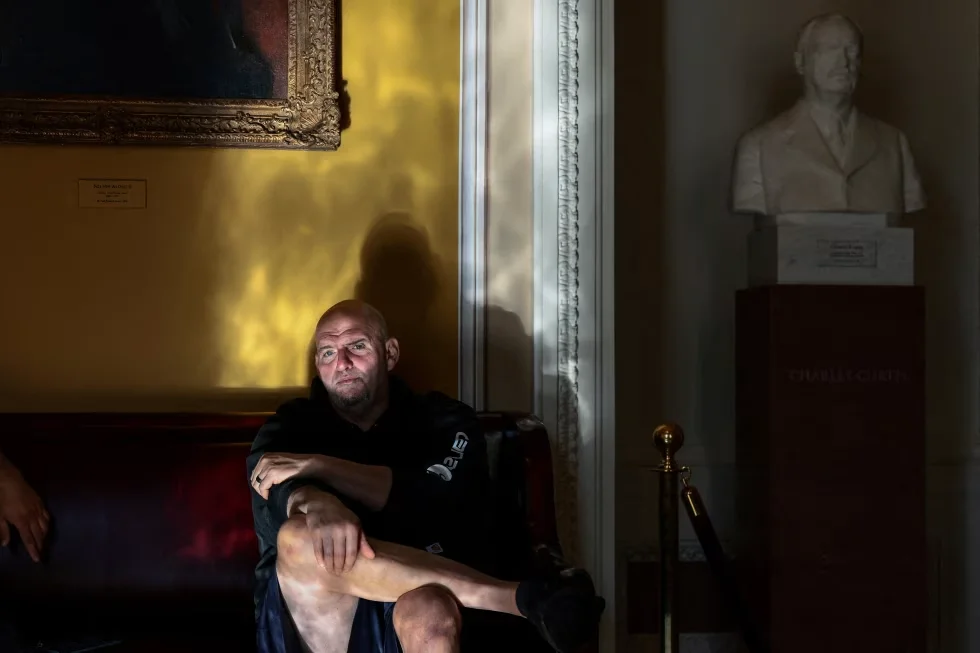
John Fetterman is facing growing criticism after a Wall Street Journal investigation examined how the Pennsylvania senator operates behind closed doors, including his interactions with constituents, lawmakers and members of his own staff.
The report has prompted a strong reaction from political figures and commentators, with some of Fetterman’s critics describing the revelations as deeply troubling.
The controversy comes at a politically important moment for Fetterman. With the Senate closely divided, his vote can carry significant weight on major legislation, particularly when Democrats cannot rely on unified support from their caucus.
WSJ report puts Fetterman’s Senate work under scrutiny
According to the Wall Street Journal report, interviews with more than a dozen former staff members and lawmakers, along with texts and internal records, offered a critical look at Fetterman’s approach to his Senate job.
The investigation portrayed a senator whose priorities, according to people familiar with his office, do not always appear to align with the traditional expectations of the job.
Fetterman has built a distinctive political identity since entering the Senate. His hoodies, shorts and blunt public style helped him develop a reputation as a politician who presents himself differently from Washington’s conventional political class.
But the WSJ report focuses on what happens away from the cameras.
One episode highlighted in the report involved three paralyzed military veterans who traveled from rural Pennsylvania to meet with Fetterman about legislation intended to improve care.
The veterans had been waiting for the meeting, but according to the report, Fetterman canceled because he was not feeling well after possibly eating something that had upset his stomach.
The incident quickly became one of the most discussed parts of the report.
Critics react to the veterans’ meeting allegation
The account sparked criticism because the visitors had traveled specifically to Washington to discuss legislation with their senator.
The broader WSJ investigation also examined staff turnover and Fetterman’s relationships with political figures and media organizations outside the Democratic establishment.
Critics have argued that the report paints a picture of a senator who is unusually detached from some of the traditional responsibilities of representing constituents.
The reaction was particularly strong on social media.
Pennsylvania Rep. Brendan Boyle sharply criticized Fetterman, calling him a “disgrace” and arguing that Pennsylvania deserves better representation.
Political commentator Mehdi Hasan also reacted strongly to the report, describing Fetterman as “beyond parody” and saying he believed many people had misjudged the senator when they supported him in 2022.
CNN senior political reporter Andrew Kaczynski also described the revelations as “wild.”
Fetterman’s political image has changed
Fetterman entered national politics with a reputation as an unconventional progressive Democrat.
His image changed considerably after his 2022 Senate campaign and subsequent battles with health issues. In the Senate, he has increasingly positioned himself as an independent-minded Democrat, including taking positions that have sometimes put him at odds with members of his own party.
His strong support for Israel has also become a defining part of his political identity.
That combination has helped Fetterman cultivate relationships with some conservative media outlets and voters, even as it has frustrated parts of the Democratic base.
The WSJ report now places that political persona under a different kind of scrutiny: how effectively he is carrying out the day-to-day work of a senator.
Why the report matters in the Senate
Fetterman represents Pennsylvania, a major swing state, and his position can become especially important when the Senate is narrowly divided.
That makes questions about his attendance, constituent relationships, legislative priorities and cooperation with colleagues more consequential than they might otherwise be.
The controversy also highlights the growing tension between Fetterman’s unconventional political style and expectations surrounding his role as a U.S. senator.
Rather than simply being another dispute over his politics, the WSJ investigation has raised questions about how Fetterman is performing the job itself.
What happens next for John Fetterman?
The immediate fallout is likely to center on the allegations and accounts detailed by the Wall Street Journal, as well as whether Fetterman or his office directly challenges specific claims in the investigation.
For his critics, the report has provided new ammunition against a senator they already viewed as unreliable.
For Fetterman, the challenge is to demonstrate that his unconventional approach to politics does not come at the expense of representing Pennsylvania and doing the work expected of a member of the Senate.
The controversy therefore goes beyond one canceled meeting or one critical report. It has opened a broader debate over John Fetterman’s role in the Senate, his relationship with constituents and what voters should expect from him as their senator.


