









Fifteen years ago, avocados could fall from trees in parts of Kerala with barely anyone interested in selling them.
Some farmers had an even less flattering name for the fruit: “dog fruit”—because dogs would eat the avocados that dropped to the ground.
Today, the same fruit is appearing on restaurant menus in Mumbai, being planted in commercial orchards and getting attention from farmers looking for alternatives to traditional crops.
Prime Minister Narendra Modi recently highlighted avocado farming in his Mann Ki Baat address, pointing to farmers in Andhra Pradesh, Tamil Nadu and Karnataka who are experimenting with the crop.
The numbers behind the change are striking. People involved in India’s avocado industry estimate that the country imports around 15,000 tonnes of avocados a year, while domestic production is only around 8,000–9,000 tonnes.
That gap has helped turn an obscure plantation fruit into one of India’s more interesting horticultural stories.
But growing avocados for a commercial market is not as straightforward as planting a few trees and waiting for prices to rise.
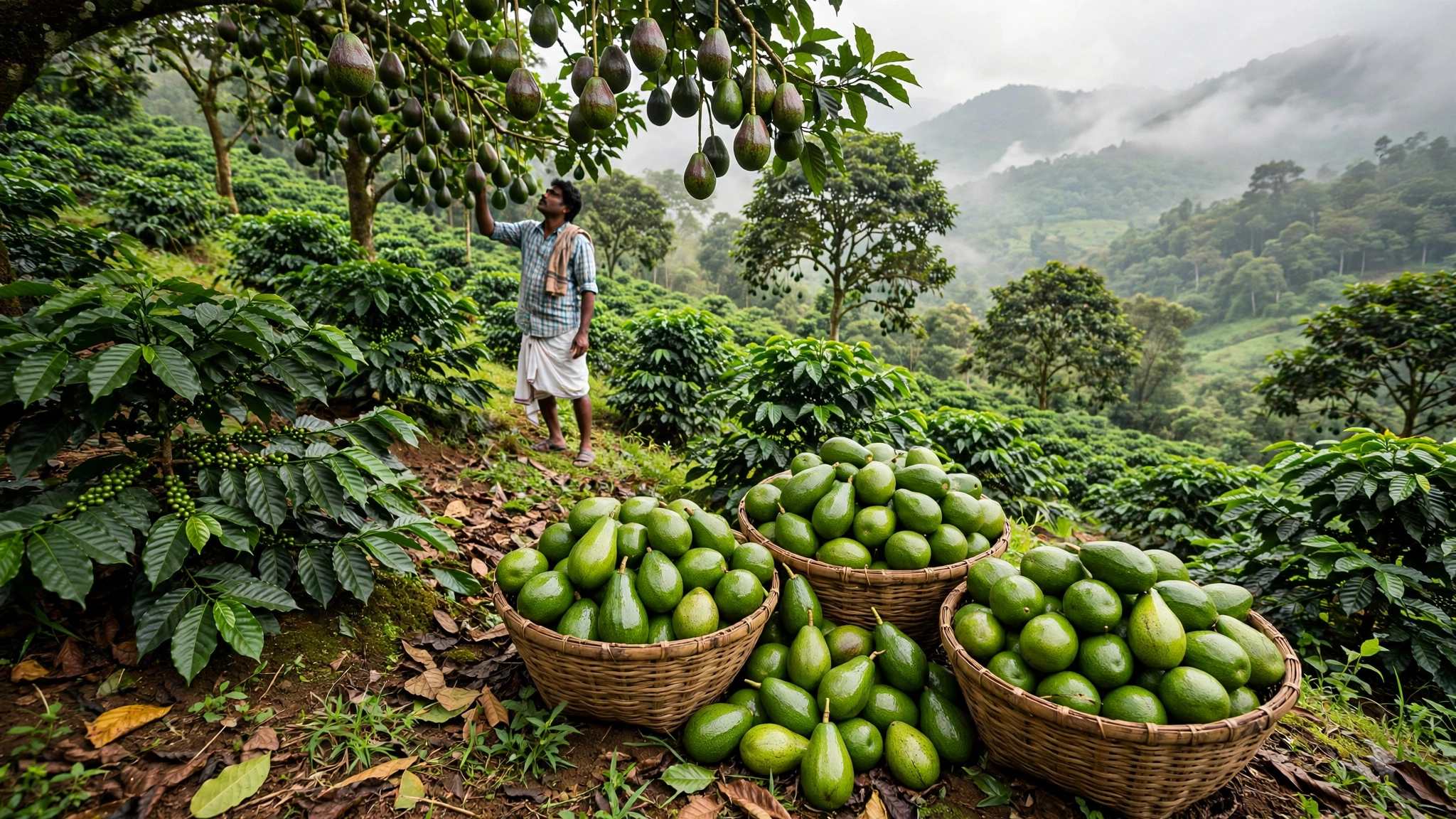
A fruit that found its market
Sunil Bopaiah has watched that change from inside the plantation industry.
He is group manager at Cottanad Plantations in Wayanad, Kerala, where the company grows coffee, cocoa, rubber, spices and fruit.
Avocado was never supposed to become one of the plantation’s main businesses.
“We never planted avocado as our main crop. We introduced it as a shade tree for coffee plantations, and only later realised it could become a profitable business,” Bopaiah says.
He remembers a turning point around 2011, when Bollywood actor Shilpa Shetty spoke publicly about using avocado for skincare.
“Overnight, prices doubled and then kept rising,” he says.
Cottanad now has about 40 acres under avocado. Last year it harvested between 10 and 15 tonnes and expects that figure to reach roughly 40–50 tonnes in three or four years.
The plantation has also had to change how it grows the crop.
Avocado roots are particularly vulnerable to disease, Bopaiah says, so the plantation adopted raised beds, wider spacing and different planting methods after learning from South African growers.
The change from a shade tree to a commercial orchard has been substantial.
The price can look attractive — until it doesn’t
The word “premium” needs some qualification when it comes to Indian avocados.
Prices vary sharply by variety, quality, season and location.
In Wayanad, premium avocados fetched as much as ₹340 a kg in the previous season, according to a report from The New Indian Express. But prices subsequently fell to around ₹60–70 a kg during the following season, putting pressure on growers and pushing some farmers towards processing and other ways of selling the crop.
That volatility is important.
A farmer cannot build a commercial orchard on the assumption that today’s highest market price will still be available several years from now.
A separate example from Kadapa illustrates the other side of the market.
Farmer Karna Varada Reddy, who had traditionally grown tomatoes and bananas, began cultivating avocados after seeing the crop on a friend’s farm and researching cultivation methods online.
He told local media that his farm produced about 1.5 tonnes after four years and that he sold the fruit locally for around ₹100 a kg. Prime Minister Modi later highlighted his avocado farming in Mann Ki Baat.
Those figures work out to roughly ₹1.5 lakh in gross sales for that 1.5-tonne harvest at ₹100 a kg — before counting cultivation, irrigation, labour, plant material, land and other costs.
That distinction matters when describing avocado as a lucrative crop: a selling price is not the same thing as farm profit.
Modi’s avocado example came from Kadapa
In his 137th Mann Ki Baat address, Modi described avocado as a fruit that was once little known in India but is now increasingly found on dining tables and in health and premium markets.
He singled out Varadaraj from Kadapa in Andhra Pradesh, who had spent years growing tomatoes and bananas.
After seeing avocados at a friend’s farm, Varadaraj researched the crop through YouTube and began cultivating it himself.
The Prime Minister said the farmer had produced nearly four tonnes of avocados and was supplying them directly to local shops.
Modi also mentioned Chandrashekaran, a farmer from Kodaikanal in Tamil Nadu who put half a hectare into avocado cultivation, and farmers in Chikkamagaluru, Karnataka, who are planting avocado trees among coffee plantations.
The examples point to something broader than a single new crop.
Farmers do not necessarily have to abandon everything they already grow.
In coffee-growing areas, avocado can be planted alongside existing crops. In other places, it can occupy land previously used for less profitable or more climate-sensitive crops.

The demand is being built in cities
The change is visible in India’s restaurants as much as on farms.
Mumbai hospitality group Hunger Inc., which operates Veronica’s and The Bombay Canteen, has experimented with different avocado varieties available in India.
Chef Hussain Shahzad says imported avocados still provide the consistency the restaurants need in flavour, texture, size and ripening.
That is one of the less obvious barriers for Indian growers.
A restaurant buying avocado is not simply looking for the cheapest fruit. It needs the fruit to behave predictably in the kitchen.
An avocado that is excellent one week and noticeably different the next makes menu planning harder.
So the Indian industry has a quality problem as well as a quantity problem.
India’s avocado trees are not all the same
For decades, many Indian avocado trees were grown in backyards or planted among other crops.
That created a large collection of local trees, but not necessarily a standardised commercial crop.
Dr Ganeshan Karunakaran, a principal scientist at ICAR-Indian Institute of Horticultural Research in Bengaluru, says the country’s backyard trees are genetically different.
The result is fruit that can vary considerably in size and quality.
Researchers have been working on that problem for years.
ICAR-IIHR has developed domestic avocado varieties, including Arka Supreme and Arka Coorg Ravi. ICAR lists Arka Supreme as an “A” type variety with fruit averaging 367–428g and a reported tree yield of about 175–200kg under the institute’s described conditions. Arka Coorg Ravi is a “B” type variety with 450–600g fruit and reported yields of 150–200kg per plant.
Those figures are useful as evidence of what improved planting material can potentially deliver, but they should not be treated as a guaranteed yield for every Indian farm.
For a grower, the choice of planting material can ultimately be as important as the selling price.
Hass is popular, but imported varieties are not the whole story
Some Indian nurseries are betting on varieties already familiar in international markets.
Harshit Godha, founder of Indo-Israel Avocado Nursery in Bhopal, established his business after travelling to Israel to learn about avocado cultivation.
Over five years, his nursery has supplied around 18,000 avocado plants to farmers across India, including varieties such as Hass and Pinkerton.
Commercial orchards require more planning than traditional backyard cultivation.
A tree grown from seed will not necessarily reproduce the characteristics a farmer wants. Commercial plants are generally grafted, with the rootstock selected for local conditions and the graft determining the fruiting variety.
Then comes orchard management.
Godha says an avocado tree can reach about 25 feet within six or seven years. That makes pruning essential if workers are expected to harvest fruit without having to deal with an increasingly tall canopy.
There is also the question of pollination.
Avocados have different flowering types, and growers need compatible varieties in the orchard to achieve good fruit set. A badly planned orchard can therefore look healthy while still producing disappointing crops.
The real calculation starts before the first harvest
Avocado farming has another characteristic that makes the current excitement easy to misunderstand: the money comes later.
Commercial orchards take years to reach meaningful production.
The establishment cost depends heavily on planting material, spacing, irrigation, fencing, land preparation, labour and local conditions. One Indian farming guide currently puts establishment costs using grafted plants and early care at roughly ₹1.5 lakh to ₹3 lakh per acre, but describes that figure as an indicative range rather than a universal cost.
The same source gives broad potential gross-income figures of around ₹6–12 lakh per acre at strong market prices from the fifth year onward, again stressing that actual returns vary by region, yield and market.
Those numbers should be treated cautiously.
There is no single nationwide “avocado profit per acre” figure for India, because a mature orchard producing high-quality Hass fruit for an urban premium market is economically very different from a small farm selling mixed local varieties through a wholesale market.
And the Wayanad price swings show why.
A ₹340-a-kg premium market can make the crop look extraordinarily attractive. A ₹60–70-a-kg season tells a very different story.
Farmers are also trying to sell more than fresh fruit
That price volatility is one reason growers in Wayanad are looking beyond the fresh-fruit market.
Farmers and local agricultural organisations have been exploring branding and value-added products to make better use of fruit that may not meet premium fresh-market standards.
It is a familiar pattern in horticulture: when production expands faster than the high-end market, growers need more buyers, not simply more trees.
That could mean supplying cities more efficiently, improving cold-chain and ripening systems, developing processed products or building stronger regional brands.
For Indian avocado growers, all of those questions are still being worked out.
Climate is pushing farmers to diversify
Avocado’s rise is also happening at a difficult moment for some traditional plantation crops.
Farmers in parts of southern India have faced changing climatic conditions affecting crops such as coffee and pepper.
That has made diversification more attractive.
Avocado does not automatically replace coffee or pepper. In Chikkamagaluru, for example, farmers are experimenting with planting avocado among existing coffee plantations.
That approach spreads the risk.
The farmer still has the traditional crop, but a second fruit crop can create another source of revenue if the orchard performs well.
The trade-off is that avocado brings its own demands: drainage, disease control, pruning, suitable varieties and carefully managed pollination.
India’s avocado market is still being built
The gap between imports and domestic production suggests there is room for Indian growers to expand.
But the market is no longer simply asking for more fruit.
Restaurants want consistency. Consumers are becoming familiar with specific varieties. Farmers need reliable planting material. Nurseries need to avoid distributing diseased or unidentified plants. Growers need buyers who can take the crop when it is ready.
And prices can move dramatically from one season to another.
That is why the story of India’s avocado boom is not really about a fruit suddenly becoming fashionable.
It is about what happens when a previously overlooked crop meets an urban consumer market — and farmers start figuring out whether that demand can be turned into dependable income.
In Wayanad, a fruit once dismissed as “dog fruit” is now being grown across commercial acreage. In Kadapa, a farmer who experimented after seeing the crop on a friend’s farm has found a market for his harvest. In Bengaluru, researchers are working on varieties that could make Indian production more uniform.
The avocado has already moved a long way from the edge of the plantation.
Whether it becomes a genuinely large commercial crop will depend on what happens next: not just how many trees India plants, but how well the industry manages the years between planting, harvesting and finding a buyer willing to pay for the fruit.


