









Rising medical costs, expensive vehicle repair bills, and increasingly higher insurance deductibles have become a growing financial concern for households across countries such as the United States and the United Kingdom during 2025–26. For example, if you file an $8,000 claim after a major vehicle accident, but your policy includes a $1,000 deductible, how much would you actually need to pay? Why do insurance companies use deductibles, and how do they affect your monthly costs and overall level of financial protection?
Understanding deductibles has become more important than ever in 2026 because they determine how much financial responsibility a policyholder must handle before insurance assistance begins. This guide explains in simple terms what a deductible is, how it works, and what factors people in the United States and the United Kingdom should consider while choosing the right deductible.
What Is a Deductible in Insurance?
An insurance deductible is a pre-defined out-of-pocket amount that an insured individual must personally pay at the beginning of a covered claim. In simple terms, it represents the policyholder’s initial financial participation, after which the insurer begins processing the remaining eligible expenses according to the applicable policy terms and coverage conditions.
For example, if a person receives a $10,000 medical bill after an unexpected emergency hospitalization and their health policy includes a $1,500 deductible, the first $1,500 may need to be paid personally, while the remaining eligible amount can then be processed by the insurer according to the coverage conditions.
How Does an Insurance Deductible Work? (Real-Life Example)
Let’s understand how a deductible works in modern insurance systems in 2026 through a simple real-life example—from the moment an insurance policy becomes active to the final payment process after a covered incident occurs and how the deductible is actually applied throughout the process at a practical level.
- The Deductible Is Chosen When Purchasing the Insurance Policy
In February 2026, Shalesh purchased an auto insurance policy for his new SUV with a $2,500 deductible.
While selecting the policy, he was shown different monthly premium options. Some plans required higher monthly payments but included lower deductibles, while others offered lower monthly costs with higher deductibles.
To keep his monthly expenses more balanced, Shalesh selected a plan with a $2,500 deductible.
This meant that in any future claim situation, he would personally need to handle the first $2,500 of eligible expenses — something that was already defined when the policy became active.
- A Serious Covered Accident Happens Later
Around four months later, Shalesh’s SUV was damaged in a multi-vehicle collision during heavy rain on a highway.
The vehicle’s front section, side panels, and safety sensors were severely affected. After towing and inspection, the total repair estimate reached approximately $18,000.
Since this was not a minor repair situation, Shalesh submitted an insurance claim.
- The Verification Process Begins After the Claim Is Filed
After receiving the claim, the insurer does not immediately release payment.
First, the insurance company verifies several important factors:
- Whether the policy is still active
- Whether the accident qualifies under the policy terms
- Whether any exclusions apply
- What deductible amount was selected
- Whether the repair estimate falls within the approved coverage range
After reviewing the inspection reports and claim documents, the insurer considered the loss eligible.
If the damage amount is less than the deductible—meaning Shalesh’s repairs cost only $1,800 while the deductible was $2,500—then the insurer pays nothing. Shalesh would have to pay the entire $1,800 out of his own pocket. Many people only realize this later on.
- The Deductible Amount Is Applied First
After the claim is approved, the deductible amount defined in the policy is then applied.
Because shalesh’s policy included a $2,500 deductible, he was required to personally pay the initial portion of the approved repair expense.
This means the insurer would not directly process the entire $18,000 amount.
First, the agreed initial portion would be handled by Shalesh, after which the remaining approved amount would be processed by the insurance provider.
- The Remaining Approved Amount Is Then Processed
The final payment structure looked like this:
- Total approved repair expense: $18,000
- Amount paid by shalesh: $2,500
- Amount processed by insurance: Remaining $15,500
This is the practical workflow of a deductible system.
In simple terms, a deductible is the initial portion of a covered expense that the policyholder handles first, while the remaining eligible amount is processed by the insurer according to the policy terms.
How Insurance Works in 2026: Premiums, Claims and Payouts Explained
How Insurance Deductibles Work Across Different Types of Insurance
Although the basic concept of a deductible is the same, how it works can vary depending on the type of insurance policy. Here’s how deductibles typically apply across the most common types of insurance.
Auto Insurance Deductible
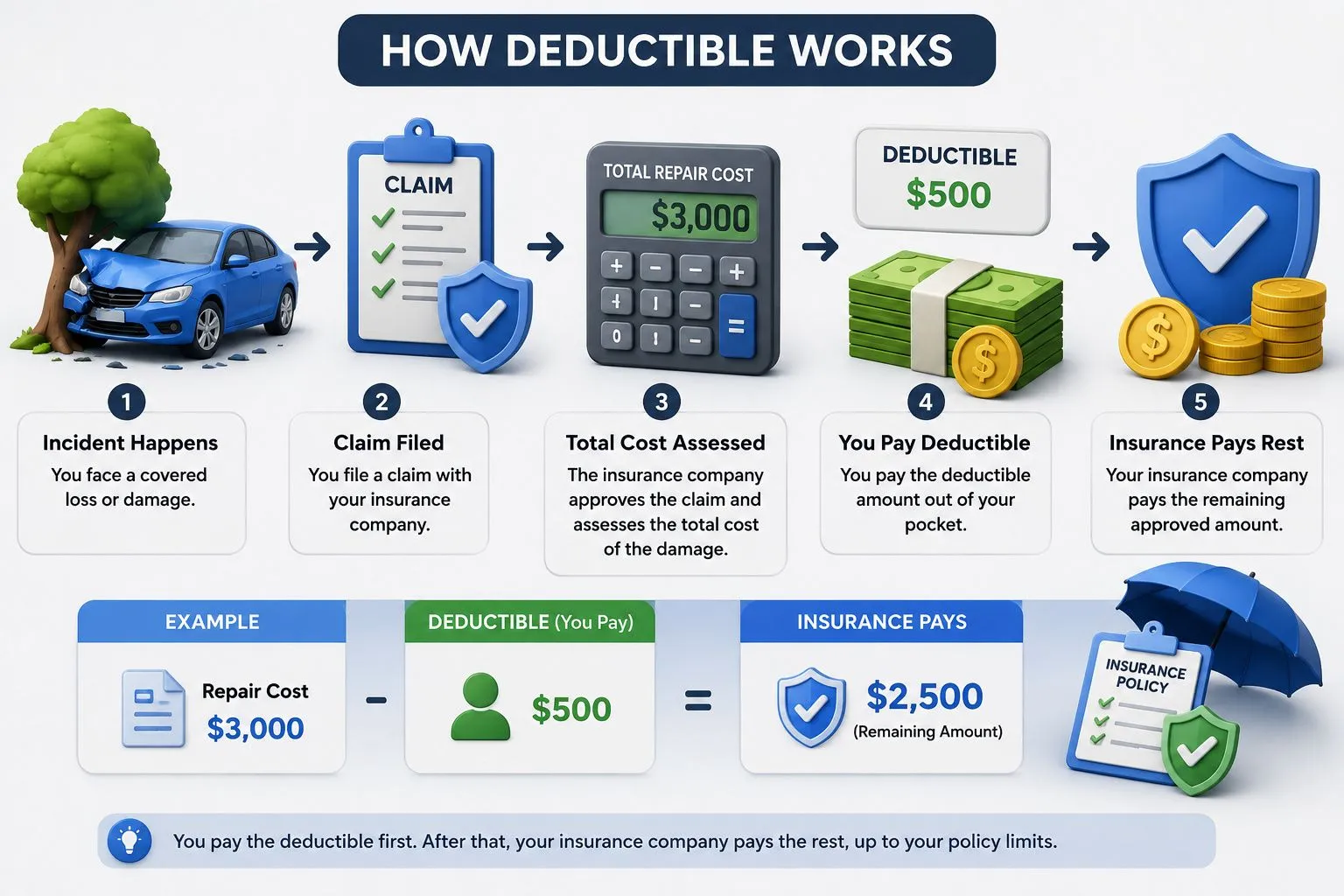
Auto insurance deductibles usually apply to collision and comprehensive claims, not liability coverage. If your policy has a $500 deductible and your covered repair bill is $3,000, you pay the first $500, and your insurer pays the remaining $2,500, subject to your policy terms and coverage limits.
Health Insurance Deductible
A health insurance deductible is generally the amount you pay for covered medical services before your insurer starts sharing eligible costs. For example, if your annual deductible is $2,000, you’ll typically pay the first $2,000 in covered healthcare expenses before coinsurance or other cost-sharing begins, depending on your plan.
Home Insurance Deductible
Homeowners insurance deductibles apply when you file a covered property claim. If a storm causes $15,000 in covered damage and your deductible is $1,000, you pay the first $1,000, while your insurer pays the remaining covered amount after the claim is approved.
Travel Insurance Deductible
Some travel insurance policies include a deductible for covered medical emergencies, baggage claims, or trip-related losses. For example, with a $100 deductible on a covered $1,000 claim, you pay $100, and the insurer may reimburse the remaining eligible amount according to the policy.
Does a Higher Deductible Lower Your Insurance Premium?
In many cases, yes. Choosing a higher deductible usually lowers your insurance premium because you’re agreeing to pay more out of pocket before insurance coverage begins. This reduces the insurer’s financial risk.
However, a higher deductible also means you’ll need enough savings to cover that amount if you ever file a covered claim. The right deductible depends on your budget, financial situation, and comfort with risk.
When Do You Have to Pay Your Deductible?
You generally pay your deductible when you file a covered claim and the policy requires deductible sharing. The deductible is usually applied before the insurance company pays its portion of the approved claim, although the exact process depends on your policy and the type of insurance.
When Might You Not Have to Pay a Deductible?
You may not have to pay a deductible in certain situations, such as claims where your policy doesn’t require one, some preventive health services covered without cost-sharing, or specific claims where another party is legally responsible. The exact rules depend on your insurance policy and applicable laws.
What Is a Good Insurance Deductible?
There isn’t a single deductible that’s best for everyone. A good deductible is one that balances affordable monthly premiums with an amount you could comfortably pay if you filed a covered claim. If you have emergency savings, a higher deductible may reduce your premium. If you’d rather avoid large out-of-pocket expenses after a loss, a lower deductible may be a better choice.
Typical Insurance Deductible Amounts
| Insurance Type | Common Deductible Range* |
|---|---|
| Health Insurance | $500–$5,000+ per year |
| Auto Insurance | $250–$1,000 (sometimes higher) |
| Home Insurance | $500–$2,500 or 1–5% of insured value |
| Travel Insurance | $0–$500 per claim |
*Actual deductible amounts vary by insurer, policy, state, and coverage options.
Deductible vs Premium: The Real Trade-Off
Understanding a deductible only through the claims process is not enough, because its real impact becomes visible when monthly premiums and future out-of-pocket responsibility begin balancing against each other.
This is why the financial trade-off between deductibles and premiums is considered one of the most important parts of any insurance decision.
A premium is the recurring payment made regularly to keep an insurance coverage policy active. In insurance schemes, the structure of deductibles and premiums often follows an inverse pricing pattern. Generally, plans with higher deductibles may have comparatively lower regular premiums, while lower deductible plans may involve higher ongoing payments.

| Feature | Lower Deductible Plan | Higher Deductible Plan |
|---|---|---|
| Deductible Amount | $500 | $2,500 |
| Monthly Premium | $320/month | $180/month |
| Annual Premium | $3,840 | $2,160 |
| Claim Cost | Lower — only $500 | Higher — up to $2,500 |
| Monthly Budget Impact | Higher regular payments | Lower monthly expense |
| May Be Better For | People who prefer predictable expenses | People who want to save on monthly premiums |
| Main Trade-Off | Higher premium costs | Higher upfront expense during claims |
Read the full article: Insurance Premium vs. Deductible: What’s the Difference?
Choosing the Right Deductible: What Most People Overlook
Understanding deductibles is one thing—choosing the right deductible is a completely different skill.
Most people select a plan by looking only at the monthly premium. This is often the biggest mistake.
1. Ask Yourself These Three Questions First
Can I suddenly afford to pay $2,000–$2,500 out of pocket?
If not, avoid high-deductible plans, no matter how low the premium appears.
How often do I use insurance during the year?
If you file claims frequently, a lower deductible is usually more practical.
Do I have an emergency fund?
If you already have a 3–6 month financial backup, a high-deductible plan may become a financially smarter option.
2. Signs That a Low Deductible May Be Better for You
- You have a chronic illness or require regular medication
- Your family includes children or elderly dependents who need frequent care
- Your emergency savings are limited
- Unexpected expenses create financial stress
3. Signs That a High Deductible May Be Better for You
- You are generally healthy and rarely visit doctors
- You have stable income and a savings buffer
- Your monthly cash flow is tight and keeping premiums lower is important
- You are more focused on long-term savings
Deductible vs Other Insurance Costs
Many policyholders confuse deductibles with other insurance-related expenses. However, premiums, copays, coinsurance, and out-of-pocket maximums all serve different purposes and apply at different stages of a policy.
The easiest way to understand these terms is to look at when each cost applies and how it affects your share of expenses.
| Cost Type | Meaning | When You Pay It | Simple Example |
|---|---|---|---|
| Premium | Regular payment required to keep a policy active | Monthly, quarterly, or annually | $200 per month for a health insurance plan |
| Deductible | Amount you must pay before insurance begins sharing covered costs | At the beginning of an eligible claim | First $1,000 of a medical bill |
| Copay | Fixed amount paid for a covered service | At the time of receiving the service | $30 for a doctor visit |
| Coinsurance | Percentage of covered costs you share after the deductible is met | After the deductible has been satisfied | You pay 20%, and the insurer pays 80% |
| Out-of-Pocket Maximum | Maximum amount you may have to pay for covered healthcare expenses during a policy year | Accumulates throughout the policy year | After reaching $6,000, most additional covered costs are paid by the insurer |
Practical Example
Suppose Shalesh receives a medical bill of $4,000, and his health insurance plan includes:
- Deductible: $1,000
- Coinsurance: 20%
- Copay: $30
- Out-of-Pocket Maximum: $6,000
Step 1—The first $1,000 (deductible): shalesh pays → $1,000
Step 2—20% coinsurance on the remaining $3,000: shalesh pays → $600
Step 3 — The insurance company pays: → $2,400
Doctor visit copay (separate): → $30
shalesh’s total out-of-pocket cost: $1,630
Insurance contribution: $2,400
If shalesh’s Out-of-Pocket Maximum is $6,000 and he has paid $1,630 this year, there is still a remaining balance of $4,370. If another major claim arises and his total out-of-pocket spending reaches $6,000, the insurer will generally cover 100% of additional covered costs for the remainder of the policy year.
Learn more about the claim process in our complete guide: What Is an Insurance Claim? Process, Types, and How It Works.
Types of Insurance Deductibles
Deductibles are not structured the same way across every insurance policy. Depending on the type of coverage, a deductible may be a fixed dollar amount, a percentage of insured value, or a threshold that applies to an individual or an entire family. Understanding these variations can help policyholders better estimate their potential out-of-pocket responsibility before a claim occurs.
1. Dollar Deductible
A dollar deductible is the most common deductible structure. It is a fixed amount that the policyholder must pay before insurance begins processing eligible covered expenses.
Example
- Repair cost: $4,000
- Deductible: $500
- Eligible insurance payment: $3,500
This structure is commonly used in auto, health, renters’, and many homeowners’ insurance policies.
2. Percentage Deductible
Instead of a fixed dollar amount, some policies calculate the deductible as a percentage of the insured property’s value.
Example
- Home value: $400,000
- Hurricane deductible: 2%
- Policyholder responsibility: $8,000
Percentage deductibles are often found in regions exposed to hurricanes, windstorms, or other major natural disasters.
3. Individual and Family Deductibles
Many health insurance plans use two deductible levels.
- Individual deductible applies to a single covered person.
- Family deductible applies collectively to covered family members under the same policy.
The exact way these deductibles interact depends on the plan structure and insurer rules.
4. Comprehensive and Collision Deductibles
Auto insurance policies may apply separate deductibles to different types of coverage.
Comprehensive Coverage
- Theft
- Vandalism
- Fire
- Storm damage
- Falling objects
- Animal-related incidents
Collision Coverage
- Damage resulting from a collision with another vehicle or object
Many drivers choose different deductible amounts for each coverage section based on their risk preferences and budget.
5. High-Deductible Health Plans (HDHPs)
High-Deductible Health Plans (HDHPs) have become increasingly common in the United States. These plans generally offer lower monthly premiums but require policyholders to absorb a larger share of healthcare expenses before insurance cost-sharing begins.
Many HDHPs are also compatible with Health Savings Accounts (HSAs), allowing eligible individuals to set aside tax-advantaged funds for qualified medical expenses.
Before purchasing or renewing any insurance policy, reviewing the deductible alongside coverage limits, premium costs, and your overall financial situation can help prevent unexpected expenses in the future. The right deductible is not necessarily the lowest or highest option available—it is the one that balances affordable premiums with an amount you can realistically afford to pay if a claim occurs. Taking the time to compare policy details today can lead to better financial protection and fewer surprises when you need coverage most.
Sources & References
The information in this guide is based on general insurance principles and consumer education published by the following official and industry-recognized organizations:
- National Association of Insurance Commissioners (NAIC) – https://content.naic.org/
- Insurance Information Institute (Triple-I) – https://www.iii.org/
- Healthcare.gov (U.S. Government) – https://www.healthcare.gov/
FAQs
1. What is an insurance deductible in simple words?
An insurance deductible is the amount you pay out of your own pocket before your insurance company starts paying for a covered claim.
2. What is an example of an insurance deductible?
If your deductible is $500 and your covered claim is $3,000, you pay the first $500, and your insurer pays the remaining covered amount according to your policy.
3. How much is an insurance deductible?
Deductibles vary by insurance type and policy. They may be a fixed dollar amount or a percentage of the insured value.
4. How does an insurance deductible work?
When you file a covered claim, you pay the deductible first, and your insurance company pays the remaining eligible amount, subject to your policy terms.
5. What is a deductible in health insurance?
A health insurance deductible is the amount you pay for covered healthcare services before your insurance plan begins sharing eligible costs.
6. What is a deductible in car insurance?
A car insurance deductible is the amount you pay toward covered collision or comprehensive damage before your insurer pays the rest of the approved claim.
7. What is a deductible in home insurance?
A home insurance deductible is your share of a covered property loss that must be paid before insurance coverage applies.
8. What is a $0 deductible?
A $0 deductible means you don’t have to pay out of pocket before insurance benefits apply for covered claims where your policy offers a zero-deductible option.
9. Is a $1,000 deductible good?
It depends on your financial situation. A $1,000 deductible often lowers your premium but requires you to pay more if you file a claim.
10. Does a higher deductible lower insurance costs?
In many cases, yes. Higher deductibles usually reduce premiums because the policyholder assumes more of the initial claim cost.
11. When do you pay an insurance deductible?
You typically pay your deductible when you file a covered claim that requires deductible payment under your policy.
12. Do you pay a deductible for every claim?
Not always. Whether a deductible applies depends on the type of claim, your insurance policy, and the coverage involved.
13. Can you change your insurance deductible?
Yes. Many insurers allow you to change your deductible when purchasing a policy or during renewal, subject to their rules.
14. What happens if you don’t meet your deductible?
If your policy requires a deductible, you’ll generally need to pay your portion before the insurer pays covered claim costs.
15. Is an insurance deductible refundable?
Generally, no. A deductible is your required share of a covered loss and is not refunded after the claim is settled.


Comments are closed.
-
-
-
-
-
-
-
-
-
-
-
-
-
-
-
-
-
-
-
-
-
-
Show Comments[…] why terms like “deductible,” “copay,” “sum insured,” “exclusions,” “waiting […]
[…] policy offers the best value. In reality, a lower price often comes with trade-offs such as higher deductibles, lower coverage limits, narrower protection, or exclusions that may only become apparent when a […]
[…] 📖 Learn how insurance deductibles work → […]
[…] plans (HDHPs), and Marketplace plans. Each type differs in provider access, monthly premiums, deductibles, referrals, and overall healthcare costs. Understanding these differences makes it easier to […]
[…] What Is an Insurance Deductible? Meaning, Examples & How It Works (2026) […]
[…] premiums and deductibles are closely connected, they are not opposites—they work together to determine the overall cost of […]
[…] most cases, you’ll also be responsible for paying your policy’s deductible. This is the amount you agree to pay out of pocket before your insurance coverage […]
[…] you and your insurance company. Every covered claim follows the same basic principle—you pay your deductible first, and your insurer pays the remaining eligible amount, up to your policy […]
[…] networks, medical billing, claim evaluation, negotiated pricing, and cost sharing. Concepts such as deductibles, copays, coinsurance, prior authorization, and Explanation of Benefits (EOB) are all part of this […]
[…] deductible is the amount you must pay out of your own pocket for most covered medical services before your […]
[…] is how coinsurance works in practice—once the deductible requirement has been satisfied, every eligible covered expense is shared between you and your […]
[…] declarations page, and coverage details show the insured property, policy number, coverage limits, deductibles, and applicable […]
[…] appendicitis surgery costing $18,400. Because her employer-sponsored health plan has a $1,500 deductible and 20% coinsurance, the insurer pays about $13,520, while Sarah pays the remaining eligible […]
[…] must cover essential health benefits, but your actual coverage depends on your plan type, network, deductible, and policy […]
[…] pay a large share of the premium. Beyond the monthly premium, it’s also important to compare deductibles, copays, coinsurance, and out-of-pocket maximums before choosing a […]
[…] and is then adjusted according to your level of risk, the amount of coverage you choose, your deductible, and any available discounts. Administrative expenses, regulatory fees, and applicable taxes are […]
[…] the right deductible is determined by the point at which premium savings outweigh the additional financial risk you […]
[…] monthly, although some plans allow quarterly or annual payments. The premium is separate from your deductible and other out-of-pocket costs, so understanding how it works is an important part of choosing the […]
[…] how much it will pay. If your claim is approved, you receive the eligible settlement amount after deductibles, limits, and exclusions are […]
[…] $500 insurance deductible means you pay the first $500 of a covered claim before your insurance company pays the remaining […]
[…] can lower your insurance premium by increasing your deductible, comparing quotes every year, bundling multiple policies, maintaining a low-risk profile, using […]
[…] pay your insurance deductible when you file a covered claim and your insurer approves it. In most cases, the deductible is paid […]