









Insurance premiums are calculated using actuarial models that estimate the likelihood and cost of future claims. Insurers begin with a base premium and adjust it according to factors such as age, location, health, claims history, coverage amount, deductible, and applicable discounts. Although each insurer uses its own pricing model, the overall calculation follows the same risk-based principle.
How Do Insurance Companies Calculate Insurance Premiums?
Insurance companies calculate premiums through a process called underwriting. Instead of using one fixed price for every customer, they estimate how likely you are to file a claim and how much that claim could cost. To do this, insurers combine actuarial data, historical claims, underwriting rules, and modern predictive models to calculate an appropriate premium.
The calculation usually starts with a base premium and is then adjusted according to your level of risk, the amount of coverage you choose, your deductible, and any available discounts. Administrative expenses, regulatory fees, and applicable taxes are also included before the insurer determines your final premium quote.
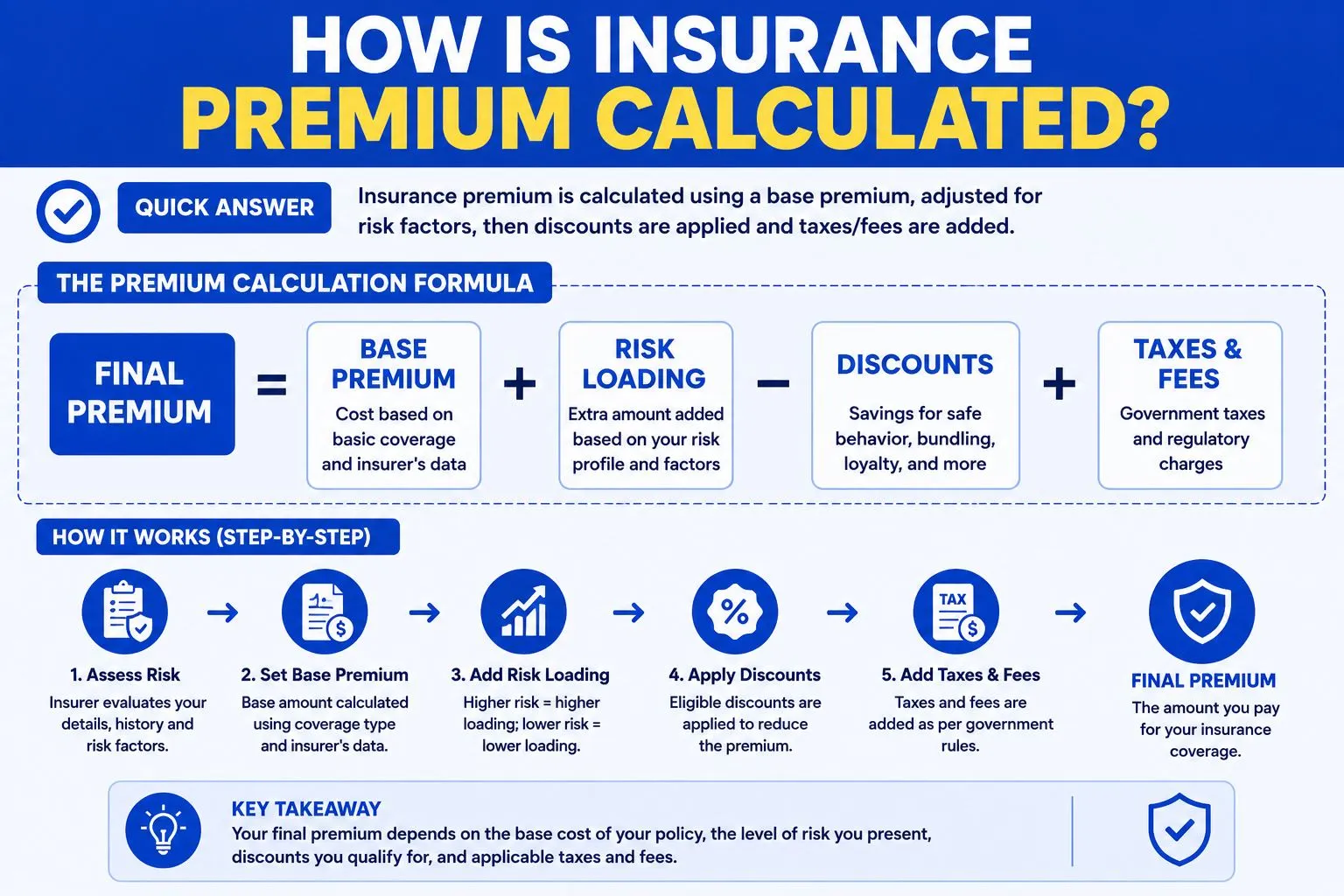
Insurance Premium Formula Explained
There isn’t a single official formula that every insurance company follows. Each insurer uses its own pricing model, but most premium calculations are built around the same core components.
Final Premium = Base Premium + Risk Loadings − Discounts + Taxes & Fees
| Component | Meaning |
|---|---|
| Base Premium | Starting price for the policy |
| Risk Loadings | Extra cost based on risk factors |
| Discounts | Savings for eligible policyholders |
| Taxes & Fees | Government charges and policy fees |
Example
If an insurer starts with a base premium of $450, adds $80 for risk factors, applies a $30 discount, and includes $20 in taxes and fees, the final premium would be $520.
Real Example: How an Insurance Premium Is Calculated
Understanding the formula is helpful, but seeing a real example makes the calculation much easier.
Imagine a 35-year-old non-smoker buying an individual Silver health insurance plan with a $5,000 deductible. The insurance company first estimates the expected annual claims based on the person’s age, location, medical risk, and historical claim data. It then adds operating expenses and a reasonable profit margin before applying any available discounts and required taxes.
In this example, the estimated annual claim cost is $4,200. The insurer adds $650 for administrative expenses, $350 as a profit margin, subtracts a $300 wellness discount, and finally adds $100 in taxes and fees.
| Premium Component | Amount |
|---|---|
| Expected claim cost | $4,200 |
| Administrative expenses | + $650 |
| Profit margin | + $350 |
| Wellness discount | − $300 |
| Taxes & fees | + $100 |
| Estimated annual premium | $5,000 |
This example is only for illustration. Every insurance company uses its own underwriting models, actuarial data, and pricing algorithms, so actual premiums may vary even for people with similar profiles.
How Insurance Premiums Are Calculated by Insurance Type
Although every insurer follows the same basic pricing principle—estimating risk before setting a premium—the factors used to calculate premiums vary depending on the type of insurance.
Health Insurance
Health insurance premiums are mainly based on age, location, tobacco use, plan category (Bronze, Silver, Gold, Platinum), family size, deductible, and whether the policy is purchased through an employer or the Health Insurance Marketplace.
Auto Insurance
Auto insurers evaluate driving history, vehicle type, ZIP code, annual mileage, age, previous claims, and selected coverage limits. Drivers with clean records and safer vehicles generally receive lower premiums.
Home Insurance
Home insurance companies calculate premiums using the property’s replacement cost, location, local weather risks, crime rates, construction materials, home age, deductible, and previous claims.
Life Insurance
Life insurance premiums depend primarily on age, health condition, medical history, smoking status, occupation, lifestyle, and the amount of coverage selected. Younger and healthier applicants usually pay significantly lower premiums.
Although the pricing factors differ across insurance products, the goal is always the same: estimate the likelihood and cost of future claims, then set a premium that reflects that level of risk.
Each insurance type uses a different underwriting model, but every insurer follows the same basic principle: higher expected risk generally leads to higher insurance premiums.

What Factors Affect Your Insurance Premium?
Insurance companies don’t set premiums randomly. They evaluate multiple risk factors to estimate the likelihood of a future claim and the potential payout. The higher the expected risk or coverage cost, the higher your premium is likely to be.
Age
Age is one of the biggest pricing factors. Younger and less experienced drivers often pay more for auto insurance, while older adults generally pay higher premiums for health and life insurance because the risk of claims increases with age.
Location (ZIP Code)
Where you live directly affects your premium. Insurers consider your ZIP code, crime rates, weather patterns, accident frequency, healthcare costs, and natural disaster risks when calculating insurance prices.
Risk Level
Every applicant receives a risk assessment during underwriting. People or properties considered higher risk usually pay higher premiums because insurers expect a greater chance of future claims.
Claims History
If you’ve filed multiple insurance claims in the past, insurers may view you as a higher-risk customer. A clean claims history can often qualify you for better pricing.
Coverage Amount and Policy Limits
Choosing higher coverage limits increases the insurer’s potential payout, which generally leads to a higher premium. Lower coverage limits usually cost less but provide less financial protection.
Deductible
The deductible is the amount you agree to pay before insurance starts covering a claim. A higher deductible usually lowers your premium, while a lower deductible increases it.
Health and Medical History
For health and life insurance, insurers evaluate your overall health, medical history, age, and sometimes tobacco use. People with higher expected medical costs generally pay higher premiums.
Driving Record
For auto insurance, your driving history matters significantly. Accidents, speeding tickets, DUIs, and other violations increase the likelihood of future claims and usually result in higher premiums.
Credit Score (Where Allowed)
Many insurers in certain U.S. states use insurance-based credit scores during underwriting. A stronger credit profile may qualify for lower premiums, while poor credit can increase insurance costs where permitted by law.
Occupation and Lifestyle
Some occupations and hobbies involve greater risk than others. Jobs with higher injury exposure or activities such as skydiving or racing may increase life, health, or disability insurance premiums.
Type of Vehicle or Property
The item being insured also affects pricing. Expensive vehicles, luxury homes, older properties, or assets located in high-risk areas generally cost more to insure because repairs or replacements are more expensive.
Policy Type and Coverage Options
The type of insurance policy you choose also changes the premium. For example, health plans with broader provider networks or lower deductibles typically cost more than basic plans with limited coverage.
Bundling and Available Discounts
Many insurers offer discounts when you bundle multiple policies, maintain a claim-free record, install safety features, or qualify for loyalty or wellness programs. These discounts can reduce your final premium.
Quick Take
While every insurance company uses its own pricing model, most premiums are based on the same core factors: age, location, overall risk level, claims history, coverage amount, deductible, health, driving record, credit profile (where allowed), the type of asset being insured, policy options, and available discounts. Understanding these factors helps explain why two people buying similar coverage may receive very different premium quotes.

How to Lower Your Insurance Premium
Paying less for insurance doesn’t always mean buying less coverage. The goal is to reduce unnecessary risk in the eyes of the insurer while keeping the protection you actually need. Many discounts and pricing factors are within your control.
Here are some of the most effective ways to lower your insurance premium without sacrificing important coverage:
- Choose a higher deductible if you can comfortably afford a larger out-of-pocket payment when filing a claim.
- Compare quotes from multiple insurers before buying or renewing your policy, as pricing formulas vary by company.
- Bundle policies such as home and auto insurance to qualify for multi-policy discounts.
- Maintain a good credit score (where insurers are legally allowed to use credit-based insurance scores).
- Keep a clean claims history by avoiding unnecessary small claims whenever appropriate.
- Drive safely to qualify for safe-driver or accident-free discounts on auto insurance.
- Quit smoking and maintain a healthy lifestyle, which can reduce life and health insurance premiums.
- Review your coverage annually and remove optional coverages you no longer need.
- Pay your premium annually instead of monthly if your insurer offers a payment discount.
- Ask about available discounts, including paperless billing, automatic payments, loyalty rewards, professional memberships, student discounts, home security systems, anti-theft devices, or wellness programs.
Remember: The cheapest premium is not always the best value. Compare the premium together with the deductible, coverage limits, exclusions, and out-of-pocket costs before making a decision.
Common Insurance Premium Calculation Mistakes
Many people misunderstand how insurance premiums work and end up choosing policies that cost more in the long run. Avoid these common mistakes when comparing insurance plans.
- Choosing the lowest premium without checking coverage. A cheaper policy may provide less protection or lower coverage limits.
- Ignoring the deductible. A very low premium often comes with a much higher deductible.
- Looking only at the monthly premium. Always consider the total yearly cost, including deductibles, copays, coinsurance, taxes, and fees.
- Buying more coverage than you actually need. Higher coverage limits generally increase premiums.
- Not comparing quotes from different insurers. Each company uses its own underwriting model, so prices can vary significantly.
- Forgetting available discounts. Bundling policies, safe driving, healthy habits, or automatic payments may reduce premiums.
- Not updating your policy. Life changes such as moving, paying off a loan, or changing vehicles may qualify you for lower rates.
- Assuming premiums are based only on age. Insurers also evaluate risk factors such as location, claims history, coverage choices, and policy type.
Avoiding these mistakes can help you choose a policy that offers the right balance between cost and financial protection.
The Bottom Line
Insurance premiums are not random prices. They are calculated using actuarial data, underwriting rules, risk assessment, coverage choices, and policy details. While insurers use different pricing models, the basic principle remains the same—the higher the expected risk and coverage, the higher the premium is likely to be.
Frequently Asked Questions (FAQ)
1. How is an insurance premium calculated?
Insurance companies calculate premiums by evaluating your risk, estimating expected claim costs, adding operating expenses and profit margin, and then applying any discounts, taxes, and fees. The exact formula varies by insurer and insurance type.
2. What is the basic insurance premium formula?
A simplified premium formula is:
Final Premium = Base Premium + Risk Loading − Discounts + Taxes & Fees
Most insurers also use actuarial models that estimate expected claim costs before arriving at the final premium.
3. What factors affect insurance premiums the most?
The biggest factors include your age, location, claims history, coverage amount, deductible, credit score (where permitted), driving record, health or lifestyle, occupation, and the type of property or vehicle being insured.
4. Does a higher deductible lower insurance premiums?
Yes. Choosing a higher deductible usually lowers your premium because you agree to pay more out of pocket before your insurance coverage begins.
5. Why does my insurance premium increase every year?
Premiums may increase because of inflation, higher claim costs, changes in your personal risk profile, increased repair or medical expenses, policy changes, or insurer-wide rate adjustments.
6. Can I lower my insurance premium without reducing coverage?
Often, yes. Comparing quotes, bundling policies, improving your credit score (where applicable), maintaining a claim-free history, choosing annual payments, and qualifying for discounts can reduce premiums without significantly reducing coverage.
7. Do all insurance companies use the same premium calculation formula?
No. Every insurer has its own underwriting model and pricing algorithm. While the general principles are similar, the exact formula and weight assigned to each risk factor differ between companies.
8. What is risk loading in insurance?
Risk loading is an additional charge added to the base premium when an insurer determines that the policyholder has a higher-than-average risk of filing a claim.
9. How does age affect insurance premiums?
Age is one of the most important pricing factors. Younger or older applicants may pay higher premiums depending on the insurance type because historical claim data shows different levels of risk for different age groups.
10. Does my location affect insurance premiums?
Yes. Your ZIP code or location can affect premiums due to local accident rates, crime levels, healthcare costs, weather risks, natural disasters, and state insurance regulations.
11. How do insurance companies estimate claim risk?
Insurers use actuarial science, historical claims data, probability models, underwriting rules, and increasingly AI-powered risk analysis to estimate how likely a claim is and how much it may cost.
12. Is the cheapest insurance premium always the best choice?
No. A lower premium may come with higher deductibles, lower coverage limits, more exclusions, or fewer benefits. Always compare the overall value of the policy—not just the monthly price.


