









Pennsylvania residents shopping for health insurance next year may be facing noticeably higher premiums after insurers submitted their proposed rates for 2027. The Pennsylvania Insurance Department (PID) has released the filings, showing an average requested premium increase of 17.1% in the individual market, while one insurer is asking for a 40.90% increase. The proposals are not final and will undergo a detailed regulatory review before any rates take effect.

The filings also show an 11.5% average proposed increase for the Small Group Market, which serves eligible small businesses. State officials say every filing will be examined to determine whether the requested premiums are justified, reasonable, and compliant with Pennsylvania insurance law before consumers see final prices.
Health insurers were required to submit their proposed 2027 premium rates to the Pennsylvania Insurance Department by May 15, 2026, beginning the state’s annual rate review process. The department has now published those filings to improve transparency and allow consumers to understand how next year’s health insurance costs could change.
The proposals cover both major ACA-compliant markets in Pennsylvania. The Individual Market is designed for people who purchase health insurance on their own rather than through an employer, while the Small Group Market provides coverage options for eligible small businesses.
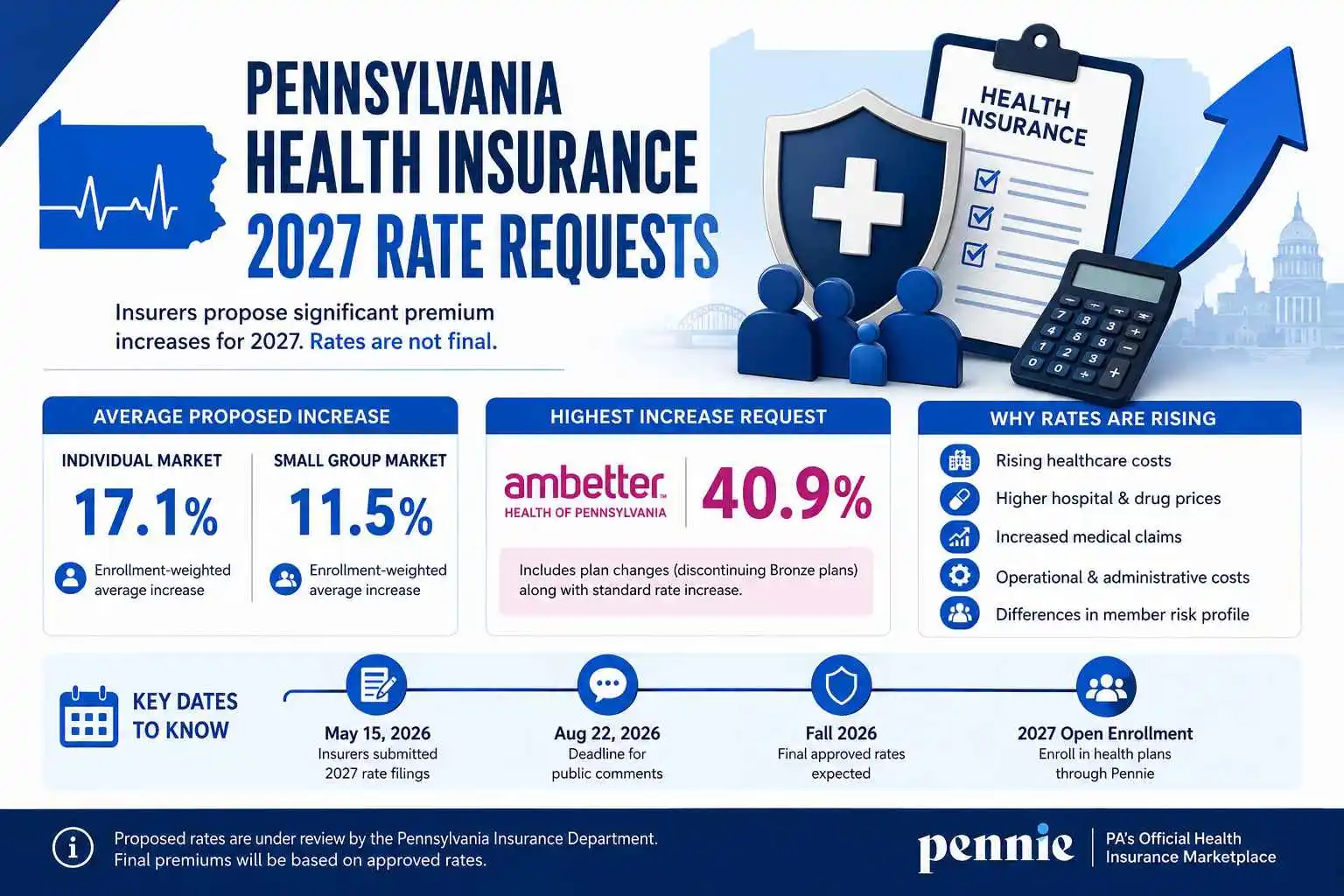
Although the statewide average increase in the individual market is 17.1%, the requests vary considerably from one insurer to another. Some companies are seeking modest double-digit increases, while others have submitted significantly larger adjustments based on their own projected medical costs, claims experience, and business assumptions.
Among the largest proposed increases in the individual market are:
| Insurance Company | Proposed Increase |
|---|---|
| Ambetter Health of Pennsylvania | 40.90% |
| Keystone Health Plan Central | 33.83% |
| Highmark Benefits Group | 21.40% |
| Partners Insurance Company | 20.51% |
| QCC Insurance Company | 19.88% |
| Capital Advantage Assurance | 18.32% |
| Highmark Inc | 16.16% |
| UPMC Health Plan | 15.82% |
| Health Partners Plans | 15.90% |
| Oscar Health Plan | 15.39% |
| Keystone Health Plan East | 14.68% |
| Geisinger Quality Options | 12.95% |
| Geisinger Health Plan | 10.46% |
Several other insurers, including Capital Advantage Assurance, Highmark Inc., UPMC Health Plan, Oscar Health Plan, Health Partners Plans, and Geisinger plans, have also requested premium increases ranging from roughly 10% to 18%.
Ambetter’s proposed 40.90% increase stands out as the largest request, but the filing includes more than a traditional annual premium adjustment. According to the Pennsylvania Insurance Department, approximately 23.44 percentage points reflect the standard Silver-to-Silver premium increase, while the remaining 17.46 percentage points are tied to the company’s decision to discontinue its Bronze plans.
That means the headline figure should not be viewed as a straightforward premium increase for every existing member. Instead, part of the change reflects a product transition, with current Bronze plan members expected to have access to Bronze plans offered by other insurers.
The Small Group Market also shows notable differences between insurers. While the overall requested increase averages 11.5%, several carriers have filed substantially higher adjustments than others.
The largest proposed small group increases include:
| Insurance Company | Proposed Increase |
|---|---|
| UnitedHealthcare Insurance Company | 33.57% |
| Keystone Health Plan Central | 20.93% |
| Highmark Care Benefits | 19.95% |
| Highmark Benefits Group | 16.99% |
| Capital Advantage Assurance | 16.11% |
| Highmark Inc | 15.57% |
| UPMC Health Plan | 15.54% |
| Highmark Coverage Advantage | 14.63% |
| Highmark Senior Health | 14.32% |
| UPMC Health Benefits | 12.39% |
| UPMC Health Network | 11.32% |
| Independence Assurance | 8.95% |
| UnitedHealthcare of PA | 8.00% |
| Keystone Health Plan East / AmeriHealth | 6.48% |
| Geisinger Quality Options | 4.05% |
| Geisinger Health Plan | 3.74% |
At the other end of the spectrum, Geisinger Health Plan requested one of the smallest increases at 3.74%, highlighting how pricing strategies differ across insurers.
One filing also includes an important technical adjustment. UnitedHealthcare of Pennsylvania’s proposed 8% increase reflects not only its annual rate adjustment but also the planned mapping of certain Gold and Silver Small Group plans into Bronze plans. Because of that transition, the reported percentage does not represent a simple year-over-year premium increase alone.
Pennsylvania Insurance Commissioner Michael Humphreys acknowledged that the proposed increases are higher than expected and said rising healthcare costs remain the primary factor behind many of the requests. He emphasized that the department’s responsibility is to conduct a detailed review of every filing before any premium changes are approved.
Rather than accepting insurers’ requests automatically, the Pennsylvania Insurance Department evaluates whether proposed rates are excessive, inadequate, or unfairly discriminatory. Only after that actuarial review is completed will final premium rates be approved for the 2027 plan year.
Why Are Health Insurance Premiums Increasing?
The proposed increases reflect a broader rise in healthcare spending rather than a single pricing decision by insurers. According to the Pennsylvania Insurance Department, insurers calculate their requested premiums using projected medical claims, hospital and physician costs, prescription drug spending, and the expected cost of covering members during the 2027 plan year.
Insurance Commissioner Michael Humphreys said rising healthcare costs remain the primary reason behind the higher requests. However, those requests are only the starting point of the review process. Before any premiums become final, the department will determine whether each filing is reasonable, actuarially supported, and fair to consumers.
Every insurer also has a different mix of members, provider contracts, prescription drug costs, and claims history. That is why two companies selling similar health plans can request very different premium increases in the same state.
Why Do Some Insurers Request Much Larger Increases?
One question many consumers ask is why one insurer requests a 40% increase while another requests less than 10%.
The answer is that every insurer manages a different risk pool. Companies covering more members with expensive medical conditions or higher claims may need larger premium adjustments. Provider reimbursement agreements, specialty drug costs, administrative expenses, and changes to plan designs can also significantly affect pricing.
This helps explain why Ambetter Health of Pennsylvania requested the largest increase in the individual market, while Geisinger Health Plan requested one of the smallest.
You may also find these related health insurance stories helpful:
- Trump Ends Medicare Part D Subsidy: What It Means for 2027 Medicare Drug Costs
- Humana to Exit Medicare Advantage Plans in 2027
- Healthcare Costs Push Consumer Confidence Down as Medical Bills Rise
- Hawaii Family Health Insurance Costs Rise 50% Over 10 Years: Report
- Healthcare Costs Push Consumer Confidence Down as Medical Bills Continue to Rise
Premiums Can Also Vary by Age
Even after the Pennsylvania Insurance Department approves the final rates, not every consumer will pay the same monthly premium.
Under Affordable Care Act (ACA) rules, age is one of the factors insurers may use when calculating premiums. In general, younger adults pay lower premiums because they are statistically expected to use fewer healthcare services, while older adults often pay more.
Federal rules also place limits on age-based pricing. For ACA-compliant health plans, a 64-year-old generally cannot be charged more than three times the premium of a 21-year-old for the same plan. This nationwide 3:1 age-rating limit is designed to balance affordability with insurers’ expected healthcare costs.
Besides age, premiums may also vary based on where a person lives, household size, tobacco use (where permitted), and the specific health plan selected.
Plan Availability Depends on Where You Live
Not every insurer offers coverage across all parts of Pennsylvania.
The state is divided into nine health insurance rating areas, and insurance companies choose where they will participate. As a result, consumers in one county may have different insurer options than those living elsewhere.
Pennsylvania also directs consumers to CMS guidance for county-by-county rating area information, helping residents identify which insurers and plans are available in their location.
Public Comments Are Open Until August 22
The Pennsylvania Insurance Department is inviting residents to comment on the proposed premium increases before completing its review.
Consumers can submit feedback by email through August 22, 2026. Public comments become part of the department’s evaluation before final premium rates are approved.
What Happens Next?
After reviewing insurer filings, actuarial data, and public comments, the Pennsylvania Insurance Department will publish its final approved premium rates in Fall 2026.
Those approved rates—not the preliminary requests released today—will determine what consumers actually pay during the 2027 plan year.
Individuals and families buying their own coverage will then be able to compare plans during Pennie’s 2027 Open Enrollment, Pennsylvania’s official health insurance marketplace. Outside the enrollment window, consumers generally need a qualifying life event, such as losing employer coverage, getting married, having a child, or other eligible circumstances, to enroll or change plans.
The Bottom Line
Pennsylvania’s proposed 2027 health insurance rate filings suggest another year of rising healthcare costs, with insurers requesting an average 17.1% premium increase in the individual market and 11.5% in the small group market. While one insurer has requested an increase of 40.90%, that figure is partly driven by changes to its product lineup rather than a standard year-over-year premium increase.
For now, these are proposed rates—not final prices. The Pennsylvania Insurance Department will continue reviewing every filing, accept public comments through August 22, and publish approved rates in Fall 2026. Consumers should wait for the final decisions before comparing plans on Pennie and selecting coverage for 2027.
Official Sources
- Pennsylvania Insurance Department (PID)
- Pennie – Pennsylvania’s Official Health Insurance Marketplace
- Centers for Medicare & Medicaid Services (CMS)
- U.S. Department of Health and Human Services (HHS)
Frequently Asked Questions
Are Pennsylvania’s 2027 health insurance premiums final?
No. The current figures are proposed rate filings. The Pennsylvania Insurance Department is still reviewing them before issuing final approved premiums.
What is the average proposed increase for 2027?
The enrollment-weighted average proposed increase is 17.1% for the Individual Market and 11.5% for the Small Group Market.
Why is Ambetter requesting a 40.90% increase?
Part of the increase reflects normal premium adjustments, while another portion is linked to the company’s decision to discontinue Bronze plans, making the overall request appear larger.
Why do insurers request different premium increases?
Each insurer has different medical claims, provider contracts, prescription drug costs, operating expenses, and member risk profiles, resulting in different premium requests.
Can my premium be different from someone else’s?
Yes. Premiums may vary based on factors such as age, rating area, household composition, tobacco use (where allowed), and the plan you choose.
When can I enroll in 2027 health coverage?
Consumers can enroll during Pennie’s 2027 Open Enrollment after the Pennsylvania Insurance Department publishes the final approved premium rates.


