









Six years after the No Surprises Act was signed into law, Congress is once again debating whether the legislation needs major changes. While the law has largely succeeded in protecting patients from unexpected medical bills, lawmakers, insurers, and physician groups now disagree over the federal arbitration system that decides payment disputes between insurers and out-of-network providers.

The debate has intensified after arbitration claims climbed far beyond what Congress originally expected, turning what was designed as a patient-protection measure into one of the biggest healthcare payment disputes in Washington.
A law that solved one problem but created another
Congress passed the No Surprises Act in 2020, and then-President Donald Trump signed it into law with a simple goal: stop patients from receiving unexpected medical bills after emergency care or treatment from out-of-network providers at in-network facilities.
For millions of Americans, that goal has largely been achieved. Patients are now protected from most surprise medical bills and, in many cases, are no longer caught in payment disputes between hospitals, physicians, and insurance companies.
But while patients have largely been removed from the middle of those disputes, disagreements over who should ultimately pay the bill have shifted behind the scenes.
Arbitration system now under growing pressure
Instead of billing patients, insurers and healthcare providers now try to negotiate payment directly. If they cannot reach an agreement within 30 days, the case moves into the federal Independent Dispute Resolution (IDR) process.
Under this system, both sides submit a final payment offer to an independent arbitrator. The arbitrator must choose one offer—not create a compromise—using a process often compared with Major League Baseball salary arbitration.
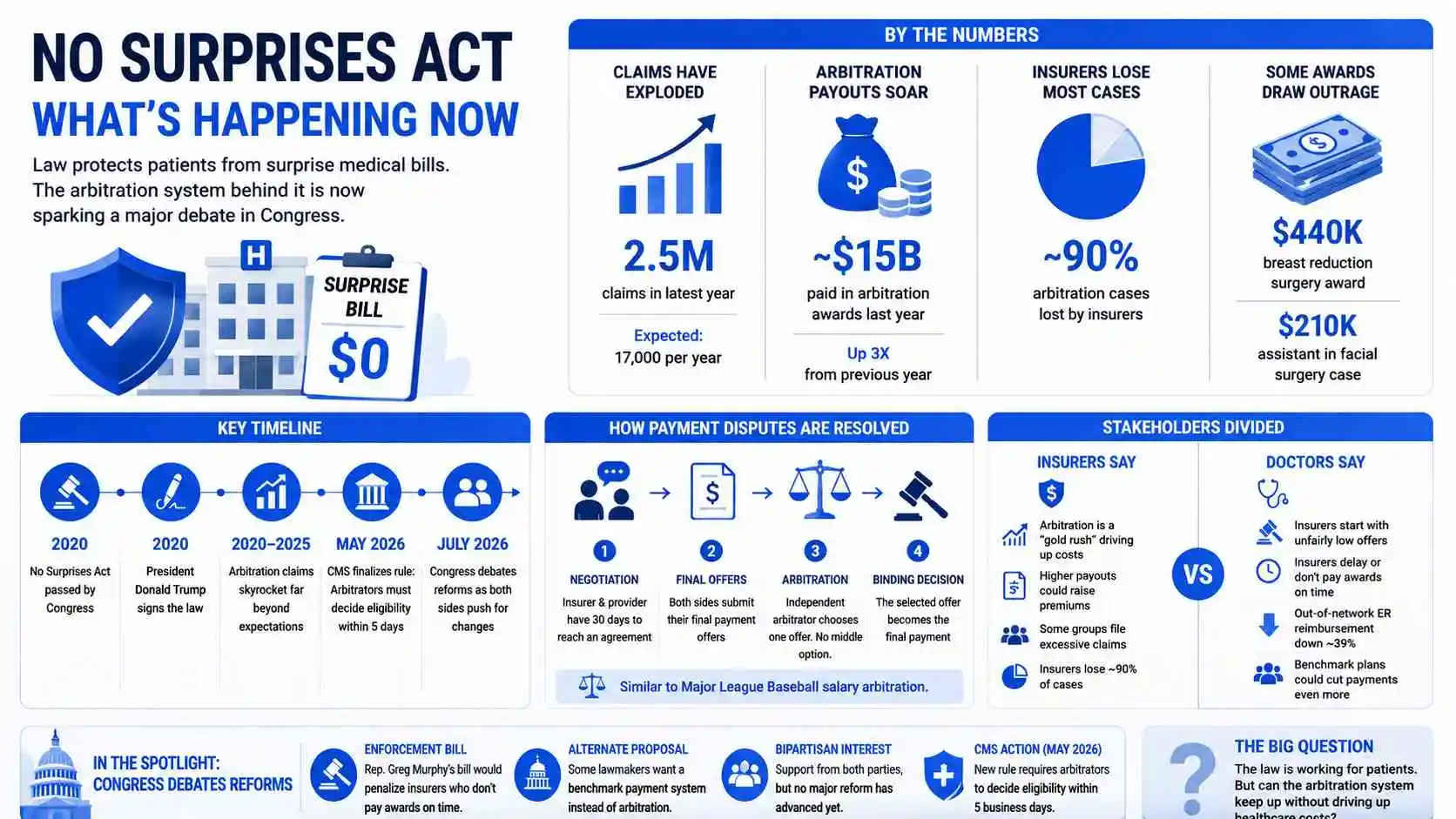
When Congress created the system, it estimated that roughly 17,000 arbitration cases would be filed each year.
The reality has been dramatically different.
Federal data show roughly 1.5 million cases were filed one year, followed by approximately 2.5 million disputes the next year, overwhelming the arbitration process and raising questions about whether the system can continue operating in its current form.
Multi-billion-dollar payouts fuel criticism
The surge in arbitration has also pushed payment awards sharply higher.
According to federal data analyzed by The Wall Street Journal, arbitration awards reached roughly $15 billion last year as more payment disputes entered the system.
Some individual decisions have also attracted attention because of the size of the awards.
One arbitration decision reportedly awarded about $440,000 for a breast reduction surgery—far above the procedure’s typical cost. Another case involved an assistant surgeon receiving an award of about $210,000, while the lead surgeon in the same operation received a much smaller payment.
Those examples have become part of a broader political debate over whether the arbitration system is producing payment decisions that go beyond what Congress originally intended.
Insurers say the system is driving higher costs
Health insurers argue the arbitration process now favors healthcare providers.
Industry groups say insurers lose nearly 90% of arbitration cases, forcing companies to make substantially higher out-of-network payments than expected. They warn those costs could eventually translate into higher health insurance premiums for employers and consumers.
AHIP, the nation’s largest health insurance trade association, has described the current arbitration process as a “gold rush” and is urging Congress to rewrite parts of the law.
Doctors say insurers are creating a different problem
Physician groups reject the insurers’ criticism and argue the bigger issue is that many insurance companies continue to underpay or delay payments for out-of-network emergency care.
The Emergency Department Practice Management Association (EDPMA) says out-of-network reimbursement for emergency services has fallen by about 39% since the law took effect. The American Medical Association (AMA) has also backed concerns that some insurers are not negotiating claims in good faith.
Doctors also argue that winning an arbitration case does not always guarantee prompt payment, creating additional financial pressure for medical practices.
Congress is split over how to fix the law
The growing dispute has now reached Capitol Hill.
Representative Greg Murphy (R-N.C.), a practicing urological surgeon, introduced the No Surprises Act Enforcement Act, which would impose tougher penalties on insurers that fail to pay arbitration awards on time.
Murphy has described the issue as nonpartisan, saying Congress needs to fix problems that have emerged since the law took effect.
His proposal has also received support from Representative Raul Ruiz (D-Calif.), while Senator Roger Marshall (R-Kan.) is leading similar efforts in the Senate.
At the same time, Senate Health Committee Chairman Bill Cassidy (R-La.) has begun reviewing the law after hearing repeated complaints that some insurers are not engaging in meaningful payment negotiations.
Despite that bipartisan interest, Murphy’s bill has not advanced in the House, leaving the future of broader reforms uncertain.
You may also find these related health insurance stories helpful:
- Trump Ends Medicare Part D Subsidy: What It Means for 2027 Medicare Drug Costs
- Humana to Exit Medicare Advantage Plans in 2027
- Healthcare Costs Push Consumer Confidence Down as Medical Bills Rise
- Hawaii Family Health Insurance Costs Rise 50% Over 10 Years: Report
- Healthcare Costs Push Consumer Confidence Down as Medical Bills Continue to Rise
- Pennsylvania Health Insurance Rates May Rise 17.1% in 2027 as Some Insurers Seek 40.9% Premium Increase
CMS has already started making changes
While Congress debates legislative changes, the Centers for Medicare & Medicaid Services (CMS) has already moved to improve the arbitration process.
In May 2026, CMS finalized a rule requiring arbitrators to determine within five business days whether a payment dispute is eligible for federal arbitration. The agency says the change is intended to reduce delays as the number of disputes continues to grow.
Several lawmakers, however, argue that administrative changes alone will not solve the underlying problems created by the rapid growth in arbitration cases.
Some lawmakers want a completely different system
Not everyone in Washington believes the current arbitration model should remain.
Some lawmakers have proposed replacing arbitration altogether with a benchmark payment system tied to typical in-network rates. Supporters say such an approach could make payments more predictable and reduce administrative costs.
Physician organizations strongly oppose that idea, arguing insurers could gain too much pricing power and reimburse providers even less than they do today.
Business groups and insurers oppose Murphy’s proposal
The debate has also drawn opposition from employers and the insurance industry.
The Coalition Against Surprise Medical Billing launched an advertising campaign on July 13, 2026, arguing Murphy’s proposal would benefit healthcare providers that aggressively use arbitration.
Major companies, including Microsoft and Dow, have also urged lawmakers to reject the legislation, warning that weakening the current rules could increase healthcare costs for employer-sponsored health plans.
Why this matters for patients
For now, patients remain largely protected from surprise medical bills—the central promise of the No Surprises Act.
The larger question is whether the arbitration system can continue handling millions of payment disputes without driving up healthcare costs or health insurance premiums.
That debate is likely to remain active as Congress weighs competing proposals, insurers push for structural changes, physicians seek stronger enforcement, and CMS continues refining the federal dispute resolution process.
The Bottom Line
The No Surprises Act has largely succeeded in removing patients from surprise billing disputes since it became law in 2020. But six years later, the spotlight has shifted to the federal arbitration system created to settle payment disagreements.
With arbitration claims rising from an expected 17,000 annually to about 2.5 million, payouts reaching roughly $15 billion, and Congress divided over the next step, the focus is no longer on whether patients are protected—it’s on whether the system itself can be sustained without increasing costs across the healthcare system.
Sources
The information in this article is based on official government sources and reputable U.S. news reporting.
- Politico
https://www.politico.com/ - Centers for Medicare & Medicaid Services (CMS)
https://www.cms.gov/ - Congress.gov
https://www.congress.gov/ - American Health Insurance Plans (AHIP)
https://www.ahip.org/
Note: This article is based on publicly available information from official government resources and trusted U.S. news reporting. Details may change as Congress, CMS, or other agencies announce new actions or guidance.
Frequently Asked Questions
Is the No Surprises Act being repealed?
No. The law remains in effect, and patients continue to receive protections against most surprise medical bills. The current debate focuses on the arbitration system used to settle payment disputes between insurers and providers.
Why is Congress discussing changes to the law?
Lawmakers are reviewing the law because arbitration claims have grown from an estimated 17,000 cases per year to millions of filings, creating significant administrative and financial pressures.
Will patients lose their protections?
There is currently no proposal to remove the law’s core patient protections. Most discussions focus on changing how insurers and healthcare providers resolve payment disagreements.
Why are insurers concerned?
Insurers argue that arbitration awards often favor providers, increasing healthcare costs that could eventually contribute to higher insurance premiums.
Why do doctors oppose some reform proposals?
Many physician groups say insurers frequently make low initial payment offers and warn that replacing arbitration with benchmark payment rates could reduce reimbursement for emergency and specialty care.


