









Supply chain insurance has become the fastest-growing commercial insurance priority as businesses face mounting pressure from geopolitical conflicts, shipping disruptions, cyberattacks, and trade restrictions. According to a new GlobalData survey, 41.1% of industry respondents identified supply chain insurance as the commercial insurance product expected to see the strongest demand, placing it well ahead of cyber insurance, which ranked second at 20.6%.

The findings reflect a significant shift in corporate risk management. Instead of focusing only on protecting buildings or equipment, companies are increasingly trying to protect the movement of goods, supplier networks, and business continuity.
Why this story matters
The biggest business risk in 2026 is no longer limited to physical damage. Many companies now face financial losses because suppliers fail to deliver, shipping routes become unavailable, governments impose new trade restrictions or cyberattacks interrupt logistics operations.
Events across the Red Sea, the Suez Canal, the Strait of Hormuz, and Eastern Europe have demonstrated how a single disruption can delay production, increase transportation costs and interrupt global supply chains. Businesses are therefore placing greater value on insurance products designed specifically for these external risks.
The GlobalData survey highlights growing demand
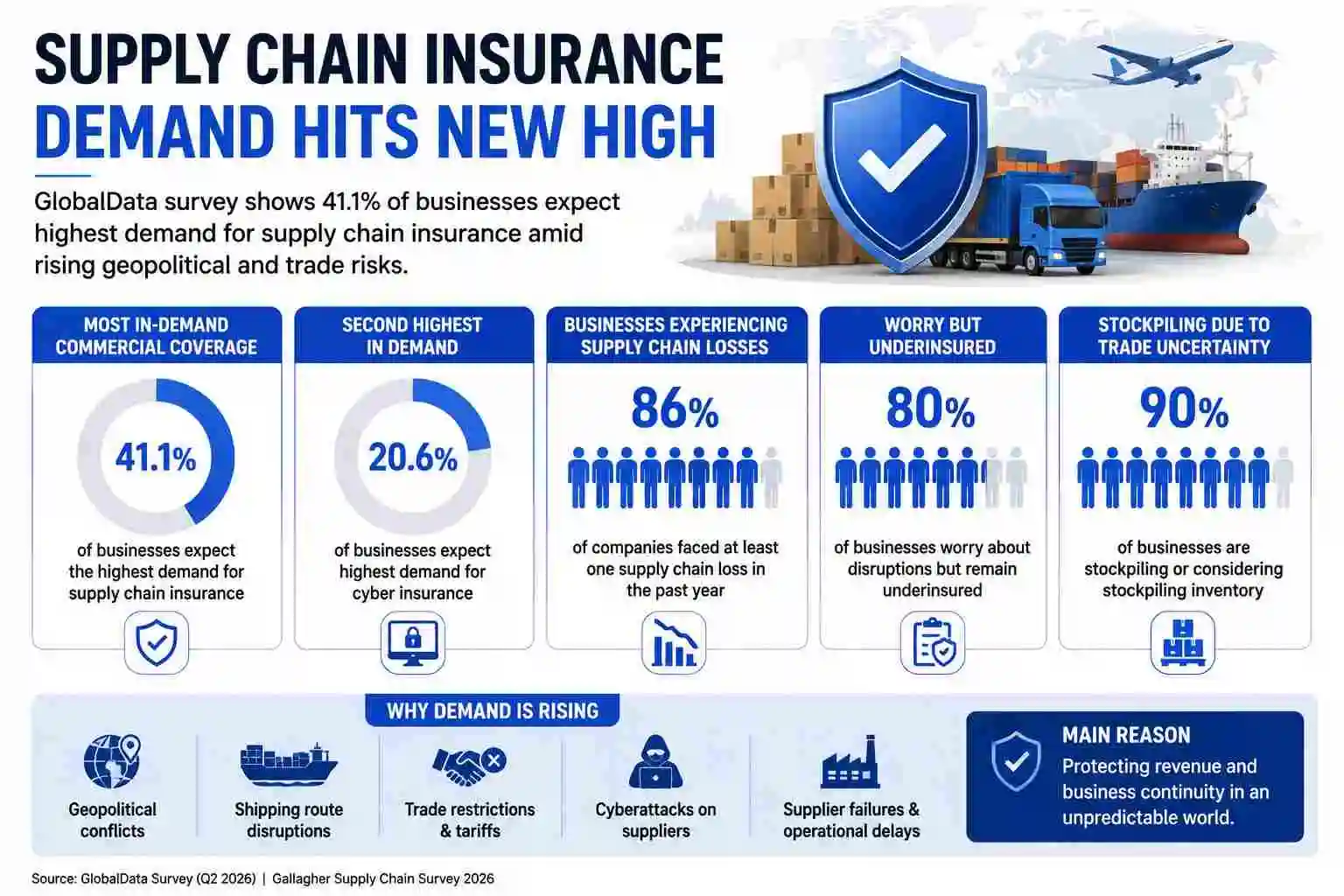
GlobalData’s second-quarter 2026 survey of insurance professionals found that supply chain insurance is now viewed as the most important commercial insurance product during periods of geopolitical uncertainty.
Cyber insurance ranked second in expected demand, while specialist transport and direct asset protection products received significantly less interest. This suggests businesses are more concerned about maintaining operations than simply protecting physical assets.
According to GlobalData, companies increasingly fear revenue losses caused by supplier failures, trade route disruptions and sanctions rather than traditional property damage alone.
Why companies are buying more supply chain insurance
The global business environment has become more unpredictable over the past two years.
Trade disputes continue to reshape international supply networks. Shipping companies have repeatedly rerouted vessels away from high-risk regions. Governments have introduced new tariffs, export controls and sanctions with little warning. At the same time, cyberattacks targeting logistics providers and suppliers have increased operational risks.
For many businesses, these events create losses even when their own offices, factories or warehouses remain completely undamaged.
That shift explains why supply chain insurance is moving from an optional product to an important component of enterprise risk management.
What supply chain insurance actually covers
Unlike traditional business interruption insurance, supply chain insurance is designed to protect businesses when disruptions occur outside their own premises.
Coverage can include lost income after supplier failures, additional costs for emergency transportation, higher expenses when sourcing alternative suppliers, and contingent business interruption losses resulting from disruptions affecting third-party manufacturers or logistics providers.
Some policies also extend protection to non-physical events such as government trade restrictions, labor strikes, cyber incidents or transportation bottlenecks, depending on policy wording.
Businesses are experiencing more disruption than ever
The growing demand is supported by broader industry data.
Gallagher’s 2026 global supply chain survey found that 86% of businesses experienced at least one supply chain loss during the past year, while nearly 80% said they remain concerned that major disruptions are not fully insured.
The survey also showed that 90% of companies are either stockpiling inventory or considering doing so as geopolitical uncertainty and tariff disputes continue to affect global trade.
These findings suggest companies are not only buying more insurance but are also redesigning their supply chain strategies to improve resilience.
The challenge facing insurers
Although demand continues to grow, insurers are becoming more selective about the risks they are willing to cover.
GlobalData notes that many insurers are tightening policy wording, adding exclusions related to sanctions and tariffs, and limiting available underwriting capacity because geopolitical risks are becoming increasingly difficult to quantify.
Instead of expanding coverage broadly, insurers are focusing on more detailed risk assessments before accepting complex international supply chain exposures.
Technology is changing risk assessment
Insurance companies are increasingly using real-time data to evaluate supply chain risks more accurately.
Advanced geospatial monitoring, digital mapping of supplier networks, artificial intelligence and predictive analytics are helping insurers identify hidden dependencies across global supply chains.
These technologies allow underwriters to understand how disruptions in one country could affect manufacturers, distributors and customers across multiple continents.
Geopolitical risk is reshaping insurance priorities
Industry research from Allianz also shows that political violence and war have become major business concerns worldwide.
As conflicts and trade restrictions become more common, companies are placing greater emphasis on protecting business continuity rather than only insuring physical assets.
For multinational businesses, supply chain disruption is now closely connected with business interruption, political violence, cyber risk and operational resilience.
What businesses are doing next
Insurance is becoming only one part of a broader risk management strategy.
Many organizations are diversifying suppliers, moving production closer to end markets through nearshoring and friendshoring, increasing inventory buffers and investing in technology that provides better visibility across global supply networks.
The objective is to reduce dependence on a single supplier or transportation route while improving the ability to respond quickly when disruptions occur.
The Bottom Line
GlobalData’s latest survey highlights a major shift in commercial insurance priorities. As geopolitical conflicts, trade restrictions, and supply chain disruptions become more frequent, businesses are placing greater emphasis on protecting revenue and operational continuity rather than only physical assets. While demand for supply chain insurance continues to rise, insurers are responding with tighter underwriting standards, making comprehensive risk planning more important than ever.
Frequently Asked Questions
What is supply chain insurance?
Supply chain insurance protects businesses against financial losses caused by disruptions involving suppliers, logistics providers or distribution networks.
Why is demand for supply chain insurance increasing?
Demand is rising because geopolitical conflicts, trade restrictions, cyberattacks and shipping disruptions are increasing operational risks for businesses worldwide.
How is supply chain insurance different from business interruption insurance?
Traditional business interruption insurance usually requires physical damage to the insured business, while supply chain insurance can cover disruptions affecting suppliers or logistics partners, depending on the policy.
What did the GlobalData survey find?
GlobalData reported that 41.1% of respondents expect supply chain insurance to see the highest demand among commercial insurance products, ahead of cyber insurance at 20.6%.
Which industries benefit most from supply chain insurance?
Manufacturing, retail, automotive, healthcare, electronics, energy, and logistics businesses often benefit because they depend heavily on complex supplier networks and international trade.
Why are insurers tightening supply chain insurance coverage?
Many insurers are adding stricter policy wording and exclusions because geopolitical risks, sanctions, and trade disruptions have become more difficult to predict and price accurately.


