









The U.S. Department of Justice (DOJ) has secured another major Medicare Advantage fraud settlement, with Florida-based Complete Health agreeing to pay $14.1 million to resolve allegations that it improperly submitted diagnosis codes to increase Medicare Advantage payments.
The case is significant because it focuses on HCC coding, the risk-adjustment system that determines how much the federal government pays private Medicare Advantage plans for enrolled beneficiaries. The settlement also signals that federal investigators are increasingly targeting coding practices that allegedly inflate Medicare payments.
What happened?
According to the DOJ, Complete Health Partners Holdings agreed to pay $14,100,000 to resolve allegations that it violated the False Claims Act between 2020 and 2023.
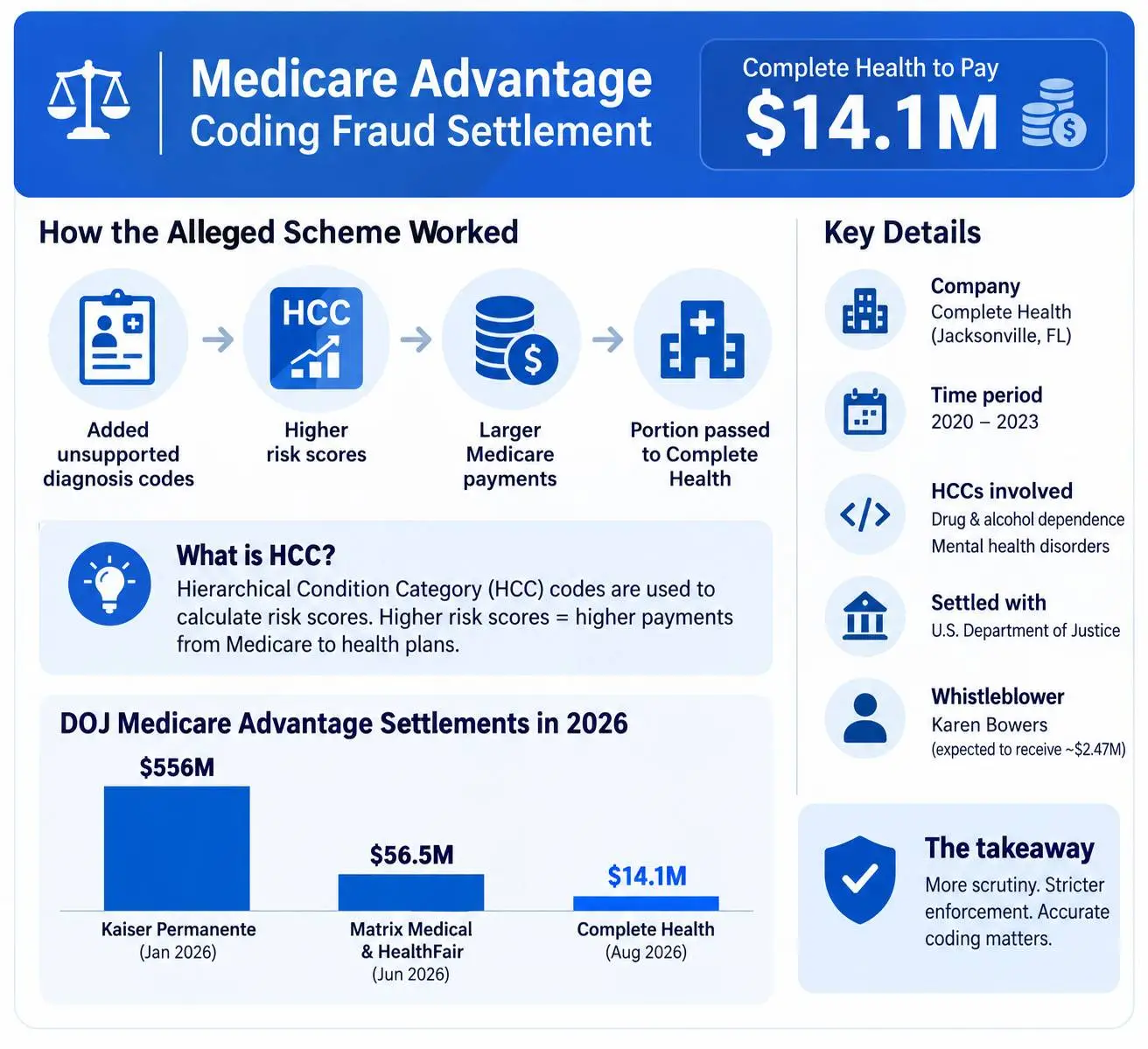
Federal authorities alleged that the company submitted diagnosis codes that were not clinically valid, not properly supported by medical records, or not considered in the patient’s treatment. The allegations involved diagnoses related to drug and alcohol dependence and major depressive, bipolar, and paranoid disorders.
The settlement resolves the government’s claims, and there was no determination of liability.
Why HCC coding matters
Medicare Advantage plans receive a fixed monthly payment from the Centers for Medicare & Medicaid Services (CMS) for each enrolled beneficiary. Those payments are adjusted using the Hierarchical Condition Category (HCC) risk-adjustment model.
In simple terms, beneficiaries with more serious medical conditions generally generate higher risk scores, which can result in higher Medicare payments to the health plan. Because of that system, accurate diagnosis coding is critical.
If unsupported diagnosis codes are added to a patient’s record, the risk score may increase, leading to larger payments from CMS.
How Medicare Advantage Payments Work
Medicare Advantage plans receive monthly payments from the Centers for Medicare & Medicaid Services (CMS).
Those payments are adjusted based on the health conditions reported for each patient.
In simple terms:
More serious documented conditions → Higher risk score → Higher Medicare payment
To calculate those payments, CMS uses a system known as Hierarchical Condition Categories (HCCs).
The HCC model is designed to ensure that plans caring for sicker patients receive more funding than plans serving healthier populations.
The system works well when diagnoses accurately reflect a patient’s medical condition.
Problems arise when diagnoses are reported without sufficient clinical support.
The Two HCC Categories at the Center of the Case
Federal investigators specifically focused on:
HCC 55
Drug and Alcohol Dependence
HCC 59
Major Depressive, Bipolar and Paranoid Disorders
According to the settlement agreement, the government contends that some diagnoses within these categories were unsupported by medical records or were not actively managed as part of patient care.
Because those conditions can increase risk scores, they can also increase Medicare payments.

What DOJ alleges Complete Health did
Federal investigators claim that Complete Health had a financial incentive to increase patients’ risk scores because its compensation was tied to Medicare Advantage payments received by affiliated health plans.
The DOJ alleges that company coders reviewed medical records, identified additional diagnosis codes, and encouraged physicians to add HCC diagnoses even when those diagnoses were unsubstantiated or not clinically justified.
According to the government, those diagnosis codes increased Medicare payments, and a portion of those additional payments was passed to Complete Health through its risk-sharing arrangements.
Why this settlement is important
This case is not just about one company. It reflects a broader federal effort to examine how diagnosis codes are generated, documented, and submitted in the Medicare Advantage program.
DOJ officials said the settlement is intended to protect taxpayer money and ensure that Medicare payments are based on accurate and truthful medical information.
HHS Office of Inspector General officials also emphasized that Medicare Advantage exists to provide necessary care to beneficiaries, not to create opportunities for improper financial gain.
The bigger DOJ enforcement trend
The Complete Health settlement is part of a larger pattern of Medicare Advantage enforcement actions in 2026.
Earlier this year, Kaiser Permanente affiliates agreed to a $556 million settlement involving alleged unsupported diagnosis codes. In June, Matrix Medical Network and HealthFair agreed to pay $56.5 million over allegations involving diagnostic coding generated through in-home assessments and screenings.
The August Complete Health settlement continues that trend and suggests that DOJ scrutiny is expanding beyond large insurers to include provider groups, management organizations, coding operations, and risk-adjustment vendors.
The case was brought under the qui tam, or whistleblower, provisions of the False Claims Act by Karen Bowers, a former Associate Director of Risk Adjustment at VIVA Health.
Under federal law, whistleblowers who help recover government funds may receive a portion of the settlement. In this case, Bowers is expected to receive approximately $2.47 million from the federal recovery.
The DOJ has repeatedly stated that whistleblower cases remain one of its strongest tools for identifying fraud involving federal health care programs.
You may also find these related health insurance stories helpful:
- Trump Ends Medicare Part D Subsidy: What It Means for 2027 Medicare Drug Costs
- DOJ Expands Health Care Fraud Crackdown: What the New Philadelphia Strike Force Means
- Humana to Exit Medicare Advantage Plans in 2027
- Hawaii Family Health Insurance Costs Rise 50% Over 10 Years: Report
- Pennsylvania Health Insurance Rates May Rise 17.1% in 2027 as Some Insurers Seek 40.9% Premium Increase
What this means for Medicare Advantage providers
The settlement sends a clear message to organizations involved in Medicare Advantage coding and risk adjustment.
Provider groups, coding companies, chart-review vendors, and organizations that participate in risk-sharing arrangements are likely to face increased scrutiny regarding:
- Clinical documentation supporting diagnoses
- Physician coding guidance
- Risk-adjustment audits
- Medical record validation
- HCC coding practices
Organizations that cannot demonstrate that diagnosis codes are supported by patient records and clinical treatment may face significant financial and legal exposure.
What Medicare beneficiaries should know
The settlement does not change Medicare benefits or Medicare Advantage coverage for beneficiaries.
Instead, the case focuses on how health plans and affiliated providers report medical conditions to CMS. The government’s concern is that inaccurate coding can result in improper Medicare payments, increasing costs for taxpayers and potentially affecting the integrity of the Medicare Advantage program.
The Bottom Line
The Complete Health settlement is the latest indication that Medicare Advantage risk-adjustment enforcement is becoming a major DOJ priority. By focusing on HCC coding, clinical documentation, and unsupported diagnoses, federal authorities are increasing pressure on organizations that participate in Medicare Advantage payment systems.
For providers, insurers, and coding organizations, the message is increasingly clear: accurate documentation and clinically supported diagnosis coding are no longer just compliance issues—they are major federal enforcement priorities.
Sources
1. U.S. Department of Justice (Official Press Release)
Article: Medicare Advantage Provider Complete Health to Pay $14,100,000 to Settle False Claims Act Suit
2. Fierce Healthcare Industry News & Policy
Reference: Complete Health to pay $14.1M in Medicare Advantage coding misuse allegations settlement
FAQ
What did Complete Health agree to pay?
Complete Health agreed to pay $14.1 million to resolve False Claims Act allegations involving Medicare Advantage diagnosis coding. The settlement does not include an admission of liability.
Why did the DOJ investigate Complete Health?
According to the Department of Justice, the company allegedly submitted diagnosis codes that were not clinically supported or properly documented, increasing Medicare Advantage risk-adjusted payments.
What is Medicare Advantage?
Medicare Advantage (Medicare Part C) is private health insurance approved by Medicare. Private insurers receive monthly payments from CMS based partly on the health conditions reported for enrolled members.
What are HCC diagnosis codes?
Hierarchical Condition Category (HCC) codes are used by CMS to estimate a patient’s expected healthcare costs. More serious documented conditions generally result in higher Medicare payments to health plans.
Did Complete Health admit wrongdoing?
No. The settlement resolves the allegations without a determination of liability.
Why is this settlement important?
The case highlights the DOJ’s increasing focus on Medicare Advantage risk adjustment, diagnosis coding accuracy, and protecting taxpayer-funded healthcare programs from fraud.
Are more Medicare Advantage investigations expected?
Yes. Federal officials have made Medicare Advantage fraud enforcement a major priority, with several large False Claims Act settlements announced during 2026.


