









Public actuarial filings unsealed by the Arizona Department of Insurance and Financial Institutions (DIFI) reveal that health insurers operating on the state’s Affordable Care Act (ACA) Marketplace are pursuing massive rate adjustments for the 2027 plan year. Six of the seven participating carriers have submitted requests for double-digit price increases, pushing the overall state average requested increase to approximately 25%.
The filing disclosures mark the beginning of a critical regulatory evaluation window ahead of the upcoming Open Enrollment season. Following the recent exit of major carriers like Cigna from Arizona’s individual market, these requested adjustments reflect severe underlying shifts in market risk pools, federal subsidy structures, and healthcare provider reimbursement costs across the state.
Carrier-by-Carrier Breakdown: Proposed 2027 Rate Adjustments
The actuarial filings show a wide range of requested rate adjustments among Arizona’s ACA Marketplace insurers. Proposed changes for individual Marketplace plans range from 3.26% to 33.90%.
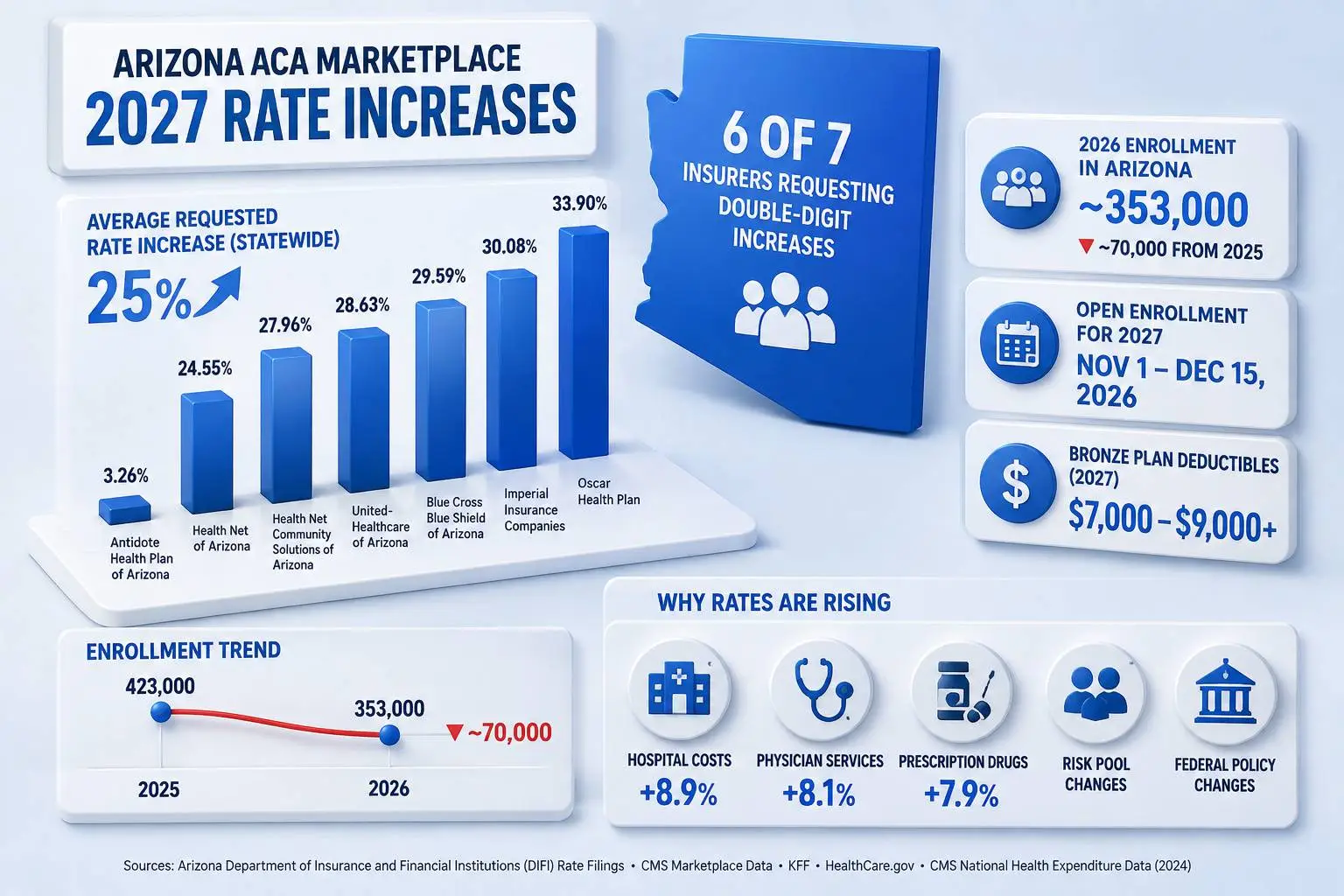
Oscar Health Plan, Inc. submitted the largest requested increase at 33.90%, followed by Imperial Insurance Companies at 30.08%. Blue Cross and Blue Shield of Arizona requested a 29.59% increase, while UnitedHealthcare of Arizona requested 28.63%.
Health Net Community Solutions of Arizona requested a 27.96% increase, and Health Net of Arizona requested 24.55%. Antidote Health Plan of Arizona is the clear outlier, requesting a much smaller 3.26% increase.
| Health Insurance Carrier | Proposed 2027 Rate Increase |
|---|---|
| Oscar Health Plan, Inc. | 33.90% |
| Imperial Insurance Companies, Inc. | 30.08% |
| Blue Cross and Blue Shield of Arizona | 29.59% |
| UnitedHealthcare of Arizona | 28.63% |
| Health Net Community Solutions of Arizona | 27.96% |
| Health Net of Arizona | 24.55% |
| Antidote Health Plan of Arizona | 3.26% |
The spread between the smallest and largest requests is significant. While Antidote Health is seeking an increase of just over 3%, Oscar’s request is more than ten times larger.
That variation also shows why the statewide average does not necessarily represent what an individual consumer will see when 2027 plans are finalized. Actual premiums will depend on the insurer, plan, age, location, household circumstances and available financial assistance.
Arizona’s ACA Marketplace Enrollment Has Declined
The proposed rate increases come after a notable decline in Arizona ACA Marketplace enrollment.
CMS reported 357,144 Marketplace plan selections in Arizona during the 2026 Open Enrollment Period. A later enrollment figure cited in Arizona health coverage reporting put 2026 enrollment at about 353,000, compared with approximately 423,000 in 2025.
That represents a decline of roughly 70,000 people in one year.
The enrollment change followed the expiration of the enhanced federal premium tax credits at the end of 2025. Those enhanced subsidies had helped reduce the monthly cost of Marketplace coverage for many households.
The effect of that change is important for insurers because the number of people enrolled is only one part of the equation. The health profile of the people who remain in the market can also influence future premiums.
Real-World Consumer Impact & Plan Downgrades
When faced with 25%+ rate increases, many consumers attempt to maintain an affordable monthly budget by downgrading plan tiers—moving from a Silver plan to a Bronze plan.
While switching to a Bronze plan keeps the monthly premium manageable, it introduces significant financial trade-offs. Bronze plans feature substantially higher annual deductibles ($7,000 to $9,000+) and higher out-of-pocket maximums. Consumers who downgrade lower their fixed monthly bill but take on extreme financial vulnerability if an unexpected accident or severe illness occurs.Arizona Consumers Should Compare Total Costs, Not Just Premiums
When the 2027 plans become available on HealthCare.gov, consumers should look beyond the sticker monthly premium figure. The key metrics that determine total out-of-pocket spending include the annual deductible, out-of-pocket maximum, copayments, coinsurance, prescription formulary coverage, and provider networks.
A plan with a $100 lower monthly premium can easily become more expensive overall if its deductible and cost-sharing requirements are substantially higher. Consumers should also verify whether their primary doctors, specialists, local hospitals, and regular medications remain covered under the plan they are considering.
HealthCare.gov specifically advises Marketplace consumers to update their expected household income and family size information during Open Enrollment. This step is critical because that data directly determines available tax credit savings, which is particularly vital in a year when both base premiums and subsidies are shifting.
Federal Policy Constraints and Disenrollment Drivers
Broader administrative and legislative shifts at the federal level are further compounding Arizona’s risk pool deterioration. Projections from CMS indicate that federal policy modifications could result in up to 2 million individuals dropping ACA coverage nationwide over the coming cycle.
Key policy changes altering the market landscape include tightened eligibility verifications for legal immigrants, the implementation of Medicaid work reporting requirements, and mandates requiring Medicaid recipients to verify eligibility twice a year rather than annually.
Additionally, federal rules have permanently shortened the ACA open enrollment window for 2027 coverage. In Arizona, enrollment will open on November 1, 2026, and close on December 15, 2026—ending a full month earlier than in prior years. This shortened timeframe restricts the window for navigators and brokers to enroll healthier consumers who typically delay sign-ups until final deadlines.
You may also find these related health insurance stories helpful:
- CMS Expands Medicare Joint Replacement Payment Model: What CJR-X Means for Patients and Hospitals
- CMS Autism ABA Toolkit Explained: How States Can Fight Medicaid Fraud and Protect Children
- Medicare Fast-Tracks Breakthrough Devices: How CMS RAPID Pathway Cuts Delays to 60 Days
Rising Medical and Prescription Drug Costs
Rising healthcare costs are putting continued pressure on health insurers as hospitals, physicians, and prescription drug companies charge more for care and treatment. The broader U.S. healthcare market shows how significant that pressure has become. According to the Centers for Medicare & Medicaid Services (CMS), national health expenditures reached $5.3 trillion in 2024, an increase of 7.2% from the previous year.
Hospital care accounted for one of the largest portions of that spending. Hospital expenditures increased 8.9% to $1.63 trillion in 2024, while spending on physician and clinical services rose 8.1% to $1.11 trillion. Those increases mean insurers are facing higher claims costs when members use hospitals, physicians, and other healthcare services.
Prescription drugs are another major source of cost growth. CMS reported that U.S. prescription drug spending increased 7.9% to $467 billion in 2024, following a 10.8% increase in 2023. CMS projects retail prescription drug spending to grow by an average of 5.7% annually from 2025 through 2034, compared with projected annual growth of 5.2% for hospital spending.
For insurers, these rising costs become part of the calculations used when setting future premiums. Higher expected spending on medical services and prescription drugs can translate into higher projected claims costs, particularly when insurers also expect changes in the health profile of their enrolled population. In Arizona, those broader healthcare cost pressures are contributing to the environment in which insurers are seeking substantially higher rates for 2027.
Why the Risk Pool Matters for 2027 Rates
The expiration of the enhanced premium tax credits is one of the major factors influencing the 2027 Marketplace outlook.
When the cost of coverage rises after the loss of enhanced subsidies, healthier consumers who expect to use little medical care may be more likely to reconsider whether they can afford coverage. Consumers with ongoing medical conditions or greater healthcare needs may have stronger reasons to remain insured.
If healthier members leave at a higher rate, the remaining Marketplace population can become more expensive to insure.
Insurers then have to price their plans based on expectations for the medical claims of that remaining population. A smaller and potentially higher-cost risk pool can put additional upward pressure on premiums.
This is one reason the Arizona rate filings cannot be viewed simply as a response to a single increase in healthcare prices. Insurers are also pricing for changes they expect in the composition of their membership during 2027.
Why a Lower Premium May Not Mean Lower Healthcare Costs
If premiums rise sharply, some Arizona consumers may look for ways to reduce their monthly insurance payments.
One option may be moving from a Silver plan to a Bronze plan or choosing another plan with a lower monthly premium.
That can reduce the amount paid each month, but the trade-off can be higher deductibles and greater out-of-pocket exposure when medical care is needed.
Bronze plans can have annual deductibles in the $7,000 to $9,000-plus range, depending on the plan and year. A consumer who chooses a lower-premium plan therefore needs to consider how much they could potentially pay if they require significant medical care during the year.
The better comparison is not simply the monthly premium. Consumers should look at the premium together with the deductible, out-of-pocket maximum, copayments, coinsurance, prescription coverage, and provider network.
The Bottom Line
Arizona ACA insurers are seeking rate increases averaging about 25% for 2027, with six of seven insurers requesting double-digit increases. These are proposed rates, not final premiums, so consumers should compare plans, subsidies, deductibles, and total out-of-pocket costs before choosing coverage.
Sources & References
- KFF — ACA Marketplace enrollment and 2027 insurer participation analysis.
- Centers for Medicare & Medicaid Services — 2026 Marketplace Open Enrollment data.
- HealthCare.gov — Marketplace enrollment dates, plan comparison and renewal guidance.
- Arizona Public Media — Arizona 2027 insurer rate filings and requested increase
Frequently Asked Questions
1. Are Arizona health insurance premiums definitely going up 25% in 2027?
No. Insurers are requesting rate increases, and the reported Arizona average is around 25%, but those requests are not final approved premiums. Regulators can modify the requested rates before plans are finalized.
2. Which Arizona ACA insurer is requesting the largest increase?
Among the seven insurers listed in the current filings, Oscar Health Plan has requested the largest increase at 33.90%, followed by Imperial Insurance Companies at 30.08%.
3. Which Arizona insurer requested the smallest increase?
Antidote Health Plan of Arizona requested a 3.26% increase, substantially below the requests made by the other insurers in the filing data.
4. How many Arizona insurers are requesting higher rates for 2027?
Six of the seven insurers listed in the Arizona individual ACA market are requesting increases of roughly 25% or more. Antidote Health is the notable exception with a 3.26% request.
5. Why are Arizona health insurers requesting higher rates?
The filings reflect pressure from higher medical costs, prescription drug spending and changes in the expected health profile of the Marketplace population. Enrollment declines can also affect insurers’ expectations about the risk pool.
6. Will everyone in Arizona pay 25% more for health insurance?
No. The insurer’s requested rate change is not the same as the amount an individual consumer will pay. Premium tax credits, income, age, location, and plan selection can substantially change the final monthly cost.
7. How many people enrolled in Arizona ACA plans for 2026?
CMS reported 357,144 Arizona Marketplace plan selections in its 2026 Open Enrollment data. Other later reporting put the figure at about 353,000, compared with roughly 423,000 in 2025.
8. When does ACA Open Enrollment begin and end in Arizona for 2027 coverage?
Arizona’s 2027 ACA Marketplace Open Enrollment period is scheduled to run from November 1 through December 15, 2026. Consumers who enroll by December 15 can generally have coverage start on January 1, 2027. Arizona uses the federal HealthCare.gov Marketplace, where the shortened Open Enrollment schedule applies beginning with the 2027 plan year.
9. Should Arizona consumers automatically renew their current plan?
Not necessarily. HealthCare.gov recommends reviewing available plans, prices, savings, and coverage each year because plans and costs can change.
10. Could a cheaper ACA plan have higher out-of-pocket costs?
Yes. A plan with a lower monthly premium can have a higher deductible, copayments, coinsurance, or other cost-sharing requirements. Consumers should compare total potential annual costs rather than looking only at the monthly premium.


