









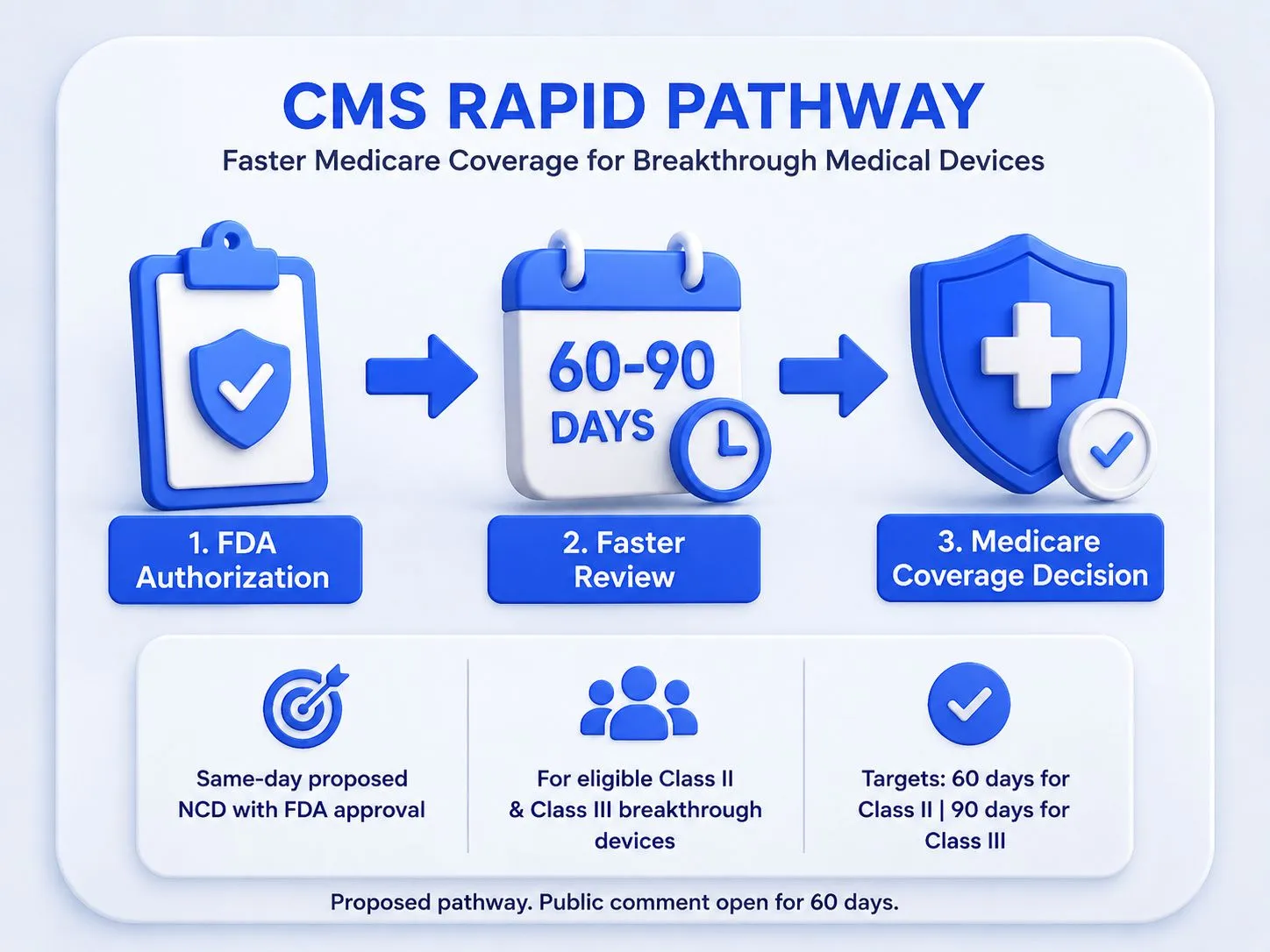
The Centers for Medicare & Medicaid Services (CMS) issued a formal proposed procedural notice (CMS-3487-NC) introducing the Regulatory Alignment for Predictable and Immediate Device (RAPID) coverage pathway. Developed jointly with the U.S. Food and Drug Administration (FDA), this initiative coordinates federal evidence reviews during premarket clinical trials.
Historically, patients faced a median delay of nearly six years between FDA market clearance and nationwide Medicare coverage for novel health technologies. Under the RAPID framework, CMS publishes a proposed National Coverage Determination (NCD) on the exact same day the FDA authorizes a participating breakthrough device, enabling full Medicare payment within 60 to 90 days.

Why Federal Agencies Combined Their Review Process
In the past, the FDA evaluated whether a medical device was safe and effective for the general public, while CMS independently evaluated whether the technology was “reasonable and necessary” specifically for senior citizens and Medicare beneficiaries. Medical device manufacturers had to complete clinical trials for the FDA first and then spend years gathering additional data to convince CMS.
The RAPID pathway connects device manufacturers with CMS experts early in development during the Investigational Device Exemption (IDE) pre-submission stage. By agreeing on clinical trial endpoints in advance, a single well-designed study generates the data required to satisfy both FDA authorization standards and CMS Medicare reimbursement criteria simultaneously.
Which Health Technologies Qualify for RAPID?
Eligibility for the RAPID program is limited to specific high-impact medical innovations that meet strict federal criteria.

Breakthrough Designation: Must hold an official FDA Breakthrough Device designation addressing an unmet clinical need.
Specific Device Categories: Presumptive Class II devices participating in the FDA Total Product Life Cycle Advisory Program (TAP) planning a De Novo request, or Class III devices planning a premarket approval (PMA) application regardless of TAP participation.
Early-Stage Requirement: The device must be in the IDE pre-submission phase. Devices that have already completed trials or obtained market clearance cannot retroactively apply.
Medicare Beneficiary Inclusion: The clinical study design must enroll actual Medicare beneficiaries to prove positive health outcomes for older adults.
Post-Market Tracking: The Role of Coverage with Evidence Development (CED)
Not every medical device emerges from clinical trials with 100% of its long-term safety questions answered. For high-risk Class III devices that show immediate clinical promise but carry remaining evidence gaps, CMS will not deny coverage outright. Instead, CMS will utilize the Coverage with Evidence Development (CED) mechanism.
Under CED, Medicare pays for the device immediately upon market launch, but requires the manufacturer and treating physicians to collect real-world patient data through post-market registries or follow-up studies.
CMS explicitly emphasized in the notice that CED coverage is not meant to last indefinitely. CED arrangements under the RAPID pathway will carry strict time limits, ensuring that long-term clinical data is gathered quickly to convert the temporary decision into a permanent, unrestricted National Coverage Determination.
The In Vitro Diagnostics (IVD) Exception
Not all breakthrough technology falls under the RAPID framework. CMS explicitly excluded In Vitro Diagnostic (IVD) products, such as specialized diagnostic laboratory tests and blood assays.
Laboratory testing policy is handled regionally by specialized Medicare Administrative Contractors (MACs) rather than through broad federal decisions. Because regional MACs can evaluate and cover localized diagnostic tests quickly through existing local pathways, CMS determined that keeping lab tests under local contractor review provides better administrative speed than moving them into a central NCD pathway.
You may also find these related health insurance stories helpful:
- CMS Expands Medicare Joint Replacement Payment Model: What CJR-X Means for Patients and Hospitals
- CMS Autism ABA Toolkit Explained: How States Can Fight Medicaid Fraud and Protect Children
Capacity Expansion: How RAPID Replaces Legacy Pilot Programs
For years, healthcare innovators criticized CMS for restricting accelerated coverage pathways to tiny pilot programs. A prime example was the Transitional Coverage for Emerging Technologies (TCET) framework, which capped participation at roughly five devices per year due to staffing and administrative bottlenecks.
The RAPID pathway represents a major capacity upgrade. By formally linking CMS evidence reviews into the FDA’s existing Total Product Life Cycle Advisory Program (TAP) and pre-market approval infrastructure, the government estimates that 40 to 60+ eligible devices could move through the expedited pipeline simultaneously every year.
This structural shift moves Medicare away from temporary, limited-slot pilot programs and establishes a permanent, scalable coverage model for the entire medical device industry.
Standard Medicare Coverage vs. The RAPID Pathway
Real-World Impact for Patients and Care PrReal-World Impact for Patients and Care Providersoviders
To see how RAPID changes healthcare access, consider a senior patient diagnosed with an advanced cardiac valve defect. Under the legacy system, when the FDA approved a novel minimally invasive valve implant, the patient’s physician often could not prescribe it because Medicare lacked a reimbursement code, leaving the patient facing either a $60,000 out-of-pocket medical bill or years of waiting.
Under RAPID, because the device manufacturer worked with CMS during clinical trials, Medicare posts its draft coverage determination the day the FDA approves the implant. Within 90 days, local hospitals receive official billing codes, enabling Medicare Part B to pay for the procedure directly.
The Bottom Line
CMS’s proposed RAPID coverage pathway could significantly shorten the gap between FDA authorization and Medicare coverage for certain breakthrough medical devices. The biggest change is earlier coordination between CMS and FDA, with CMS targeting a final coverage decision in about 60 days for eligible Class II devices and 90 days for Class III devices. The pathway is still proposed, so these timelines are targets—not a guarantee of Medicare coverage.
Sources & References
For the article, I’d keep the source section tight—CMS + FDA + CMS’s NCD process are enough. The FDA and CMS announcements confirm the core RAPID structure, eligibility concept, same-day proposed NCD, and the approximately two-month pathway target.
- Primary Source: Centers for Medicare & Medicaid Services (CMS) / U.S. Department of Health and Human Services (HHS)
- Federal Inspection Notice: Federal Register Public Inspection Docket — CMS-3487-NC
FAQs
What is the CMS-3487-NC procedural notice?
CMS-3487-NC is a proposed procedural notice issued by the Centers for Medicare & Medicaid Services (CMS) that outlines implementation rules for the new Regulatory Alignment for Predictable and Immediate Device (RAPID) coverage pathway and opens a 60-day public comment window.
How fast will Medicare cover breakthrough devices under the RAPID pathway?
Under the RAPID pathway, CMS aims to issue a final National Coverage Determination (NCD) within 60 days of FDA market authorization for Class II devices and within 90 days for Class III devices, dramatically cutting historical delays of 3 to 6 years.
Do In Vitro Diagnostics (IVDs) and lab tests qualify for RAPID coverage?
No, In Vitro Diagnostic (IVD) products and specialized diagnostic lab tests are excluded from the RAPID pathway. CMS delegates coverage determinations for lab tests to specialized regional Medicare Administrative Contractors (MACs) through established local review pathways.
Does FDA Breakthrough Device designation guarantee Medicare payment?
No. Breakthrough designation makes a medical device eligible to participate in RAPID, but the manufacturer must still demonstrate during its IDE clinical study that the device produces statistically significant positive health outcomes for Medicare beneficiaries.
Which devices can qualify for RAPID?
The pathway is limited to certain FDA-designated Class II and Class III Breakthrough Devices that meet CMS eligibility requirements, including specific development-stage and clinical-evidence criteria.


