









CMS Expands Medicare Joint Replacement Payment Model: What CJR-X Means for Patients and Hospitals


The Centers for Medicare & Medicaid Services (CMS) has finalized one of its biggest Medicare payment reforms for hospitals by expanding the Comprehensive Care for Joint Replacement Expanded (CJR-X) Model across the United States. The policy is part of the FY 2027 Hospital Inpatient Prospective Payment System (IPPS) Final Rule and marks a broader move toward value-based healthcare.
Unlike traditional Medicare payments that reimburse each service separately, the new model focuses on the entire treatment journey. CMS says this approach is intended to improve coordination between hospitals, physicians, and rehabilitation providers while encouraging better patient outcomes at a lower overall cost.
Why CMS is expanding the program now
The new model is based on lessons from the original Comprehensive Care for Joint Replacement (CJR) program, which operated in selected metropolitan areas from 2016 through the end of 2024. According to CMS, that program reduced Medicare spending while maintaining the quality of care for eligible patients.
Based on those results, the agency concluded that the bundled payment approach is ready for broader use. Instead of limiting participation to selected test markets, CMS is now extending the program nationwide to make coordinated care a standard part of Medicare’s payment system for many joint replacement procedures.
What changed under the FY 2027 final rule?
The final rule officially establishes CJR-X as a mandatory nationwide payment model for most acute care hospitals that participate in Medicare’s payment systems. CMS also confirmed that the program will begin on January 1, 2028, giving hospitals additional time to prepare before financial accountability starts.
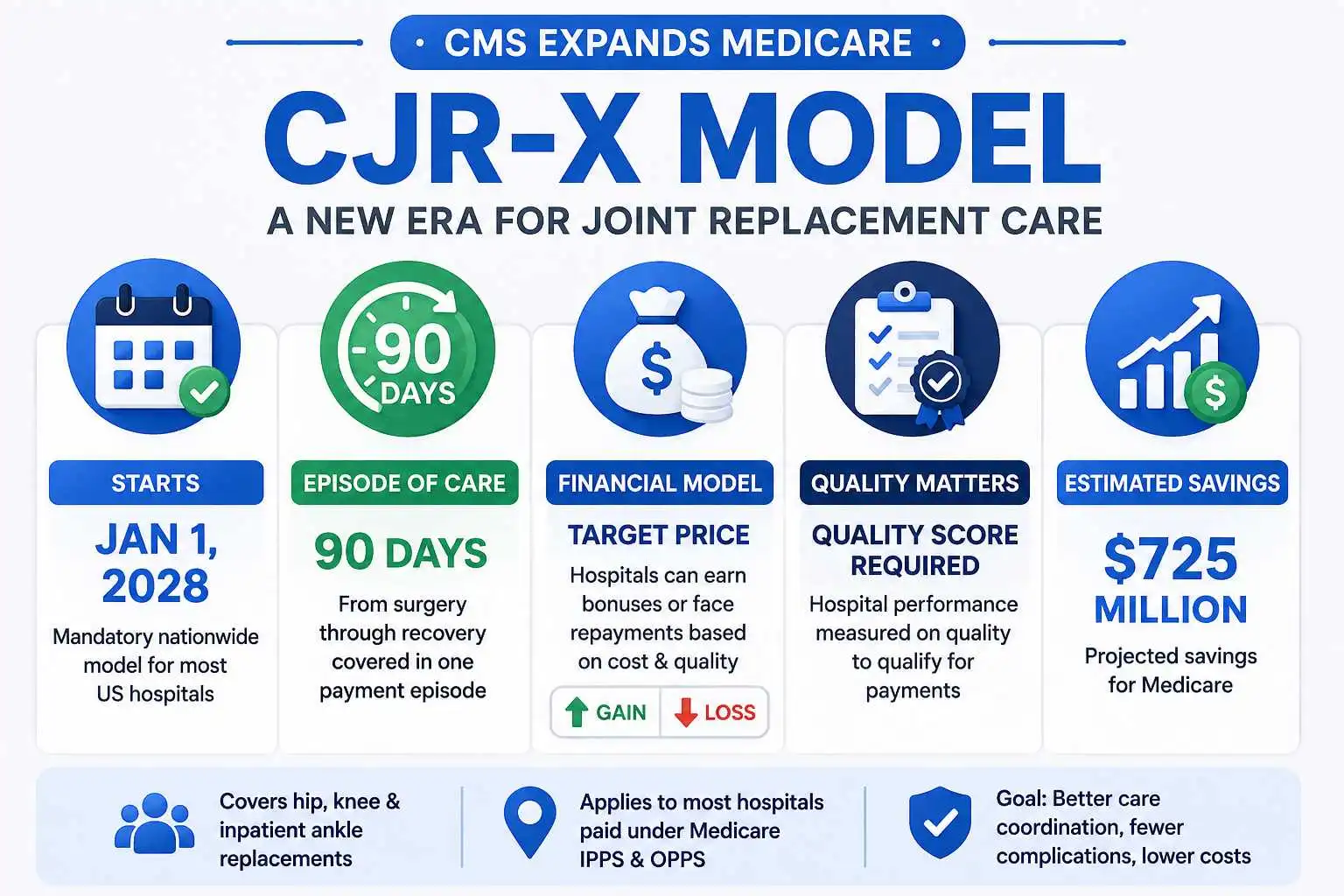
The model covers hip and knee replacement surgeries performed in both inpatient and hospital outpatient settings, along with inpatient ankle replacement procedures. Rather than paying separately for each stage of treatment, Medicare will evaluate the entire episode of care under a single payment framework.
Which hospitals will be required to participate?
Most acute care hospitals that are paid under both the Inpatient Prospective Payment System (IPPS) and the Outpatient Prospective Payment System (OPPS) will be required to participate in CJR-X.
However, CMS has created several important exemptions. Hospitals participating in the Transforming Episode Accountability Model (TEAM), hospitals located in Maryland, and facilities that are not paid under both Medicare payment systems will not be required to join the new model.
For hospitals that are covered, the rule represents a significant operational change. Many organizations will need to strengthen coordination with physicians, rehabilitation providers, and post-acute care partners before the model takes effect.
Why this rule matters beyond hospital payments
Although CJR-X is primarily a Medicare payment reform, its impact extends beyond hospital reimbursement. The model reflects CMS’s broader strategy of rewarding healthcare providers for the overall quality and efficiency of care, rather than the number of individual services delivered.
Joint replacement surgeries are among the most common and costly procedures covered by Medicare. By making hospitals responsible for both spending and patient outcomes throughout recovery, CMS hopes to reduce avoidable complications, improve coordination after surgery and encourage more consistent standards of care across the country.
Which Hospitals Will Have to Participate?
The CJR-X model is no longer limited to a few test markets. Beginning January 1, 2028, participation will be mandatory for most acute care hospitals paid under Medicare’s Inpatient Prospective Payment System (IPPS) and Outpatient Prospective Payment System (OPPS).
However, CMS has excluded some hospitals, including those participating in the Transforming Episode Accountability Model (TEAM), hospitals in Maryland, and facilities that do not meet the required Medicare payment system criteria.
For many hospitals, this means they have roughly 18 months to redesign how they manage joint replacement patients before the new payment rules take effect.
You may also find these related health insurance stories helpful:
- Trump Ends Medicare Part D Subsidy: What It Means for 2027 Medicare Drug Costs
- CMS Autism ABA Toolkit Explained: How States Can Fight Medicaid Fraud and Protect Children
- Humana to Exit Medicare Advantage Plans in 2027
What Happens During the 90-Day Episode of Care?
One of the biggest changes under CJR-X is that Medicare will evaluate an entire episode of care instead of paying separately for each service.
The episode begins when a patient undergoes a qualifying hip, knee, or inpatient ankle replacement procedure and continues for 90 days after surgery.
During that period, Medicare considers nearly all related spending, including:
- Hospital care
- Physician services
- Physical therapy
- Rehabilitation
- Follow-up appointments
- Other Medicare Part A and Part B services related to the procedure
Instead of focusing only on the surgery itself, hospitals are expected to coordinate the patient’s recovery from start to finish.
Hospitals Will Be Paid Based on Cost and Quality
Under CJR-X, CMS will assign a target price for every joint replacement episode.
After the performance year ends, Medicare will compare the hospital’s actual spending with that target.
If a hospital delivers high-quality care while keeping costs below the target, it may receive a reconciliation payment from Medicare.
If spending exceeds the target, the hospital could be required to repay Medicare.
The model therefore shifts hospitals from a traditional fee-for-service approach toward value-based reimbursement, where financial performance depends on both efficiency and patient outcomes.
Quality Scores Matter as Much as Costs
Saving money alone is no longer enough.
CMS says hospitals must also achieve a minimum Composite Quality Score before they can qualify for any financial reward.
The score is based largely on quality measures hospitals already report through existing Medicare quality programs, including:
- Surgical complication rates
- Patient experience surveys
- Patient-reported outcome measures
- Existing Hospital Inpatient Quality Reporting (IQR) data
- Hospital Outpatient Quality Reporting (OQR) measures
This means hospitals cannot simply reduce spending—they must also maintain or improve patient outcomes.
CMS Expects Significant Medicare Savings
CMS estimates that expanding the bundled payment model nationwide could save the Medicare program approximately $725 million.
The agency says the estimate is based on the performance of the original CJR model, which showed that coordinated care could lower costs while maintaining quality.
According to CMS, the expanded model is designed to reduce avoidable complications, improve recovery after surgery, and encourage hospitals to work more closely with physicians, rehabilitation providers, and post-acute care teams.
Why Some Hospital Groups Oppose the Expansion
Not everyone supports the nationwide rollout.
The American Hospital Association (AHA) argued that mandatory participation could place significant financial and operational pressure on smaller hospitals, particularly those with limited resources.
Among its recommendations, the AHA asked CMS to:
- Make participation voluntary instead of mandatory.
- Reduce financial risk during the transition period.
- Remove certain payment discount factors.
- Give hospitals more time to build care coordination systems.
CMS ultimately finalized the mandatory model, although some implementation timelines were adjusted before the final rule took effect.
What Does This Mean for Medicare Patients?
For most Medicare beneficiaries, the CJR-X model does not change how they choose a doctor or hospital. Patients will continue to have the freedom to select their providers under Original Medicare.
The biggest difference happens behind the scenes. Hospitals will now have stronger financial incentives to coordinate every stage of recovery, from surgery through the following 90 days. That could mean better communication between surgeons, rehabilitation providers, physical therapists, and primary care teams.
If the model works as CMS expects, patients may experience fewer complications, smoother recovery, and less unnecessary care after hip, knee, or ankle replacement surgery.
How Should Hospitals Prepare Before 2028?
Although CJR-X will not begin until January 1, 2028, hospitals have limited time to prepare for a much different payment environment.
Healthcare organizations are expected to review their physician partnerships, strengthen care coordination programs, improve quality reporting systems, and monitor spending across the entire 90-day episode of care.
Hospitals that already participate in value-based care programs may have an advantage because many of the required quality measures and reporting systems are already in place. Others may need significant operational changes before the model becomes mandatory.
Why This Rule Matters Beyond Joint Replacement
Many healthcare experts believe CJR-X is more than a payment update for orthopedic procedures.
CMS has increasingly shifted Medicare away from traditional fee-for-service reimbursement toward value-based care, where providers are rewarded for delivering better outcomes instead of simply performing more services.
Because CJR-X expands a payment model that previously demonstrated cost savings, many analysts view it as another step toward broader bundled payment programs that could eventually cover additional medical specialties
Who Could Be Most Affected?
The final rule primarily affects hospitals performing Medicare-funded hip, knee, and ankle replacement procedures. Orthopedic surgeons, rehabilitation providers, physical therapists, and post-acute care facilities may also see changes because they play an important role during the 90-day recovery period.
Patients are unlikely to notice major administrative changes immediately, but hospitals may introduce new care coordination programs, follow-up processes, and recovery planning designed to improve outcomes while controlling costs.
Expert Takeaway
The CJR-X model represents one of CMS’s largest nationwide bundled payment expansions in recent years. Instead of paying separately for each medical service, Medicare is increasing its focus on the total cost and quality of an entire episode of care.
For hospitals, the rule creates both financial opportunities and financial risks. For Medicare patients, the goal is to deliver more coordinated recovery after joint replacement surgery without limiting provider choice.
As the January 2028 implementation date approaches, hospitals across the United States are expected to spend the next several months preparing their clinical, operational, and financial systems for the new model.
Bottom Line
CMS has finalized the nationwide Comprehensive Care for Joint Replacement Expanded (CJR-X) model, requiring most eligible hospitals to manage the cost and quality of hip, knee, and certain ankle replacement care across a 90-day recovery period beginning January 1, 2028. The agency estimates the model could save Medicare about $725 million, while hospital groups warn that mandatory participation may create operational and financial challenges for some providers. Whether the program delivers the expected improvements will become clearer once implementation begins.
Frequently Asked Questions
1. What is the CJR-X model?
The CJR-X (Comprehensive Care for Joint Replacement Expanded) model is a Medicare bundled payment program that holds hospitals financially accountable for the cost and quality of hip, knee, and certain ankle replacement care during a 90-day episode.
2. When does the CJR-X model start?
CMS finalized the model to begin on January 1, 2028, after adjusting the original proposed implementation timeline.
3. Which hospitals must participate?
Most acute care hospitals paid under Medicare’s IPPS and OPPS will be required to participate unless they qualify for a specific exemption.
4. Which surgeries are included?
The model covers hip replacements, knee replacements, and inpatient ankle replacement procedures performed for eligible Medicare patients.
5. What is the 90-day episode of care?
It starts on the day of surgery and includes nearly all related Medicare-covered services provided during the following 90 days, such as rehabilitation, physical therapy, and follow-up care.
6. Can hospitals receive bonus payments?
Yes. Hospitals that keep costs below CMS’s target while meeting required quality standards may receive reconciliation payments.
7. What happens if hospitals spend too much?
Hospitals whose spending exceeds the CMS target may have to repay Medicare, depending on the program’s payment rules.
8. Does CJR-X affect Medicare patients’ choice of doctor?
No. Original Medicare beneficiaries generally keep the freedom to choose their doctors, hospitals, and other providers.
9. Why has the American Hospital Association raised concerns?
The AHA argues that mandatory nationwide participation could place financial and operational pressure on smaller hospitals and has called for a more gradual, voluntary approach.
10. Why is CJR-X important?
The model reflects Medicare’s continued shift toward value-based care, rewarding providers for improving patient outcomes while controlling overall healthcare spending.


