









UnitedHealth Reaches a New Global Milestone—But Faces Growing Challenges
UnitedHealth Group has reached a historic milestone, climbing to fourth place on the 2026 Fortune Global 500 after generating $447.6 billion in revenue during fiscal 2025.

The achievement places the healthcare giant behind only Walmart, Amazon, and China’s State Grid, making it the highest-ranked health insurance company on the list.
But the celebration comes at a difficult time.
While revenue continued to grow, the company’s operating earnings fell sharply, medical costs remained elevated, and lawmakers in Washington are weighing legislation that could eventually force UnitedHealth to separate parts of its business.
The contrast has made UnitedHealth one of the most closely watched companies in the healthcare industry this year.
A Record Revenue Year Lifted UnitedHealth to No. 4
Fortune’s latest Global 500 ranking shows UnitedHealth generated $447.6 billion in revenue for fiscal 2025, an increase of nearly 12% from the previous year.
That performance helped the company move into fourth place worldwide.
Only three organizations reported higher annual revenue:
- Walmart
- Amazon
- State Grid (China)
The ranking reflects UnitedHealth’s enormous presence across health insurance, pharmacy benefits, healthcare services, and technology.
Bigger Revenue Didn’t Mean Bigger Profits
Although revenue reached a record high, profitability moved in the opposite direction.
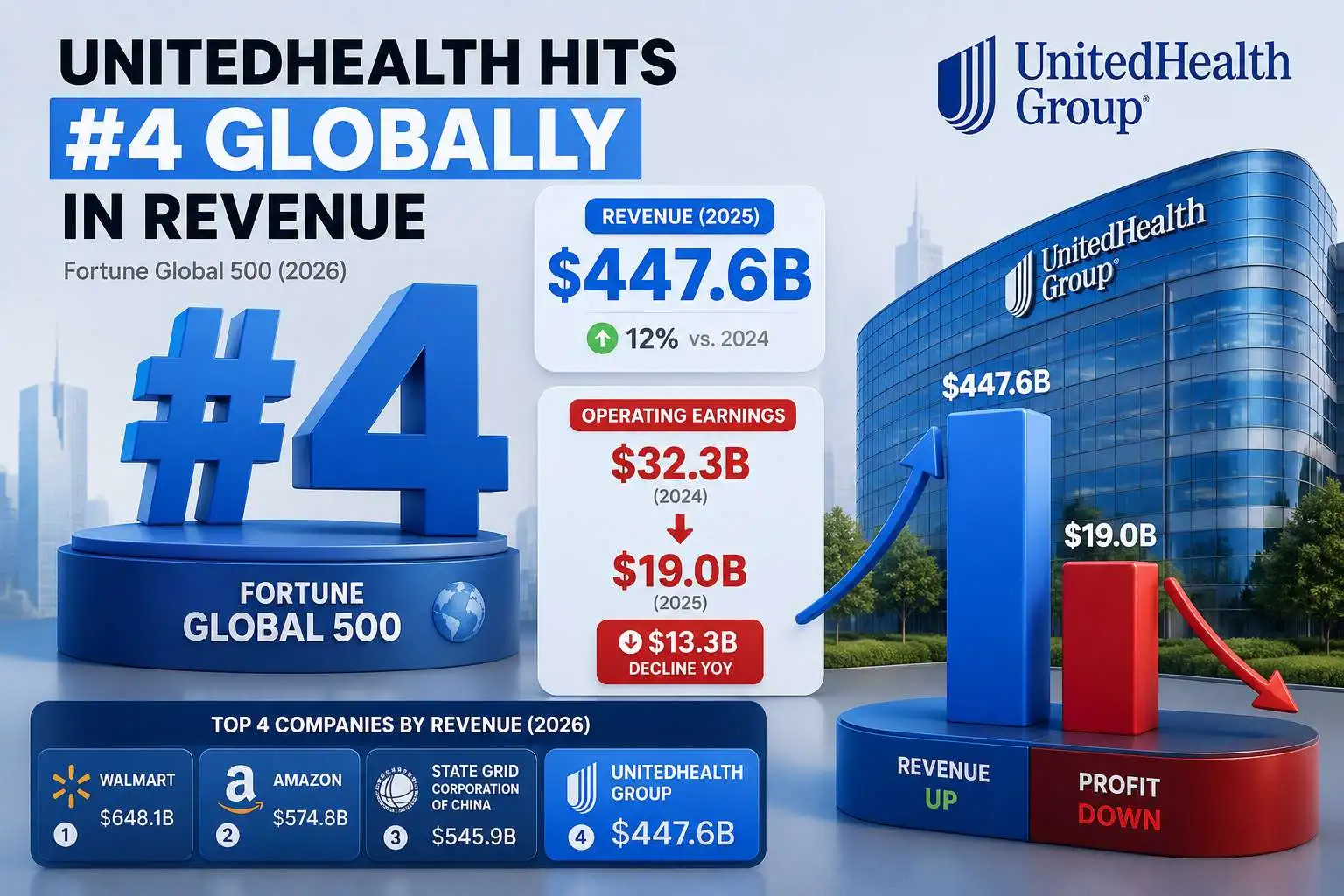
UnitedHealth reported $19 billion in operating earnings for 2025, down from $32.3 billion a year earlier.
The decline of more than $13 billion highlights how rising healthcare costs and funding pressures have affected the company’s financial performance despite continued business growth.
For investors, the results showed that generating more revenue has become increasingly expensive.
Rising Medical Costs Put Pressure on Margins
One of the biggest reasons behind the earnings decline was higher medical spending.
UnitedHealth’s medical care ratio (MCR) increased from 85.5% in 2024 to 88.9% in 2025.
The medical care ratio measures how much of every premium dollar is spent on medical claims. A higher percentage generally leaves less room for operating profit.
The company said the increase reflected continued growth in healthcare utilization alongside reductions in Medicare funding.
UnitedHealthcare’s Insurance Business Also Slowed
The pressure was especially visible inside UnitedHealthcare, the company’s insurance division.
Operating earnings fell from $15.6 billion in 2024 to $9.4 billion in 2025.
Its operating margin also declined from 5.2% to 2.7%, even though the business generated $344.9 billion in annual revenue and served 49.8 million members.
The figures suggest that higher medical costs weighed heavily on the insurer’s core business throughout the year.
Change Healthcare Costs Added Another Financial Hit
UnitedHealth also absorbed a significant one-time expense during 2025.
The company recorded a $2.8 billion charge tied to the final direct costs of the Change Healthcare cyberattack, along with restructuring initiatives and business divestitures.
Those restructuring efforts included workforce reductions and real estate rationalization as the company continued reshaping its operations following one of the largest cyberattacks ever to affect the U.S. healthcare industry.
A Simpler Corporate Structure Draws Attention
Another notable change appeared in UnitedHealth’s corporate structure.
According to the company’s latest filing, it reported 10 subsidiaries for fiscal 2025, compared with thousands of entities reported previously.
The disclosure comes as lawmakers continue examining the size and complexity of large healthcare organizations and the relationships between insurers, pharmacy benefit managers, healthcare providers, and technology businesses.
Congress Is Increasing Pressure on Big Healthcare Companies
Financial performance is not the only issue facing UnitedHealth.
The company is also under growing political scrutiny as lawmakers debate whether large vertically integrated healthcare companies have become too powerful.
Earlier this year, CEO Stephen Hemsley appeared before House committees alongside executives from other major insurers to answer questions about competition, healthcare pricing, and vertical integration.
At the center of those discussions is whether companies should be allowed to own insurance businesses, pharmacy benefit managers, and healthcare providers under the same corporate umbrella.
The Breakup Bill Could Reshape UnitedHealth’s Business
UnitedHealth’s financial results are arriving at the same time as growing political scrutiny in Washington.
In February 2026, Senators Elizabeth Warren and Josh Hawley introduced the Break Up Big Medicine Act, a bipartisan proposal that targets vertically integrated healthcare companies like UnitedHealth.
The bill would prohibit a company from owning a health insurer or pharmacy benefit manager (PBM) while also controlling physician practices or healthcare provider organizations.
Although the legislation remains under consideration and has not become law, it has intensified the debate over consolidation in the U.S. healthcare industry.
Why Optum Is at the Center of the Debate
Much of the political attention is focused on Optum, UnitedHealth’s fast-growing healthcare services business.
Optum includes pharmacy benefit management, healthcare technology, data services, and physician networks. Over the past decade, it has become one of the company’s largest growth engines.
In 2025 alone:
- Optum Rx generated $154.7 billion in revenue.
- It processed 1.66 billion adjusted prescriptions.
- The business controls more than 20% of the U.S. pharmacy benefit manager (PBM) market.
Supporters of the breakup proposal argue that combining insurance, pharmacy benefits, and healthcare delivery under one company could reduce competition. UnitedHealth has consistently maintained that its integrated model helps improve efficiency, coordinate care, and lower healthcare costs.
Congress Is Taking a Closer Look
The scrutiny extends beyond proposed legislation.
Earlier this year, UnitedHealth CEO Stephen Hemsley appeared before House committees alongside executives from other major insurers to answer questions about healthcare pricing, competition, and vertical integration.
Lawmakers from both parties questioned whether large healthcare companies have gained too much influence across multiple parts of the healthcare system.
While no immediate structural changes have been ordered, the hearings signal that regulatory oversight of major insurers is likely to remain intense.
Signs of Recovery Appeared in the Second Quarter
Despite a difficult 2025, UnitedHealth reported stronger second-quarter results for 2026.
The company generated $112.0 billion in revenue during the quarter and reported $8.0 billion in operating earnings.
Adjusted earnings reached $6.38 per share, while the medical care ratio improved to 86.7%, compared with higher levels seen previously.
The company said improved pricing discipline, product mix and medical cost management contributed to the stronger quarterly performance.
UnitedHealth Raised Its 2026 Outlook
Following the second-quarter results, management increased its full-year earnings guidance.
UnitedHealth now expects adjusted earnings of $19.50 to $20.00 per share for 2026, reflecting stronger-than-expected performance during the first half of the year.
The company also reaffirmed plans to continue investing in technology, healthcare operations, and long-term efficiency initiatives.
The improved outlook suggests management believes operating performance is stabilizing after a challenging 2025.
You may also find these related health insurance stories helpful:
- Trump Ends Medicare Part D Subsidy: What It Means for 2027 Medicare Drug Costs
- Hinge Health Buys Cylinder Health in $105M Deal to Expand Into GI Care After Record Q2 Growth
- Humana to Exit Medicare Advantage Plans in 2027
- Healthcare Costs Push Consumer Confidence Down as Medical Bills Rise
- Hawaii Family Health Insurance Costs Rise 50% Over 10 Years: Report
- Healthcare Costs Push Consumer Confidence Down as Medical Bills Continue to Rise
- Pennsylvania Health Insurance Rates May Rise 17.1% in 2027 as Some Insurers Seek 40.9% Premium Increase
Why This Matters for Employers and Health Insurance Customers
For most policyholders, the Fortune ranking itself will not change their health insurance coverage.
However, the financial trends behind the ranking could have a broader impact.
Higher medical costs continue to pressure insurers across the industry, while ongoing regulatory scrutiny could influence how large healthcare companies operate in the future. Changes to pharmacy benefit management, provider ownership rules, or market competition could eventually affect employers, brokers and millions of insured Americans.
For investors, the story is also mixed. UnitedHealth remains one of the world’s largest companies by revenue, but slower profit growth and increasing political pressure mean its future will depend on more than financial performance alone.
The Bottom Line
UnitedHealth’s rise to fourth place on the Fortune Global 500 highlights the company’s enormous scale, but the milestone comes during one of its most challenging periods in recent years.
Profits have fallen sharply, medical costs remain elevated, and lawmakers are considering legislation that could reshape how large healthcare companies operate. At the same time, stronger second-quarter results suggest the company is beginning to recover financially.
The coming months will likely determine whether UnitedHealth can maintain its growth while navigating rising regulatory scrutiny and ongoing cost pressures.
Sources (Use These in the Article)
- 1. UnitedHealth Group – Official Q2 2026 Results
- 2. Fortune Global 500 (Official Ranking)
- 3. Reuters (Independent Reporting)
Frequently Asked Questions
Why did UnitedHealth rank fourth on the Fortune Global 500?
The company reported $447.6 billion in fiscal 2025 revenue, placing it behind only Walmart, Amazon and China’s State Grid.
Why did UnitedHealth’s profits decline?
Operating earnings fell mainly because of higher medical costs, Medicare funding reductions, and a $2.8 billion charge related to the Change Healthcare cyberattack, restructuring, and divestitures.
What is the Break-Up Big Medicine Act?
It is a proposed bipartisan bill that would prevent companies from owning a health insurer or pharmacy benefit manager while also controlling healthcare provider organizations. The legislation is still under consideration.
Is UnitedHealth recovering financially?
Its second-quarter 2026 results showed stronger revenue and earnings, and the company raised its full-year earnings guidance, indicating improving operating performance despite ongoing challenges.


