









A coalition of 21 state attorneys general and Pennsylvania Governor Josh Shapiro has filed a federal lawsuit seeking to block key parts of the Trump administration’s 2027 Affordable Care Act (ACA) Marketplace Rule.
The lawsuit, filed in the U.S. District Court for the Northern District of California, argues that the new federal rule would make health insurance more expensive, reduce Marketplace enrollment, and weaken consumer protections created under the Affordable Care Act.

According to the coalition, millions of Americans could lose health insurance coverage if the rule takes effect.
What happened?
The lawsuit challenges the 2027 Notice of Benefit and Payment Parameters (NBPP) issued by the U.S. Department of Health and Human Services (HHS) and the Centers for Medicare & Medicaid Services (CMS).
The final rule was released in May 2026 and establishes how Affordable Care Act Marketplace plans will operate during the 2027 plan year.
California Attorney General Rob Bonta and New Jersey Attorney General Jennifer Davenport are leading the legal challenge, joined by New York Attorney General Letitia James and officials from 19 other states.
The defendants include HHS Secretary Robert F. Kennedy Jr. and CMS Administrator Dr. Mehmet Oz.
Why are states challenging the rule?
State officials argue that several provisions violate both the Affordable Care Act and the Administrative Procedure Act.
According to the lawsuit, the rule would:
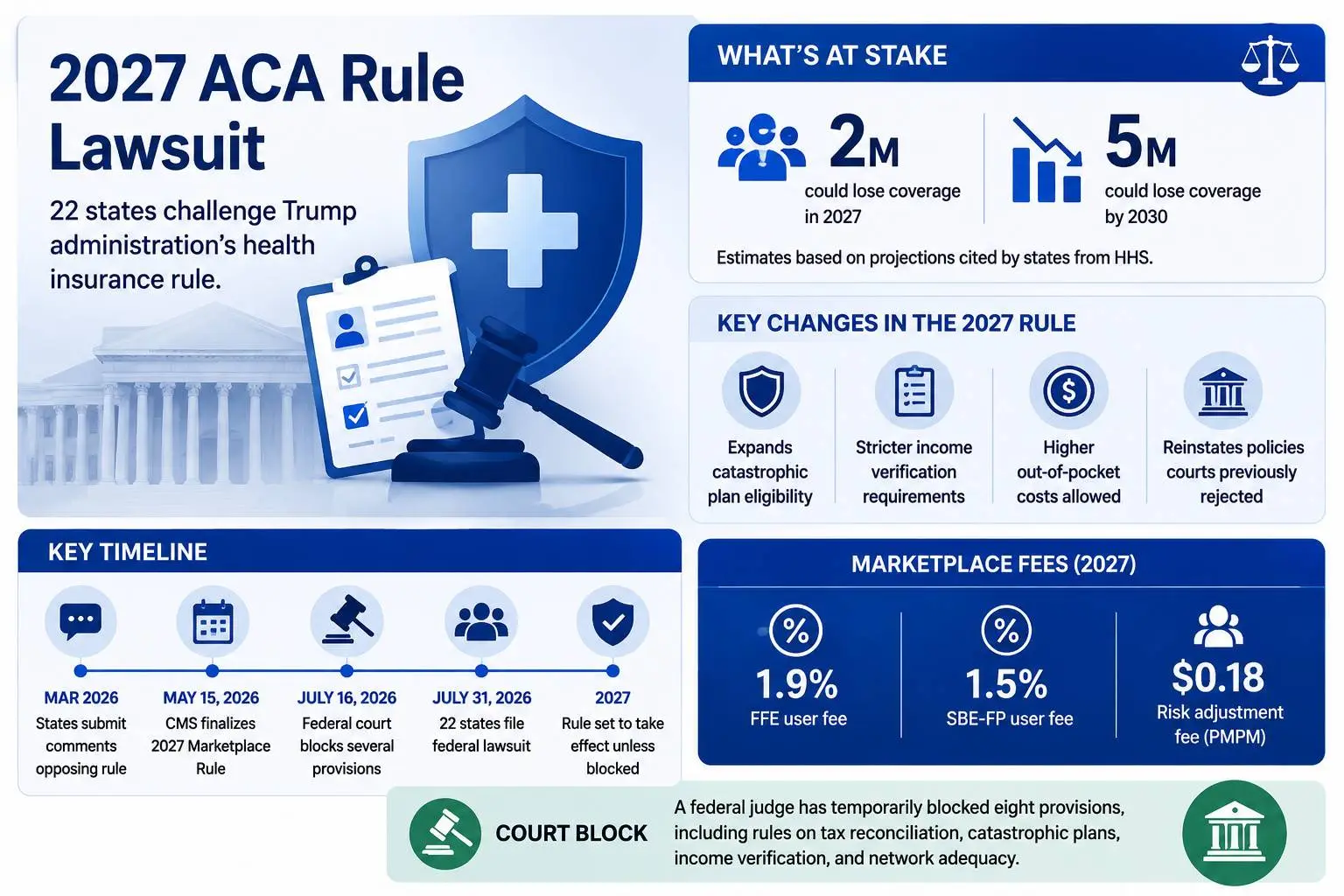
- expand eligibility for catastrophic health plans
- allow higher annual out-of-pocket costs
- reduce Marketplace enrollment
- increase financial pressure on consumers and states
- revive policies that federal courts have already rejected
The coalition says these changes move the Marketplace away from the ACA’s original goal of making health coverage more affordable.
States warn millions could lose coverage
One of the lawsuit’s biggest claims is based on the federal government’s own estimates.
According to HHS projections cited in the complaint:
- around 2 million people could lose health insurance during 2027
- coverage losses could reach 5 million people by 2030
The coalition argues these reductions would leave more Americans uninsured while increasing costs for those who remain enrolled.
Catastrophic plans are at the center of the dispute
A major focus of the lawsuit is the expansion of catastrophic health plans.
These plans generally offer:
- lower monthly premiums
- much higher deductibles
- limited coverage
- no premium tax credits in most cases
State officials argue that encouraging more people into these plans could leave consumers paying significantly more out of pocket when they need medical care.
The lawsuit also challenges provisions allowing catastrophic and some bronze plans to exceed standard ACA limits on annual out-of-pocket costs.
Coalition says the rule revives policies already rejected by courts
The complaint argues that the administration is attempting to bring back several provisions that federal courts have already found unlawful.
Among them are:
- stricter income verification requirements
- additional tax-credit reconciliation penalties
- other Marketplace eligibility restrictions
According to the states, HHS adopted these changes without adequately addressing previous court rulings or responding to public comments.
CMS says the rule protects taxpayers
When the final rule was announced in May 2026, CMS defended the changes.
CMS Administrator Dr. Mehmet Oz said the rule was designed to:
- strengthen eligibility verification
- reduce fraud
- improve oversight of brokers
- provide consumers with more coverage choices
- give states greater flexibility in managing Marketplace operations
Oz also said taxpayer-funded subsidies should go only to people who qualify under federal rules.
Some provisions have already been blocked
The legal fight over the Marketplace rule began before this latest lawsuit.
In July 2026, a federal judge in Maryland issued a nationwide preliminary injunction temporarily blocking several provisions of the rule.
Among the paused provisions were:
- expanded catastrophic plan eligibility
- stricter income verification rules
- certain premium tax credit reconciliation requirements
- changes affecting network adequacy oversight
Those provisions remain temporarily blocked while litigation continues.
Lower marketplace fees—but broader legal concerns
The 2027 rule also finalized several Marketplace financing changes.
These include:
- FFE user fee: 1.9% of monthly premiums
- State-based Exchange on the Federal Platform fee: 1.5%
- Risk Adjustment user fee: $0.18 per member per month
Although these fees were reduced compared with 2026, the lawsuit focuses primarily on eligibility, consumer protections and Marketplace coverage rules rather than user fees.
You may also find these related health insurance stories helpful:
- Trump Ends Medicare Part D Subsidy: What It Means for 2027 Medicare Drug Costs
- Humana to Exit Medicare Advantage Plans in 2027
- Healthcare Costs Push Consumer Confidence Down as Medical Bills Rise
- Hawaii Family Health Insurance Costs Rise 50% Over 10 Years: Report
- Healthcare Costs Push Consumer Confidence Down as Medical Bills Continue to Rise
What happens next?
The coalition is asking the federal court to prevent the challenged provisions from taking effect before the 2027 Marketplace plan year begins.
If the court grants the requested relief, parts of the rule could remain blocked while the case proceeds.
If not, insurers and Marketplace exchanges may begin implementing the new standards for 2027 coverage.
Timeline
| Date | Event |
|---|---|
| March 2026 | States submitted comments opposing the proposed rule |
| May 15, 2026 | CMS finalized the 2027 Marketplace Rule |
| July 2026 | Federal judge temporarily blocked several provisions |
| July 31, 2026 | 22-state coalition filed the new federal lawsuit |
| 2027 | Rule scheduled to govern ACA Marketplace plans |
Key Numbers
- 22 plaintiffs (21 attorneys general + Pennsylvania)
- 23+ million Americans receive ACA Marketplace coverage
- 2 million projected coverage losses in 2027
- 5 million projected coverage losses by 2030
- 1.9% FFE user fee
- 1.5% SBE-FP user fee
- $0.18 PMPM Risk Adjustment user fee
The Bottom Line
The latest lawsuit marks another major legal battle over the future of the Affordable Care Act. While the Trump administration says the 2027 Marketplace Rule strengthens program integrity and protects taxpayers, the coalition of states argues it will reduce coverage, increase healthcare costs, and weaken key ACA protections. The outcome of the case could significantly influence how millions of Americans purchase health insurance beginning in 2027.
Source & References
FAQ
Why did states sue the Trump administration?
States argue that the 2027 ACA Marketplace Rule increases costs, reduces coverage, and violates the Affordable Care Act and the Administrative Procedure Act.
Which states filed the lawsuit?
The lawsuit was co-led by California and New Jersey, joined by New York, 18 other states, and Pennsylvania Governor Josh Shapiro.
What is the 2027 Marketplace Rule?
It is an HHS and CMS regulation establishing standards for Affordable Care Act Marketplace health plans offered during the 2027 plan year.
What are catastrophic health plans?
They are lower-premium health insurance plans with higher deductibles and limited benefits, generally intended for specific eligible individuals.
Could the rule affect insurance coverage?
According to projections cited in the lawsuit, up to 2 million people could lose coverage in 2027, with losses reaching 5 million by 2030 if the rule is fully implemented.


