









Erie Insurance delivered another profitable quarter, but its latest financial results also show a clear shift. After several quarters of strong premium-driven growth, the insurer is now seeing slower business expansion as higher insurance costs make customers more price-sensitive.

The company reported $862.9 million in management fee revenue, up 4.7% from a year earlier. Net income increased to $180.3 million, while operating income rose 2.5%. However, customer retention slipped to about 87.5%, policy growth weakened, and commission expenses climbed sharply.
For policyholders, the report highlights an important trend: insurers can continue growing revenue through premium increases, but retaining customers becomes more difficult when insurance becomes less affordable.
What’s Driving Slower Growth?
The biggest story isn’t that Erie earned more money—it’s why growth has slowed.
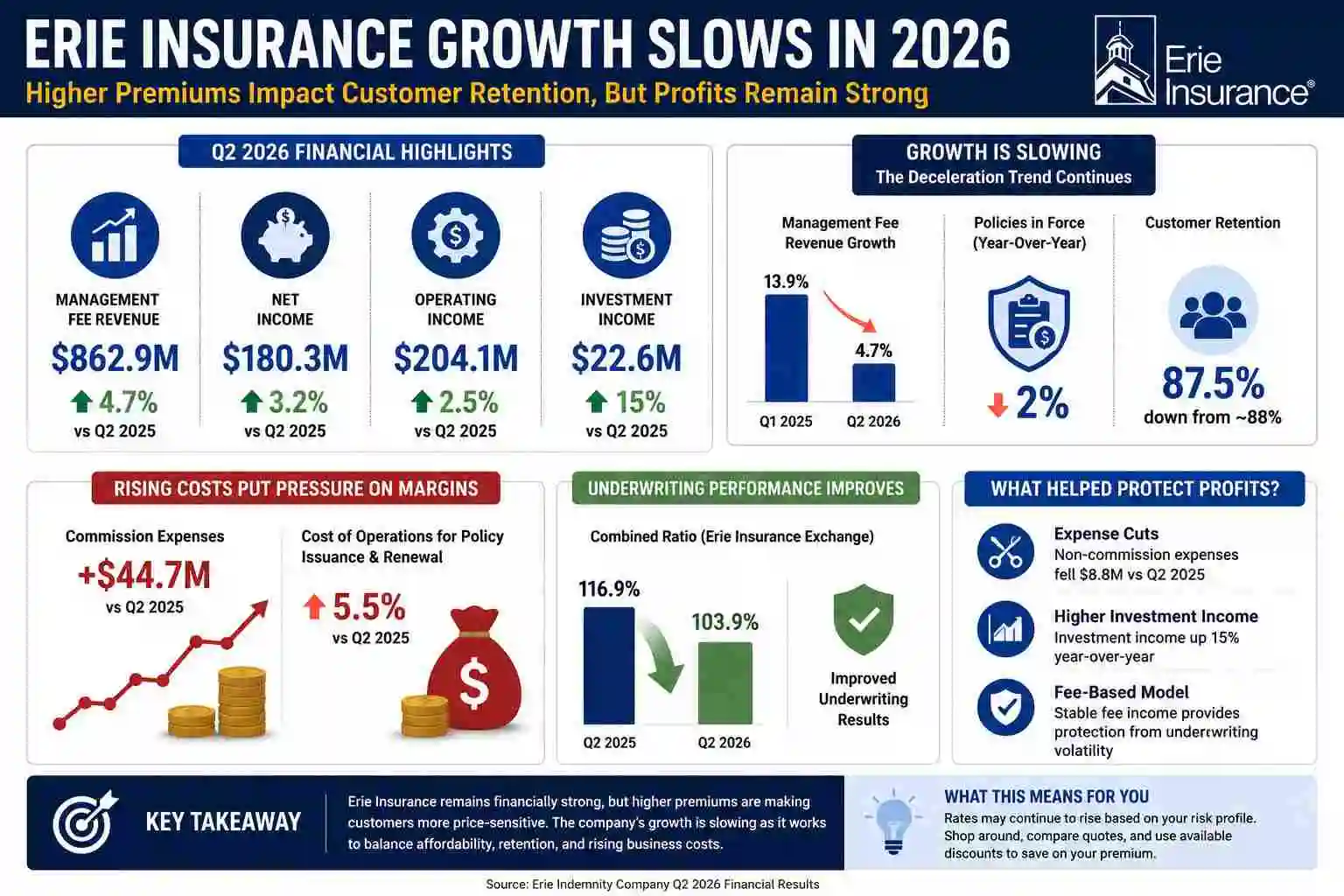
Over the past two years, insurers across the U.S. have raised premiums to offset inflation, higher repair costs, and larger claim payouts. Erie also increased rates, helping revenue grow.
Now those higher premiums are beginning to affect customer behavior.
More policyholders are comparing prices before renewing coverage, making it harder for insurers to maintain the rapid growth seen during previous quarters.
Higher Rates Are Creating More Competition
Erie continues to rank among the more affordable insurers in many markets, but customers are becoming increasingly price-conscious.
Even modest premium increases can encourage drivers and homeowners to request new quotes from competing insurers during renewal season. That trend has reduced customer retention and slowed policy growth.
The company also expects growth to become more dependent on attracting new customers rather than relying only on pricing adjustments.
Rising Commission Costs Added Pressure
Another notable takeaway from the report is the sharp increase in distribution costs.
Commission expenses rose by $44.7 million as Erie paid higher incentives to independent agents responsible for selling and renewing policies.
While strong agent networks remain one of Erie’s biggest strengths, these higher costs are putting additional pressure on profit margins.
Expense Cuts Helped Protect Earnings
Despite slower growth and rising commissions, Erie maintained solid profitability.
The company reduced several operating expenses, including professional services and underwriting support costs. At the same time, higher investment income provided another boost to earnings.
These measures helped offset growing business costs and allowed Erie to report higher profits despite a more challenging operating environment.
What It Means for Existing Customers
The latest results do not indicate financial problems at Erie Insurance.
Instead, they suggest that the company—like many insurers—is adjusting to a market where customers are more sensitive to premium increases.
Policyholders renewing coverage may continue to see rate adjustments depending on their location, claims history, vehicle, or property risk. Existing customers can often reduce costs by reviewing coverage limits, bundling policies, or using available discounts such as Erie Rate Lock®, where eligible.
Is Erie Insurance Still Financially Strong?
Yes.
The company remains financially stable, continues to generate healthy profits, and maintains strong investment performance.
However, the latest quarter signals that future growth may depend less on premium increases and more on improving customer retention, expanding policy counts, and managing operating costs efficiently.
Why This Quarter Matters
Insurance companies benefited from aggressive premium increases throughout 2024 and 2025. The second quarter of 2026 suggests that strategy is becoming less effective as consumers increasingly shop for lower-priced alternatives.
For Erie, the challenge now is balancing profitability with affordability while keeping existing customers from switching to competitors.
The Bottom Line
Erie Insurance remains in a solid financial position, but its latest results show that the era of easy, rate-driven growth is beginning to fade. Revenue and earnings continued to rise, yet slower customer growth and weaker retention indicate that affordability is becoming a bigger factor in the U.S. insurance market.
Sources
- Erie Insurance – https://www.erieinsurance.com/
- AM Best – https://www.ambest.com/
- J.D. Power – https://www.jdpower.com/
Frequently Asked Questions (FAQ)
1. Why is Erie Insurance’s growth slowing in 2026?
Erie Insurance continues to grow, but at a slower pace than in previous quarters. Higher insurance rates, increased competition, and more price-conscious customers have reduced policy growth and customer retention.
2. Did Erie Insurance still report strong financial results?
Yes. The company reported $862.9 million in management fee revenue, $180.3 million in net income, and $204.1 million in operating income during the second quarter of 2026.
3. Why did customer retention decline?
Customer retention fell to 87.5% as many policyholders compared prices after several rounds of premium increases across the insurance industry.
4. What was the biggest challenge in Erie Insurance’s Q2 2026 results?
The biggest challenge was rising operating costs. Agent commission expenses increased by $44.7 million, putting pressure on margins even as revenue continued to grow.
5. Does this mean Erie Insurance is financially weak?
No. Erie Insurance remains financially strong. The company stayed profitable, improved underwriting performance, and continued to generate solid investment income despite slower growth.
6. What does this mean for Erie Insurance customers?
Customers may continue to see competitive pricing pressure across the market. Comparing quotes, reviewing coverage regularly, and using available discounts can help manage insurance costs.


