









Why Did Lionel Messi Retire From Argentina? His Father’s Death and World Cup Final Changed His Decision

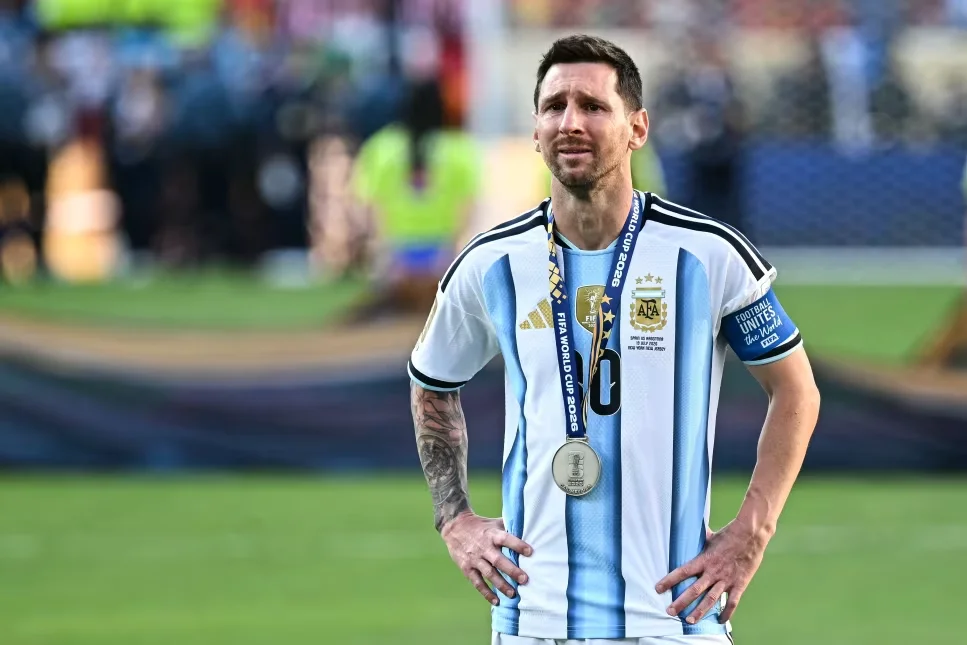
Lionel Messi has ended his Argentina international career at 39, revealing that he had already written his retirement statement two days after the 2026 World Cup final and became even more certain after the death of his father, Jorge Messi.
Lionel Messi has announced his retirement from international football, but his decision did not come suddenly.
The Argentina captain revealed that he had already written his retirement statement on July 21, 2026, just two days after Argentina lost the FIFA World Cup final to Spain in New York.
More than a month later, Messi made the decision public. He said the death of his father, Jorge Messi, on August 8, further strengthened his belief that it was time to end his international career.
At 39, Messi said he had given everything he could to Argentina and had reached a point where he had “nothing left to give.”
Why did Lionel Messi retire from international football?
Messi’s retirement appears to have been shaped by several factors rather than one single reason.
The first was the experience of the 2026 World Cup final, where Argentina lost to Spain. Messi later described the physical difficulty he experienced during the match and acknowledged that his body was approaching its limits.
The second was the death of his father, Jorge Messi, who died aged 68 in August.
The third was Messi’s recognition that a new generation of Argentine players was emerging and deserved an opportunity to take the national team forward.
Together, those factors convinced the 39-year-old that his international chapter had reached its end.
Messi had already made the decision after the World Cup final
One of the most revealing details in Messi’s announcement was that he had made up his mind much earlier than fans realized.
Messi said he wrote his retirement statement on July 21, two days after Argentina’s World Cup final defeat.
However, he did not immediately publish it.
Instead, he waited before formally announcing his retirement.
Messi later said that events following his father’s death made him even more convinced that stepping away from the national team was the right decision.
That means his retirement announcement was not simply a reaction to the latest international fixture. The decision had been developing for weeks.
His father’s death reinforced the decision
Messi’s father, Jorge Messi, died on August 8, 2026, at the age of 68.
In his retirement message, Messi directly connected his father’s death with his decision.
He said that although he had already written the statement in July, what happened with his father left him even more certain about ending his Argentina career.
The timing adds an emotional dimension to Messi’s retirement.
After more than two decades representing Argentina, the footballer decided to close that chapter while dealing with the loss of his father.
Messi also admitted his physical limits
The 2026 World Cup final appears to have played an important role in Messi’s thinking.
In a statement following his father’s death, Messi had previously acknowledged doubts about how much longer he could continue playing internationally.
He also described how difficult the World Cup final had been physically.
Messi said that during the final, his legs could no longer continue and that he had tried to push himself beyond his physical limits.
That experience appears to have contributed to his realization that his time with Argentina was coming to an end.
Despite those difficulties, Messi continued playing at club level with Inter Miami.
Messi says he has nothing left to give
In announcing his retirement, Messi made clear that the decision was painful.
He said he had always given everything to Argentina, including during the difficult years before the team’s run of major successes.
But after more than two decades with the national side, he believes he has reached the end of what he can contribute.
Messi also pointed to the emergence of younger players.
He said there are talented young footballers coming through who deserve their opportunity with Argentina.
That suggests his retirement is not only about his own physical condition. Messi also sees the transition as part of the natural evolution of the national team.
What did Messi win with Argentina?
Messi leaves international football with one of the most decorated careers in Argentina’s history.
He made his senior Argentina debut in 2005 and went on to become the country’s leading goalscorer.
According to the figures reported by the supplied sources, Messi finished with 125 international goals and more than 200 appearances, while the Guardian reported 207 caps.
His biggest achievements with Argentina include:
- 2022 FIFA World Cup — Champion
- 2021 Copa América — Champion
- 2024 Copa América — Champion
- 2014 FIFA World Cup — Runner-up
- 2026 FIFA World Cup — Runner-up
- 2014 World Cup Golden Ball
- 2022 World Cup Golden Ball
Messi also became the only player to win the World Cup Golden Ball twice, doing so in 2014 and 2022.
He appeared at six World Cups and played in three World Cup finals.
Messi’s final Argentina chapter ends after another World Cup final
The timing of his retirement is particularly significant because Messi’s final Argentina match came in a World Cup final.
Argentina’s defeat to Spain ended a tournament in which Messi had once again reached the biggest stage of international football.
Rather than attempting another cycle with the national team, he decided to step away.
His statement suggests he believes Argentina now has enough emerging talent to begin its next era without him.
Is Messi retiring from football completely?
No. Messi’s announcement concerns international football with Argentina, not his club career.
He continues to play for Inter Miami, where his contract runs through 2028.
The retirement therefore does not mean Messi is immediately leaving professional football altogether.
In fact, just before his Argentina announcement, Messi scored four goals for Inter Miami in a Major League Soccer match against CF Montréal, helping his team to a 7-1 victory.
His club career can therefore continue even though his time with Argentina is over.
Messi will now support Argentina from the outside
Messi’s relationship with the Argentina national team will change from player to supporter.
In his farewell message, he thanked Argentine fans for their support throughout his roughly two decades with the national side.
He said he would miss hearing them from inside the team but would now be among those supporting Argentina from the outside.
For a player who spent 21 years representing his country, the transition marks the end of one of the defining international careers of the modern era.
Messi also thanked his family, coaches, teammates and officials who accompanied him throughout his journey.
He ended his message with a tribute to Argentina itself.
“Thank you God for making me Argentine.”
And then: “Vamos Argentina!”
What happens next for Lionel Messi?
Messi’s international retirement closes his Argentina chapter, but it does not necessarily mark the end of his playing career.
At Inter Miami, he remains under contract through 2028 and can continue competing at club level.
For Argentina, however, the focus now shifts toward the next generation.
Messi’s decision comes after a career that delivered the World Cup, two Copa América titles and more than 200 international appearances.
His final decision was shaped by the physical demands of the 2026 World Cup final, personal loss following his father’s death and his belief that younger players now deserve the opportunity to lead Argentina.
After years of uncertainty over when the Argentina chapter would end, Messi has finally provided the answer.
He is stepping away from the national team — but not necessarily from football.


