









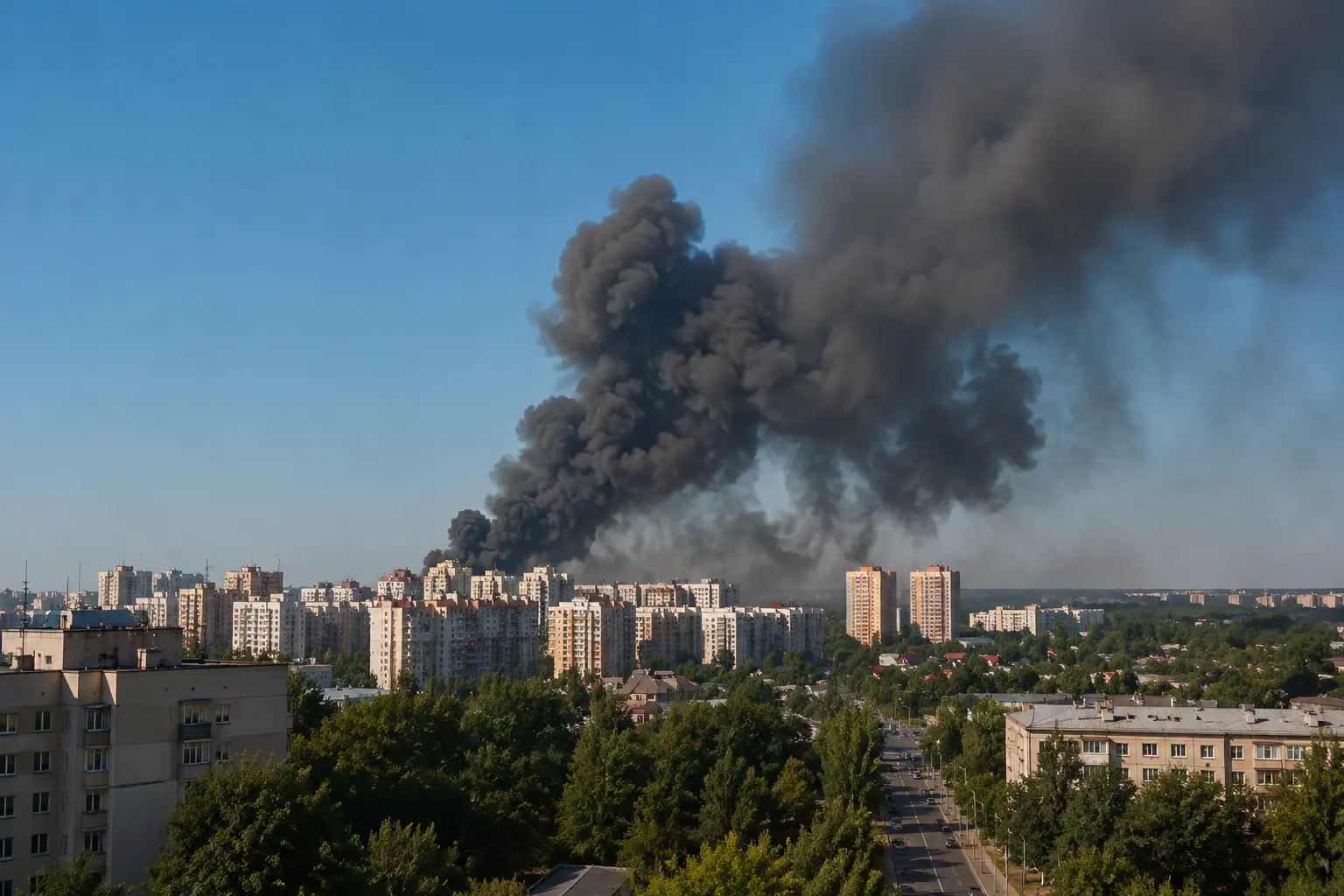
A Russian drone strike on a warehouse near Kyiv has killed at least 37 people, injured 42 others and forced more than 380 people to evacuate after the attack triggered a major fire followed by explosions, Ukrainian officials said.
The strike occurred late Friday in Myla, in the Bucha district on the western outskirts of Kyiv. Emergency crews were still working at the site on Saturday as authorities investigated what caused the powerful detonations.
What happened at the Kyiv warehouse?
According to Ukraine’s prosecutor general, a drone struck or fell onto an enterprise in Myla at about 8:10 p.m. local time on Friday. A large fire then broke out and detonations began.
The incident caused significant damage beyond the immediate warehouse area. Ukrainian President Volodymyr Zelensky said nearby residential buildings and a facility caring for elderly and disabled people were also affected.
More than 300 emergency responders were deployed to the scene, according to Zelensky.
The question now: what was stored inside?
The investigation is focusing on whether explosive materials or ammunition were being stored at the site and whether the facility had the necessary permits and approvals.
Russia’s Defense Ministry described the target as an ammunition depot, claiming it stored components and launch boosters for FP-1 and FP-2 long-range unmanned aerial vehicles.
Ukrainian officials have not simply accepted that description. Prosecutors are investigating the legality of storing explosive objects and materials at the facility, including whether required safety rules were followed.
That distinction is important because the warehouse was close to residential areas.
Zelensky calls for accountability
Zelensky said those responsible for allowing the situation to develop must be held accountable.
He pointed to regulations prohibiting ammunition from being stored near homes and residential buildings and said criminal cases had already been opened over possible official negligence.
The Kyiv regional governor, Tymur Tkachenko, also warned that the death toll could rise.
Why the blast became so destructive
The initial drone impact appears to have been followed by a much larger chain of events.
Officials said the strike caused a large-scale fire and then detonations at the facility. If explosive materials were present, they could help explain why a drone strike produced a prolonged fire and multiple explosions rather than a single impact.
However, investigators have not yet established the complete sequence publicly, and the exact contents of the facility remain part of the investigation.
Russia and Ukraine intensify long-range attacks
The Kyiv strike came after two days of repeated Russian drone attacks against the capital and surrounding region, with warehouses and homes among the sites damaged.
Ukraine’s military said it had shot down 233 Russian unmanned aerial vehicles overnight into Saturday.
Zelensky also reported attacks in Odesa, Dnipropetrovsk, Sumy and Zaporizhzhia.
At the same time, Ukraine has continued striking targets inside Russia. Russian online retailer Ozon said one of its logistics centers was hit by a Ukrainian drone attack and that operations at another facility were suspended because of security concerns.
A separate deadly attack in the Kyiv region
The warehouse strike was not the only deadly incident reported overnight.
Tkachenko said a 14-year-old was killed in a separate attack in the Boryspil district.
Russian officials, meanwhile, reported that two people were killed and 21 injured in strikes in Russia’s Belgorod and Rostov regions over the previous 24 hours.
Death toll discrepancy
Early reports from Ukrainian authorities put the warehouse strike death toll at 37, with 42 injured and more than 380 evacuated. A later France 24 report cited Ukrainian authorities as saying at least 37 people had died.
Because officials warned that the casualty count could change as rescue and recovery operations continue, the confirmed toll should be treated as developing.
The central investigation now goes beyond the drone strike itself: authorities are examining what was stored at the facility, why explosive materials may have been kept near residential buildings, and whether safety rules were breached.


