









Hinge Health Buys Cylinder Health in $105M Deal to Expand Into GI Care After Record Q2 Growth


Hinge Health is making one of its biggest strategic moves since becoming a public company, announcing plans to acquire virtual digestive care provider Cylinder Health in a $105 million cash deal while reporting record second-quarter financial results.
The acquisition is more than another healthcare merger. It marks Hinge Health’s expansion beyond musculoskeletal (MSK) and migraine care into gastrointestinal (GI) care—one of the largest and fastest-growing areas of healthcare spending in the United States. At the same time, the company posted strong revenue growth, higher profitability and raised its full-year financial outlook, signaling confidence that its AI-powered care model is expanding successfully into multiple chronic conditions.
Hinge Health combines record earnings with a major expansion strategy
Hinge Health reported second-quarter revenue of $212.8 million, up 53% year over year, while free cash flow nearly tripled to $99.6 million. The company also increased its full-year revenue guidance to approximately $856 million–$860 million, reflecting continued demand from employers and health plans.
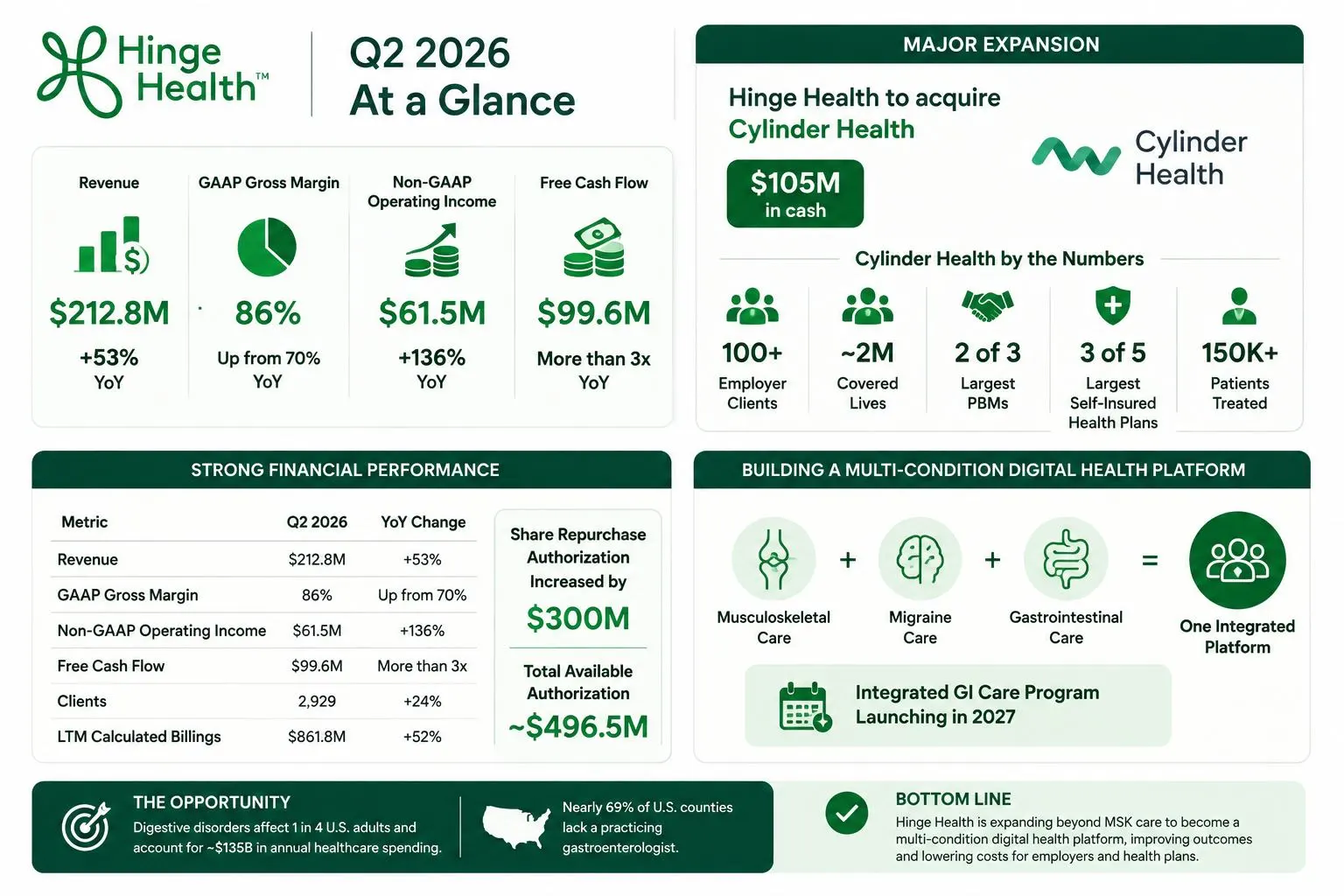
Alongside those financial results, Hinge Health announced it has signed a definitive agreement to acquire Cylinder Health for $105 million in cash, with the transaction expected to close during the third quarter of 2026.
Rather than focusing only on financial performance, the announcement shows the company is using its improving profitability to expand into new areas of healthcare.
Why Hinge Health is moving into gastrointestinal care
Digestive health has become one of the largest untreated challenges for employers and health insurers.
According to Hinge Health, digestive disorders affect one in four U.S. adults and account for roughly $135 billion in annual healthcare spending. Yet access to specialists remains limited, with nearly 69% of U.S. counties lacking a practicing gastroenterologist.
That gap creates delayed diagnoses, repeated primary care visits, and higher healthcare costs for employers.
Hinge Health believes GI care follows the same opportunity it previously identified in musculoskeletal care—high demand, fragmented treatment pathways and significant potential for technology-driven care delivery.
What Cylinder Health brings to the acquisition
Founded in 2021, Cylinder Health specializes in virtual digestive healthcare and has already built meaningful relationships across the healthcare industry.
According to Hinge Health, Cylinder currently serves:
- More than 100 employer clients
- About 2 million covered lives
- Partnerships with two of the three largest pharmacy benefit managers (PBMs)
- Relationships with three of the five largest self-insured health plans
- More than 150,000 patients treated
Instead of building a GI program from scratch, Hinge Health gains an established clinical platform that can be integrated into its existing technology ecosystem.
Hinge Health wants to become a multi-condition digital healthcare platform
The acquisition reflects a broader strategy rather than a single-product expansion.
Hinge Health first built its business around musculoskeletal care, later expanded into migraine treatment and is now adding gastrointestinal care.
CEO Daniel Perez said the company follows the same framework whenever it enters a new healthcare category:
- identify an unmet clinical need,
- automate care delivery using AI,
- improve patient outcomes,
- lower healthcare costs for employers.
The integrated GI care program is expected to launch in 2027, bringing digestive care into the same platform already used for musculoskeletal and migraine services.
You may also find these related health insurance stories helpful:
- CVS Health Raises 2026 Profit Forecast After Strong Q2 Results and Aetna Recovery
- UnitedHealth Becomes World’s No. 4 Company by Revenue as Q2 2026 Results Signal Recovery
What this means for employers and health plans
Large employers increasingly want healthcare vendors capable of managing multiple chronic conditions through a single platform instead of contracting with separate vendors for each specialty.
By adding digestive care, Hinge Health can potentially offer employers:
- one digital care platform,
- one member experience,
- coordinated clinical support,
- broader chronic disease management,
- potentially lower healthcare spending.
That integrated approach could strengthen Hinge Health’s competitive position as employers look to simplify benefit programs.
What investors will be watching next
Although the acquisition expands Hinge Health’s addressable market, investors will now focus on execution.
Key questions include:
- How quickly Cylinder Health will be integrated.
- Whether GI care adoption matches MSK growth.
- Revenue contribution beginning in 2027.
- Client retention after expanding into multiple specialties.
- Continued profitability while investing in new care programs.
Management expects Cylinder to contribute $7–8 million in revenue during 2026 and substantially more once the integrated GI platform launches in 2027.
The Bottom Line
Hinge Health’s acquisition of Cylinder Health is not simply an expansion into digestive healthcare. It represents the company’s broader strategy to evolve from a musculoskeletal care provider into a multi-condition digital healthcare platform serving employers and health plans. Backed by record quarterly revenue, stronger profitability and higher full-year guidance, the deal positions Hinge Health to compete across a wider range of chronic conditions while continuing to build an AI-powered healthcare ecosystem.
Sources
- Hinge Health Investor Relations — Q2 2026 Financial Results & Cylinder Health Acquisition (Official)
- Fierce Healthcare — Hinge Health to acquire Cylinder Health for $105 million to expand into GI care
FAQs
What did Hinge Health announce in Q2 2026?
Hinge Health announced a definitive agreement to acquire virtual digestive healthcare company Cylinder Health for $105 million while reporting record second-quarter 2026 financial results.
Why is Hinge Health buying Cylinder Health?
The acquisition allows Hinge Health to expand beyond musculoskeletal and migraine care into gastrointestinal (GI) care, one of the largest unmet healthcare markets in the United States.
How much did Hinge Health pay for Cylinder Health?
Hinge Health agreed to acquire Cylinder Health for $105 million in cash, subject to customary closing conditions.
When will Hinge Health launch its GI care program?
The company expects to launch its integrated AI-powered gastrointestinal care platform in 2027 after completing the acquisition and integrating Cylinder Health’s technology and clinical expertise.
How did Hinge Health perform in Q2 2026?
The company reported:
- Revenue of $212.8 million (up 53% YoY)
- Free cash flow of $99.6 million
- GAAP operating income of $40.4 million
- Non-GAAP operating income of $61.5 million
Did Hinge Health raise its 2026 guidance?
Yes. Hinge Health raised its full-year 2026 revenue guidance to $856 million–$860 million and increased its non-GAAP operating income outlook to $236 million–$244 million.
Why is the acquisition important for employers and insurers?
The acquisition helps Hinge Health build a multi-condition digital care platform. Employers and health plans could potentially manage musculoskeletal, migraine and gastrointestinal conditions through a single platform, improving patient access while helping reduce healthcare costs.
Is this acquisition related to health insurance?
Indirectly, yes. Hinge Health is not a health insurer, but it partners with employers, pharmacy benefit managers (PBMs) and health plans. Expanding into GI care strengthens its value proposition for insurers and self-insured employers seeking lower healthcare costs and better member outcomes.


