









Standalone Health Insurers Surge in FY27: Market Share Reaches 14.10% as General Insurers Cede Ground


In a significant structural shift within India’s non-life insurance sector, standalone health insurers (SAHIs) expanded their market footprint during the first four months of FY27 (April–July 2026). Data released by the General Insurance Council (GI Council) indicates that SAHIs captured 14.10% of total non-life insurance premiums, up from 11.72% during the same period in FY26.
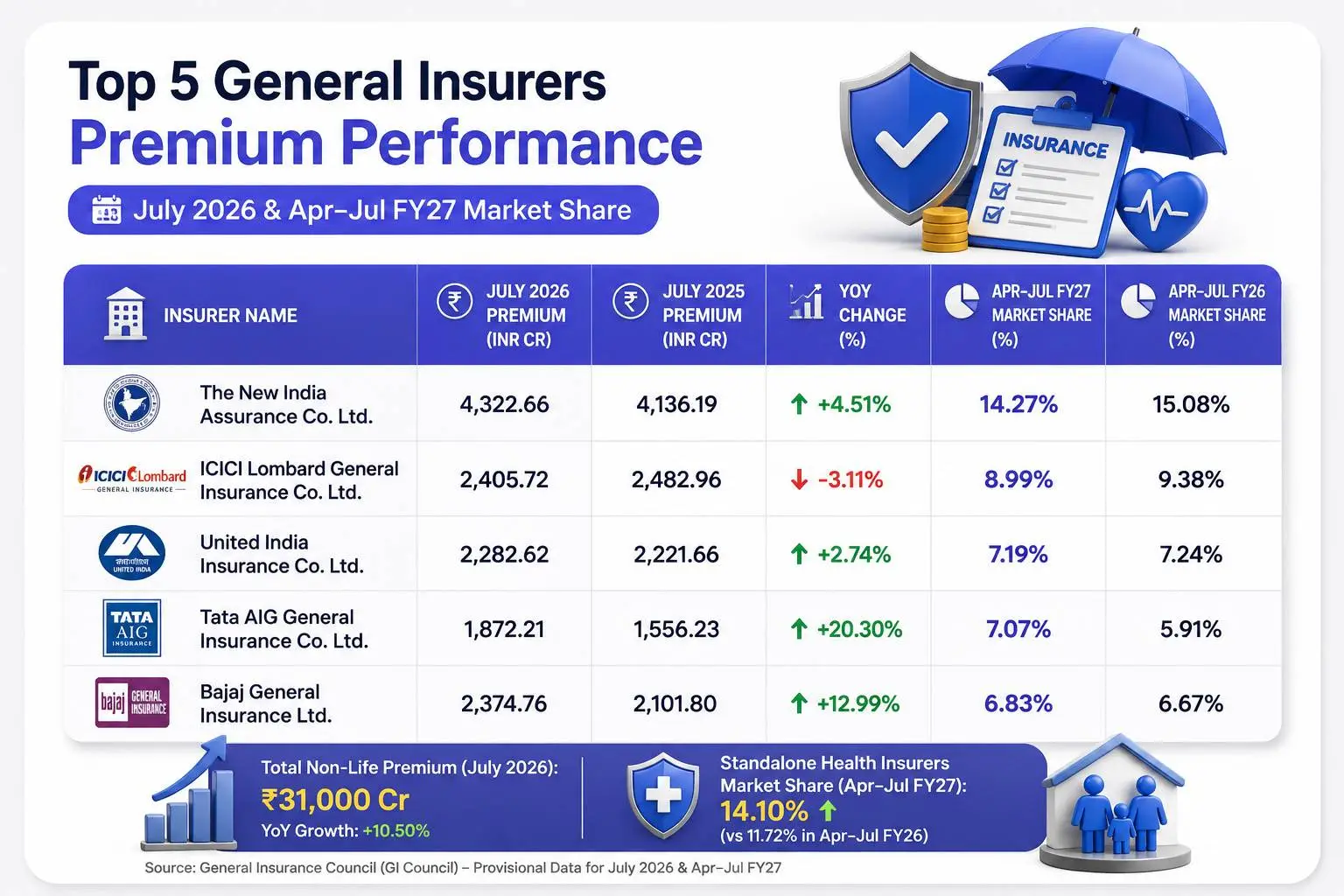
This 2.38 percentage point market share gain came as traditional general insurers saw their market dominance contract to 85.34% from 86.43%. The divergence highlights an accelerating consumer preference for dedicated, health-first underwriting over multi-line commercial policy issuers.
Premium Collections: SAHI Growth Outpaces Broader Market
Total gross direct premiums underwritten by the non-life insurance industry reached INR 1,19,540 crore (INR 1.195 trillion) during the four-month cumulative period ended July 2026, marking an overall year-on-year increase of approximately 9.5% to 11%.
However, top-line performance diverged sharply between segments:
- Standalone Health Insurers: Collected INR 16,827 crore in cumulative direct premiums through July 2026, up 31.74% from INR 12,773 crore in the year-ago period. Single-month premium collections for July 2026 alone reached INR 4,666 crore, a 28.8% year-on-year increase.
- General Insurers: Recorded INR 1,01,812 crore in cumulative premiums through July 2026, representing an 8.09% increase compared to INR 94,196 crore during the same period in FY26. Single-month collections for July stood at INR 25,771 crore, up 5.4% year-on-year.
Performance Disparity Across Top 5 General Insurers
The market share reduction among general insurers was not uniform across all market participants. While major public and private multi-line carriers faced top-line headwinds in commercial lines like fire insurance, select private entities recorded strong double-digit growth.
The five largest general insurers held a combined 44.35% market share in July 2026, virtually unchanged from 44.28% a year earlier. This indicates that general insurers as a collective category ceded market share to SAHIs rather than simply losing ground to smaller general insurance competitors.
SAHI Breakdown: Star Health, Care, and Niva Bupa Lead Expansion
Within the specialized health ecosystem, all major standalone insurers maintained robust growth trajectories during early FY27, capitalizing on expanding tied-agency networks and higher direct-to-consumer (D2C) digital adoption.

Key SAHI Performance Highlights
Star Health & Allied Insurance Co. Ltd.: Retained its position as the largest standalone health insurer, generating INR 1,803.63 crore in July 2026 premiums (+18.77% YoY). Its market share reached 5.11%. In Q1 FY27 earnings, Star Health reported a 25.5% jump in net profit to INR 550 crore and an underwriting profit turnaround to INR 111 crore, supported by 97% digital policy sourcing for fresh retail lines.
Care Health Insurance Ltd.: Posted INR 1,173.95 crore in July 2026 premiums, representing a 40.40% YoY surge. Care Health’s cumulative market share expanded to 3.44% from 2.65% a year prior.
Niva Bupa Health Insurance Co. Ltd.: Underwrote INR 852.19 crore in July 2026 premiums (+33.71% YoY), pushing its cumulative market share to 2.52% from 2.08%.
Aditya Birla Health Insurance Co. Ltd.: Reached INR 589.88 crore in July 2026 premiums (+27.57% YoY), holding a 2.18% cumulative market share.
Emerging Entrants: Specialized niche players showed accelerated baseline expansion, with Galaxy Health Insurance growing 106.61% YoY (INR 25.93 crore) and ManipalCigna Health Insurance expanding 42.55% YoY (INR 216.97 crore).
Key Drivers Fueling Standalone Health Insurance Growth
1. Zero-Percent GST Adjustment on Retail Health Policies
Following decisions by the GST Council, the Goods and Services Tax rate on individual health insurance policies, family floaters, and senior citizen covers was reduced from 18% to 0% (nil) effective September 22, 2025. This tax elimination reduced out-of-pocket acquisition costs for households, driving policy renewals and higher sum-insured purchases throughout late FY26 and into FY27. Commercial and group health policies retain standard tax structures.
2. High Medical Inflation Outpacing General CPI
Healthcare expense inflation in India runs between 10% and 14% annually, driven by higher hospitalization charges, advanced diagnostic technologies, and specialized surgical procedures. With out-of-pocket medical expenditure remaining near 39%, urban and semi-urban households are increasingly transferring health liability risks to dedicated health insurers.

You may also find these related health insurance stories helpful:
- CMS Expands Medicare Joint Replacement Payment Model: What CJR-X Means for Patients and Hospitals
- CMS Autism ABA Toolkit Explained: How States Can Fight Medicaid Fraud and Protect Children
- Medicare Fast-Tracks Breakthrough Devices: How CMS RAPID Pathway Cuts Delays to 60 Days
3. Weakness in Commercial General Insurance Portfolios
While health and motor lines sustained top-line momentum, general insurers faced slowing growth in corporate property and fire insurance portfolios. Additionally, specialized lines experienced year-on-year contractions; for instance, Agriculture Insurance Co. of India Ltd. saw July premiums drop 82.40% to INR 265.02 crore, weighing down broader non-life figures.
Star Health shows what is happening inside the retail market
The performance of Star Health provides another indication of where growth is coming from.
The company’s Q1 FY27 results showed gross written premium of ₹4,287 crore, up about 19% year over year.
More notably, retail fresh health premium increased 37%.
The company also reported a sharp improvement in underwriting performance, with underwriting profit rising to ₹111 crore from ₹16 crore a year earlier.
Net profit increased 25.5% to ₹550 crore.
The company said it was targeting a 15–16% return on equity by FY28 and a FY27 gross written premium target of ₹24,000 crore.
These figures are significant because they show that the story is not only about market expansion.
At least for some major standalone health insurers, the strategic focus is shifting toward profitable growth, digital distribution and risk selection, rather than simply maximizing premium volume.
Motor insurance remains an important growth engine
The health story should not obscure the importance of motor insurance.
Motor insurance remains one of the major premium-generating businesses for general insurers, and vehicle sales can directly influence policy volumes.
That gives diversified insurers another important source of growth.
But motor insurance has a different economic profile from retail health insurance.
Motor premium growth is closely linked to vehicle sales, mandatory third-party coverage and repair costs, while health insurance demand is increasingly linked to medical expenses, health awareness and household financial protection.
That difference helps explain why the two segments can move at different speeds.
Fire insurance is moving in the opposite direction
The July data also shows why the overall market can look relatively moderate even while health insurance is growing rapidly.
Fire insurance has been a weaker area for some general insurers.
The Indian Express report noted a decline in fire premium income, while the much faster expansion of standalone health insurers helped reshape the overall premium mix.
This is important for interpreting the headline numbers.
A 3.83% monthly growth rate for the entire non-life sector does not mean every insurance category is growing at 3.83%.
The industry is experiencing very different conditions across health, motor, fire, agriculture and other lines.
Agriculture insurance creates another distortion in the headline numbers
Specialized insurers also produced an unusually weak July comparison.
Agriculture Insurance Company of India recorded July premium of ₹265.02 crore, down 82.40% from ₹1,505.91 crore a year earlier.
As a result, specialized insurers collectively recorded a 75.65% decline in July premiums.
That is why the headline total for all non-life insurers needs to be read carefully.
When specialised insurers are excluded, the July market’s growth was 8.44%, compared with 3.83% for the entire market.
This is one of the most important analytical points in the latest GI Council data.
The overall headline growth rate understates the underlying growth of the core general-and-health insurance market because of the sharp decline in specialised-insurer premium.
What the market-share change means
The shift from 11.72% to 14.10% may look relatively small at first glance.
It is not.
A gain of 2.38 percentage points in just one year means standalone health insurers are capturing a considerably larger portion of the industry’s premium pool.
At the same time, general insurers still control more than 85% of the market.
So this is not a displacement story yet.
It is better described as share redistribution at the margin.
Traditional insurers remain dominant, but health-focused companies are becoming increasingly important competitors.
What comes next for India’s health insurance market?
The April–July data points to several trends worth watching through FY27.
First, standalone health insurers are likely to remain a major source of incremental premium growth.
Their 31.74% cumulative growth is substantially above the 8.09% recorded by general insurers.
Second, competition among health-focused insurers is increasing.
Care, Niva Bupa, Aditya Birla Health and ManipalCigna are all posting strong growth rates, while Star Health continues to maintain the largest position.
Third, affordability remains critical.
The zero-GST treatment for eligible individual health policies has changed the pricing environment, but rising medical costs can offset some of the benefit for consumers over time.
Fourth, profitability will matter more than headline premium growth.
As insurers become larger, investors and regulators will increasingly focus on underwriting performance, claims experience, solvency, distribution costs, and return on equity.
The Bottom Line
Provisional data for the first four months of FY27 confirms that standalone health insurers are capturing an expanding share of India’s non-life insurance landscape. Driven by consumer demand for high sum-insured health coverage, tax relief on retail policies, and dedicated distribution agency networks, SAHIs are outperforming general insurers whose top-line growth remains moderated by softening commercial lines.
Sources & References
- General Insurance Council — Industry Statistics
- Indian Express — Standalone health insurers gain market share
- Department of Financial Services — GST exemption for individual health insurance
- IRDAI
Frequently Asked Questions (FAQs)
What was the market share of standalone health insurers in April–July FY27?
According to GI Council data, standalone health insurers (SAHIs) achieved a 14.10% market share of total non-life premiums during the four-month period ending July 2026, up from 11.72% in the corresponding period of FY26.
How fast did standalone health insurers grow compared to general insurers?
In the first four months of FY27, SAHIs grew gross direct premiums by 31.74% year-on-year (reaching INR 16,827 crore), whereas general insurers grew by 8.09% year-on-year (reaching INR 101,812 crore).
Which standalone health insurer holds the largest market share in India?
Star Health & Allied Insurance Co. Ltd. remains the largest SAHI player, capturing a 5.11% market share of the total non-life insurance pool in April–July FY27 with July 2026 premium underwritings of INR 1,803.63 crore.
Did tax changes impact health insurance demand in 2026?
Yes. The reduction of GST on individual health insurance policies from 18% to 0% in late 2025 improved policy affordability, serving as a primary structural driver for retail health insurance growth in FY27.


