









Insurance companies earn money mainly through premium income, investment returns, underwriting profits, and other service-related revenue. While a portion of the premiums collected is used to pay claims and operating expenses, the remaining funds are invested to generate additional income. This business model allows insurers to remain profitable while providing financial protection to policyholders.
The Main Ways Insurance Companies Make Money
Understanding how insurance companies make money helps explain why premiums differ, why claims are carefully assessed, and how insurers stay financially strong even after paying large claims. In this guide, you’ll learn how the insurance business works, where insurers earn their profits, and what factors affect their long-term profitability.
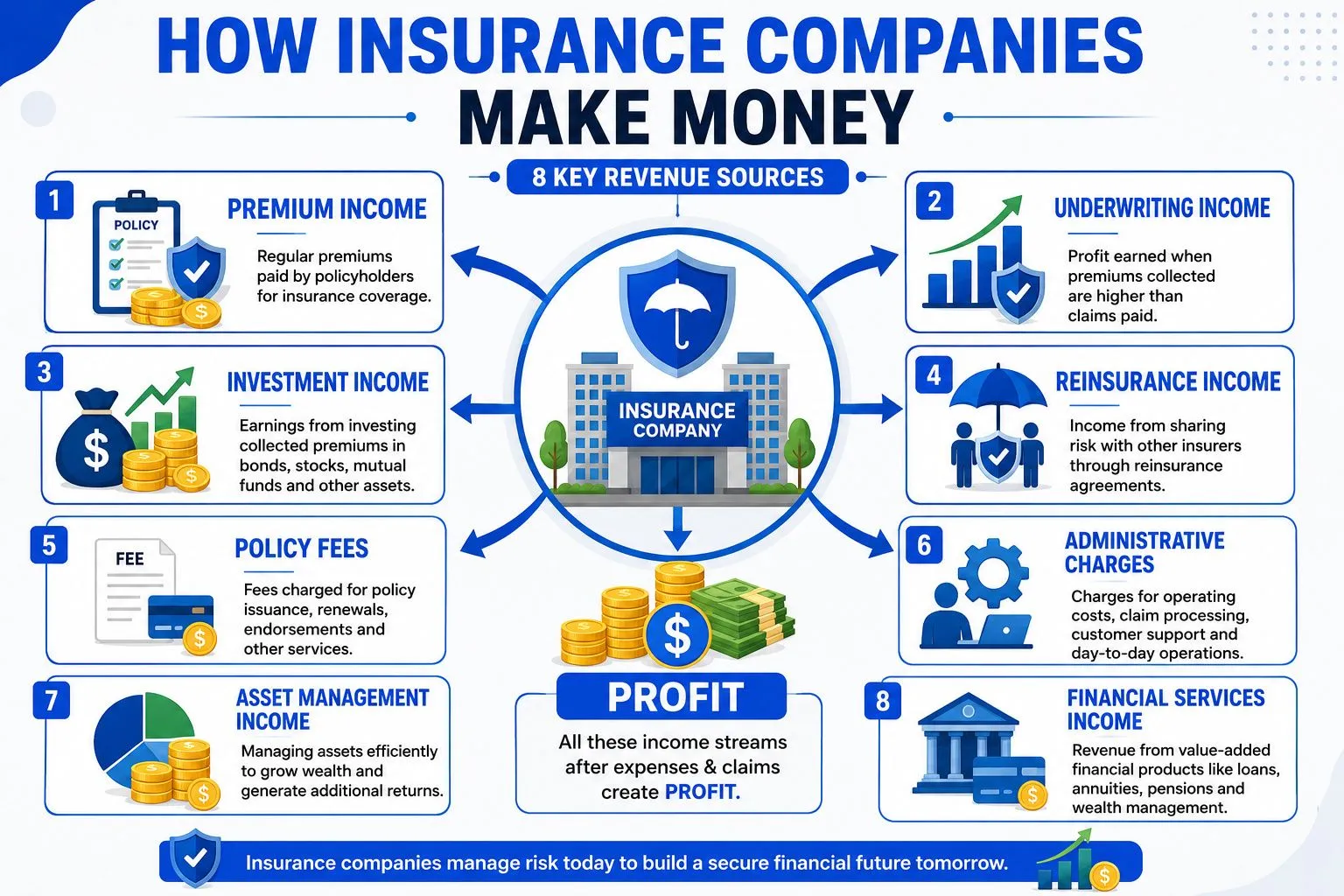
1. Premium Income
Premium income is the primary source of revenue for insurance companies. Every time a policyholder purchases or renews an insurance policy, they pay a premium in exchange for insurance coverage. Because insurers collect premiums from a large pool of customers, premium income provides the financial foundation that supports the company’s day-to-day operations.
2. Underwriting Profit
Underwriting profit is earned when the total premium collected is greater than the combined cost of claims and operating expenses. To achieve this, insurers carefully evaluate every applicant’s level of risk before deciding how much premium should be charged.
Successful underwriting is one of the key indicators of a financially healthy insurance company.
3. Investment Income
Insurance companies also generate income by investing a portion of their available capital in financial assets. These investments commonly include government bonds, corporate bonds, fixed-income securities, equities, and other regulated investment instruments.
For many insurers, investment income represents a significant long-term contributor to overall profitability.
4. Reinsurance
Reinsurance enables insurance companies to transfer a portion of high-value risks to another insurer. This helps reduce exposure to catastrophic losses and protects the company’s financial strength during large-scale claim events.
Rather than increasing revenue directly, reinsurance protects profitability by limiting extreme financial losses.
5. Policy Fees and Administrative Charges
Some insurance companies earn additional revenue through policy-related administrative charges. These may include policy issuance fees, installment processing fees, reinstatement charges, document replacement fees, and other administrative costs permitted under the policy terms.
Although these charges represent a relatively small portion of total revenue, they contribute to overall operating income.
6. Asset Management and Financial Services
Large insurance groups often expand beyond traditional insurance by offering investment management, retirement planning, pension administration, and other financial services. Revenue from these businesses is typically earned through management fees and advisory services.
This diversification helps reduce dependence on insurance operations alone.
- Learn how insurance premiums are calculated.
- See how insurance deductibles actually work.
- Understand why insurance premiums increase.
- Compare insurance premium vs. deductible.
- Learn how to lower your insurance premium.
- Understand insurance coverage limits.
- Read our complete guide to health insurance premiums.
How Different Types of Insurance Companies Make Money
Although the core business model is similar, different insurance companies earn revenue in slightly different ways depending on the type of coverage they provide.
Health Insurance
Health insurance companies primarily earn money from monthly premiums. They also manage healthcare costs through provider networks, negotiated medical rates, and investment income while paying covered claims.
Auto Insurance
Auto insurers rely on premium income, careful underwriting, and claim management. Safe driving discounts, lower claim frequency, and investment returns all help improve long-term profitability.
Home Insurance
Home insurance companies generate revenue from premiums and investment income. However, profits can fall significantly after major disasters such as hurricanes, wildfires, floods, or severe storms that trigger thousands of claims.
Life Insurance
Life insurance companies generally receive premiums over many years before most death benefits are paid. Long-term investments and accurate actuarial pricing are major reasons why life insurers remain financially stable.
Quick Tip: Regardless of the insurance type, most companies earn money through the same three pillars: premium income, underwriting discipline, and investment returns.

Real-World Example: How an Insurance Company Makes Money
Imagine an insurance company has 50,000 active policyholders.
Step 1: Customers Buy Insurance
Each customer pays an average premium of $1,200 per year.
Total Premium Collected
50,000 × $1,200 = $60 million
At the beginning of the year, the insurer has collected $60 million in premium revenue.
Step 2: Claims Are Paid
During the year, most policyholders never file a claim.
Out of 50,000 customers:
- 47,800 never file a claim.
- 2,200 files valid insurance claims.
The company pays a total of the following:
Claims Paid = $36 million
Step 3: Operating Costs
Running an insurance company also costs money.
This includes:
- Employee salaries
- Customer support
- Technology systems
- Marketing
- Fraud investigations
- Administrative expenses
Operating Expenses = $10 million
Step 4: Investment Income
While the premium money is waiting to pay future claims, the insurer invests part of its available funds in relatively low-risk assets such as government bonds and corporate bonds.
During the year, those investments generate:
Investment Income = $4 million
Step 5: Other Revenue
The company also earns a smaller amount from:
- Policy fees
- Administrative charges
- Financial services
Additional Revenue = $1 million
Final Results
| Item | Amount |
|---|---|
| Premium Income | $60 million |
| Investment Income | + $4 million |
| Other Revenue | + $1 million |
| Total Revenue | $65 million |
| Claims Paid | − $36 million |
| Operating Expenses | − $10 million |
| Annual Profit | $19 million |
What This Example Shows
This example demonstrates that insurance companies do not profit simply because customers don’t file claims. Their business model combines premium income, careful underwriting, investment returns, and efficient cost management. When these elements are managed effectively, the company can pay covered claims while still earning a sustainable profit.
Do Insurance Companies Make Money After Paying Claims?
Yes—but not from every policy or every customer. Insurance companies collect premiums from thousands or even millions of policyholders, while only a portion of them file covered claims in a given year. The remaining funds are used to pay operating costs, build financial reserves, and generate investment income.
For example, if an insurer collects $100 million in premiums and pays $72 million in claims, the balance helps cover expenses and, if managed efficiently, contributes to profit.
This is why paying claims does not automatically mean an insurer loses money. Their business model is designed to spread risk across a large pool of customers, so profitable years can offset periods with unusually high claim payouts.
Why Are Insurance Companies Still Profitable?
Insurance companies remain profitable because they manage risk rather than predict individual claims. They price premiums using actuarial data, diversify risk across many policyholders, invest premium funds before claims are paid, and use reinsurance to reduce the impact of major losses. Even in years with higher claim costs, these strategies help many insurers remain financially stable and profitable over the long term.
Can an Insurance Company Lose Money?
Yes. Insurance companies can lose money when claim payouts and operating expenses exceed the premiums they collect. Large hurricanes, wildfires, floods, pandemics, or a surge in expensive lawsuits can quickly increase claim costs. Poor underwriting decisions or weak investment performance can also reduce profitability.
For example, if an insurer collects $500 million in premiums but pays $560 million in claims after a major natural disaster, it may report an underwriting loss for that year. However, insurers often rely on investment income, financial reserves, and reinsurance to recover from these periods and maintain long-term financial stability.
The Bottom Line
Insurance companies generate revenue through premium income, underwriting, investments, and other business activities while carefully balancing claims, operating expenses, and long-term financial obligations. However, profitability is never guaranteed. Large natural disasters, unexpectedly high claim payouts, inaccurate risk assessment, rising healthcare or repair costs, investment losses, and intense market competition can all reduce profits or even result in financial losses. Ultimately, long-term success depends on effective risk management, disciplined cost control, and sound financial decision-making—not simply on collecting premiums.
Sources & References
- Swiss Re Institute
- Insurance Information Institute (Triple-I)
- National Association of Insurance Commissioners (NAIC)
FAQ
1. What is the main source of income for insurance companies?
The primary source of income is insurance premiums paid by policyholders. Companies also earn money through underwriting profits, investment income, reinsurance activities, and service-related fees.
2. How do life insurance companies make money if everyone dies?
Life insurers collect premiums for many years before most claims are paid. They also invest those premiums, and some policies lapse before a payout is made. These factors help keep the business profitable over time.
3. How do health insurance companies make money?
Health insurance companies mainly earn revenue from monthly premiums. They also negotiate healthcare costs with providers and generate investment income while paying covered medical claims.
4. Where do insurance companies invest premiums?
Insurance companies typically invest premiums in government bonds, corporate bonds, high-quality fixed-income securities, stocks, and real estate to generate long-term investment returns.
5. Do insurance companies make money after paying claims?
Yes. Paying claims is a normal part of the business. Insurers remain profitable by collecting premiums from many policyholders, controlling underwriting risk, and earning investment income.
6. What are the 5 C’s of insurance?
The term does not have one universal definition, but it commonly refers to coverage, cost, claims, customer service, and company financial strength when comparing insurance providers.
7. How much do insurance agents get paid per policy?
Insurance agents usually earn a commission rather than a fixed amount per policy. The commission varies by insurance type, company, and whether the policy is new or a renewal.
8. Who is the richest insurance company?
It depends on how “richest” is measured. By assets or market value, some of the world’s largest insurance groups include Berkshire Hathaway, UnitedHealth Group, Ping An Insurance, Allianz, and AXA.


