









California Moves on Two Fronts as Homeowners Face Insurance Pressure
California is taking action on two of the biggest problems facing homeowners after the Los Angeles wildfires: how insurers handle claims after a disaster and how homeowners can keep coverage before a loss occurs.
The California Department of Insurance has taken formal enforcement action against State Farm General following an examination of its handling of 2025 Los Angeles wildfire claims. At the same time, Senate Bill 1301, authored by Sen. Ben Allen, is advancing through the Legislature with proposed changes to residential insurance nonrenewal rules.
Together, the developments show how California regulators and lawmakers are responding to growing pressure in the state’s property insurance market.
State Farm Investigation Found 398 Alleged Violations
The State Farm action stems from a market conduct examination ordered by Insurance Commissioner Ricardo Lara.
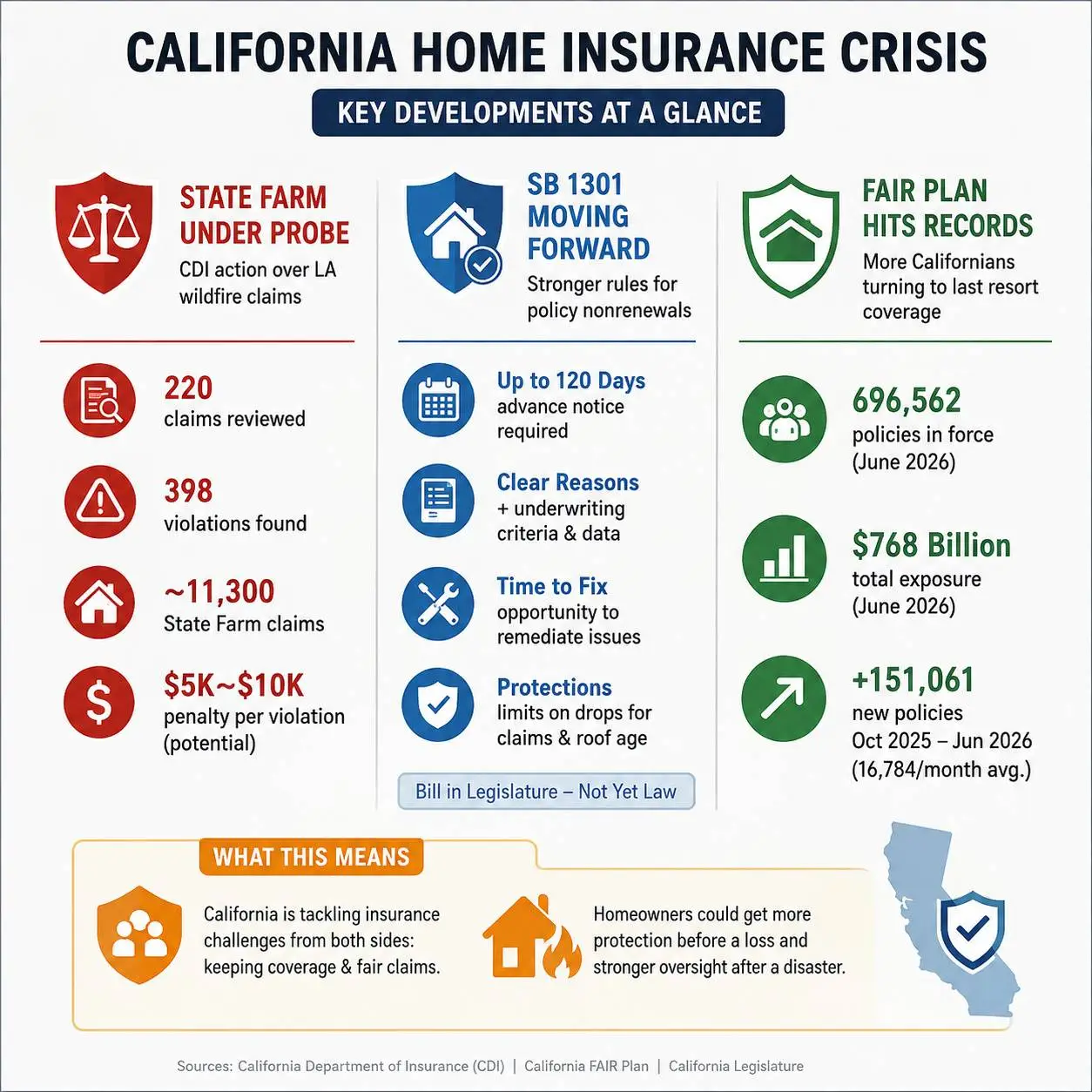
California insurance officials reviewed 220 State Farm claims connected to the Los Angeles wildfires and identified 398 violations of state law across 114 claims. The department said many individual files contained more than one violation.
The findings included alleged delays in starting investigations, accepting or denying claims and making payments on accepted claims. Regulators also cited underpayment of claims, repeated adjuster reassignments, and problems handling smoke-damage claims.
State Farm handled approximately 11,300 residential wildfire claims, compared with 38,835 residential claims across all insurers, according to the department’s figures.
The Department has filed an Accusation and Order to Show Cause, beginning a formal administrative process. That means the allegations are subject to further proceedings; the enforcement action is not the same as a final finding of liability.
Under California Insurance Code Section 790.035, penalties can reach $5,000 per violation or $10,000 for willful violations if penalties are ultimately imposed following the administrative process.
SB 1301 Targets Residential Insurance Nonrenewals
The other major development concerns what happens before a homeowner loses coverage.
SB 1301 proposes changes to California’s residential property insurance nonrenewal rules. The measure would require insurers to provide more detailed explanations when they decide not to renew certain policies and, in specified circumstances, give homeowners an opportunity to correct property conditions.
One of the bill’s central ideas is greater transparency. Proposed requirements include explanations tied to an insurer’s underwriting guidelines and documentation used in reaching a nonrenewal decision.
The bill also addresses wildfire-risk assessments. In applicable cases, homeowners would receive information about the wildfire risk score used in the decision and factors contributing to that assessment.
Homeowners Could Get More Time to Correct Certain Problems
For qualifying properties with correctable conditions, SB 1301 proposes a remediation process rather than making nonrenewal the immediate end point.
That could become particularly important for homeowners dealing with wildfire-related mitigation requirements, property maintenance issues, or other conditions an insurer believes increase risk.
The proposal also includes protections concerning certain claims activity and roof age, limiting the circumstances in which those factors alone could be used as grounds for nonrenewal.
Importantly, SB 1301 is still legislation moving through the process. It should not be described as a new protection that is already available to every California homeowner.
Why the FAIR Plan Matters to This Debate
The pressure on private homeowners insurance is also visible in the growth of the California FAIR Plan, which serves as an insurer of last resort when coverage is not reasonably available in the voluntary market.
The FAIR Plan reported 696,562 dwelling and commercial policies in force as of June 2026, an 8% increase from September 2025. Its total exposure reached $768 billion, up 11% from September 2025 and 250% from September 2022.
The plan also recorded 151,061 new policies during October 2025 through June 2026, averaging 16,784 new applications per month.
Those figures help explain why insurance availability has become such a major policy issue in Sacramento. As private insurers become more selective in high-risk areas, more homeowners can find themselves looking for coverage through alternatives such as the FAIR Plan.
What These Changes Mean for Homeowners
For homeowners, the developments involve two different points in the insurance process.
Before a policy is nonrenewed, SB 1301 could give eligible policyholders more information and, in certain situations, more time to address problems identified by an insurer.
After a disaster, the State Farm enforcement action demonstrates the level of scrutiny California regulators are applying to claim investigations, payments, communications, and adjustment practices.
The two issues are connected by a broader concern: having an insurance policy is only useful if homeowners can keep appropriate coverage and obtain the benefits the policy provides when they suffer a covered loss.
California’s Insurance Market Is Still Evolving
The State Farm enforcement action and SB 1301 are not standalone solutions to California’s insurance problems.
The Department of Insurance is pursuing broader changes under its Sustainable Insurance Strategy, while lawmakers are considering additional disaster-related measures. The FAIR Plan’s rising exposure also shows that the underlying availability problem remains significant.
For homeowners, the practical takeaway is straightforward: SB 1301 is a proposed change, not yet a blanket new right, while the State Farm case is an ongoing regulatory proceeding rather than a final judgment.
The outcome of both could influence how California’s property insurance market handles nonrenewals and wildfire claims in the years ahead.
Frequently Asked Questions
1. Is State Farm being sued by California?
The California Department of Insurance has filed an Accusation and Order to Show Cause against State Farm General following its examination of wildfire claims. This is an administrative enforcement proceeding, not a conventional civil lawsuit.
2. What did California find in its State Farm investigation?
Regulators reviewed 220 claims and identified 398 alleged violations across 114 claims, including alleged delays, underpayments, adjuster-related problems, and smoke-damage claim issues.
3. What is SB 1301?
SB 1301 is proposed California legislation that would change certain residential property insurance nonrenewal requirements, including notice, explanations, documentation and remediation opportunities.
4. Is SB 1301 already law?
No. It is a bill moving through the California Legislature. Homeowners should not treat its proposed protections as current law until the legislative process is completed and the measure takes effect.
5. How large is the California FAIR Plan?
As of June 2026, the FAIR Plan reported 696,562 dwelling and commercial policies in force and $768 billion in total exposure.
6. Does the State Farm action mean the company is leaving California?
No. The department’s enforcement action concerns alleged claims-handling violations related to the Los Angeles wildfires. It does not by itself mean State Farm is exiting the California market.
The Bottom Line
California’s insurance debate is moving beyond premium increases. Claims handling, policy nonrenewals, and the shrinking availability of private coverage are now being addressed simultaneously. What happens with SB 1301 and the State Farm proceeding could determine how much protection California homeowners receive as the state continues to deal with wildfire risk.
Sources & References: California Department of Insurance; California FAIR Plan; California Legislature.


